Artist: Anonymous master
Origin: Switzerland
Date: 1557 (?)
Material: coloured and clear glass, lead
Technique: silver stain, overglaze painting
Dimensions: 33.5 × 23 cm
Current Collection: The State Hermitage Museum
Inventory Number: V-206
Hermitage ID: 134672
Rudanovsky Connection: Entered the Hermitage in 1919 from the collection of A. K. Rudanovsky.
A Swiss stained-glass panel of 1557, painted with a young woman caressing a unicorn while a hunter raises his axe behind her.
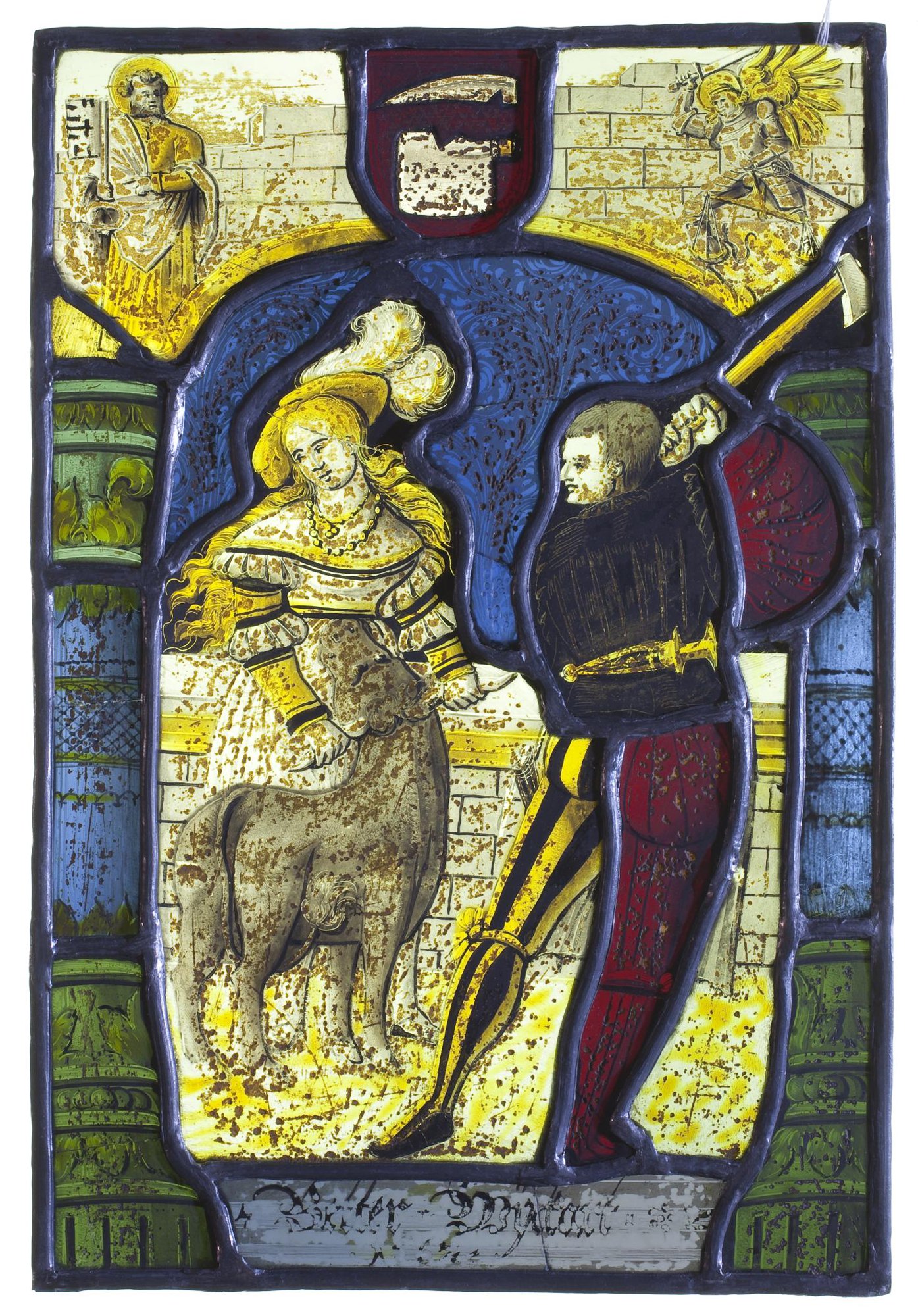
Stained Glass Petter Wyccart. The State Hermitage Museum.
The panel entered the Hermitage in 1919 from the collection of A. K. Rudanovsky. It is not currently on permanent display.
It is a vertical panel with a central scene, a coat of arms at the top and two half-figures in the upper corners.
The Object
The panel is framed by painted architecture: green columns, a blue arch and a tiled floor.
In the centre, a woman in a feathered hat and a jewelled dress stands beside a unicorn, her hand on its neck. Behind her, a man in a dark doublet and red hose raises an axe above his head.
At the top, a red shield with a white charge; in the corners, two saints — one with a column, one with a sword. Below, an inscription in black lettering.
The Lady and the Unicorn
The subject is the medieval allegory of the unicorn.
According to the legend, the unicorn could be captured only by a virgin: it would come to her, lay its head in her lap, and become tame. The hunt that follows is the allegory of the Incarnation, or of the soul’s surrender to love.
The panel shows the moment of capture: the woman has tamed the beast, and the hunter waits behind her with his axe.
The Unicorn
The unicorn is painted in grey and white, with a single horn and a goat-like beard.
It stands quietly beside the woman, its head turned toward her, and it seems entirely tame. The animal is a symbol as much as a creature: it represents purity, love and the divine.
In the sixteenth century, the unicorn was a familiar figure in art, heraldry and literature, and it appeared in tapestries, manuscripts and glass.
The Hunter
The hunter is the panel’s counterpoint.
He stands behind the woman, his axe raised, his face in profile. He is dressed in a dark doublet, red hose and yellow-and-black stockings, and he is ready to strike.
The hunter introduces the drama: the unicorn is tamed, but the kill is imminent. The panel holds both moments — the tenderness and the violence — in a single image.
The Arms
The coat of arms at the top belongs to the donor.
It is a red shield with a white charge — perhaps a stone, a loaf or a tool — and it is flanked by the two saints. The arms identify the family that commissioned the panel.
Heraldry is the panel’s documentary element: without it, the object would be a religious allegory; with it, it is a family’s statement.
The Saints
Two half-figures occupy the upper corners.
The one on the left holds a column and a book; the one on the right holds a sword. They are martyrs or patron saints, and they frame the scene with their intercession.
Their presence turns the panel into an act of devotion as well as a display of family pride.
1557
The date 1557 places the panel in the sixteenth century, before the Reformation had fully transformed Swiss glass painting.
At that time, panels were commissioned for churches, monasteries and town halls, and they combined religious subjects with heraldry. The tradition was at its height, and its workshops were among the finest in Europe.
The panel is therefore a late medieval object, made on the eve of the modern era.
Silver Stain
The panel is painted with silver stain and overglaze painting.
Silver stain gives the yellows — the woman’s dress, the unicorn’s horn, the hunter’s stockings — while overglaze painting draws the faces, the draperies and the architecture.
The combination produces a surface of great richness, in which the colours seem to glow from within the glass.
The Frame
The painted architecture is the panel’s frame.
Green columns, a blue arch and a tiled floor create a shallow stage for the figures. The architecture is drawn in perspective, and it gives the scene depth and dignity.
Frames of this kind are a hallmark of Renaissance glass painting, and they connect the panel to the traditions of theatre and perspective.
The Inscription
An inscription runs along the bottom of the panel.
It is painted in black letter on a pale band, and it names the donor and the date: Petter Wyccart, 1557. The text is partly legible, but the name is clear.
Inscriptions of this kind are the panels’ archives: they identify the person who paid for the window and the year it was made, and they allow the object to be dated and placed.
The Costume
The costumes date the panel as much as the inscription.
The woman wears a feathered hat, a high collar and a jewelled dress — the fashion of the mid-sixteenth century. The hunter wears a doublet, red hose and yellow-and-black stockings, the dress of a soldier or a courtier of the period.
The costumes are painted with care, and they give the panel its period character.
The Workshop
The panel was made in a workshop of glass painters.
Such workshops were family businesses, often in Zurich, Bern or Lucerne, and they produced panels for churches, town halls and private houses. The master designed the composition, the assistants cut and painted the glass, and the panel was assembled with lead.
The quality of this panel suggests a skilled workshop, with a good command of drawing, colour and firing.
The Panel in a Window
The panel was set into a window.
It was surrounded by other panels or by plain glass, and it was seen in daylight, from inside a hall or a church. The lead cames held it in place, and the stone tracery framed it.
In a museum, the panel is isolated and lit artificially, but the glass still holds the memory of the window it once filled.
The Unicorn’s Horn
The unicorn’s horn is the panel’s emblem.
It is a long, spiral horn, painted in yellow and white, rising from the animal’s forehead. In medieval symbolism, the horn was a sign of purity and power, and it was often used in heraldry.
The horn also makes the animal legible: without it, the creature would be a white horse; with it, it is a unicorn, and the whole allegory falls into place.
Provenance
The panel carries the inventory number V-206 and entered the Hermitage in 1919 from the collection of A. K. Rudanovsky.
In the Hermitage
The panel is preserved in the State Hermitage Museum in Saint Petersburg and is not on permanent display.
It is a rare and beautiful object, and it preserves, in glass and lead, one of the oldest allegories of European art: the lady, the unicorn and the hunter, caught in a single moment.
The glass has kept them there for nearly five long centuries, and the moment is still unresolved, and still beautiful.