Origin: Western Europe
Date: 1880s – 20th century
Material: hard-paste porcelain
Technique: painting with gold, printing
Dimensions: height 15.5 cm; width with handles 17.3 cm
Current Collection: The State Hermitage Museum
Inventory Number: ZF-14983
Hermitage ID: 330085
Rudanovsky Connection: Entered the Hermitage in 1919 from the collection of A. K. Rudanovsky.
A Western European hard-paste porcelain sugar bowl of the late nineteenth or early twentieth century, decorated with a gilt coat of arms on a cobalt ground.
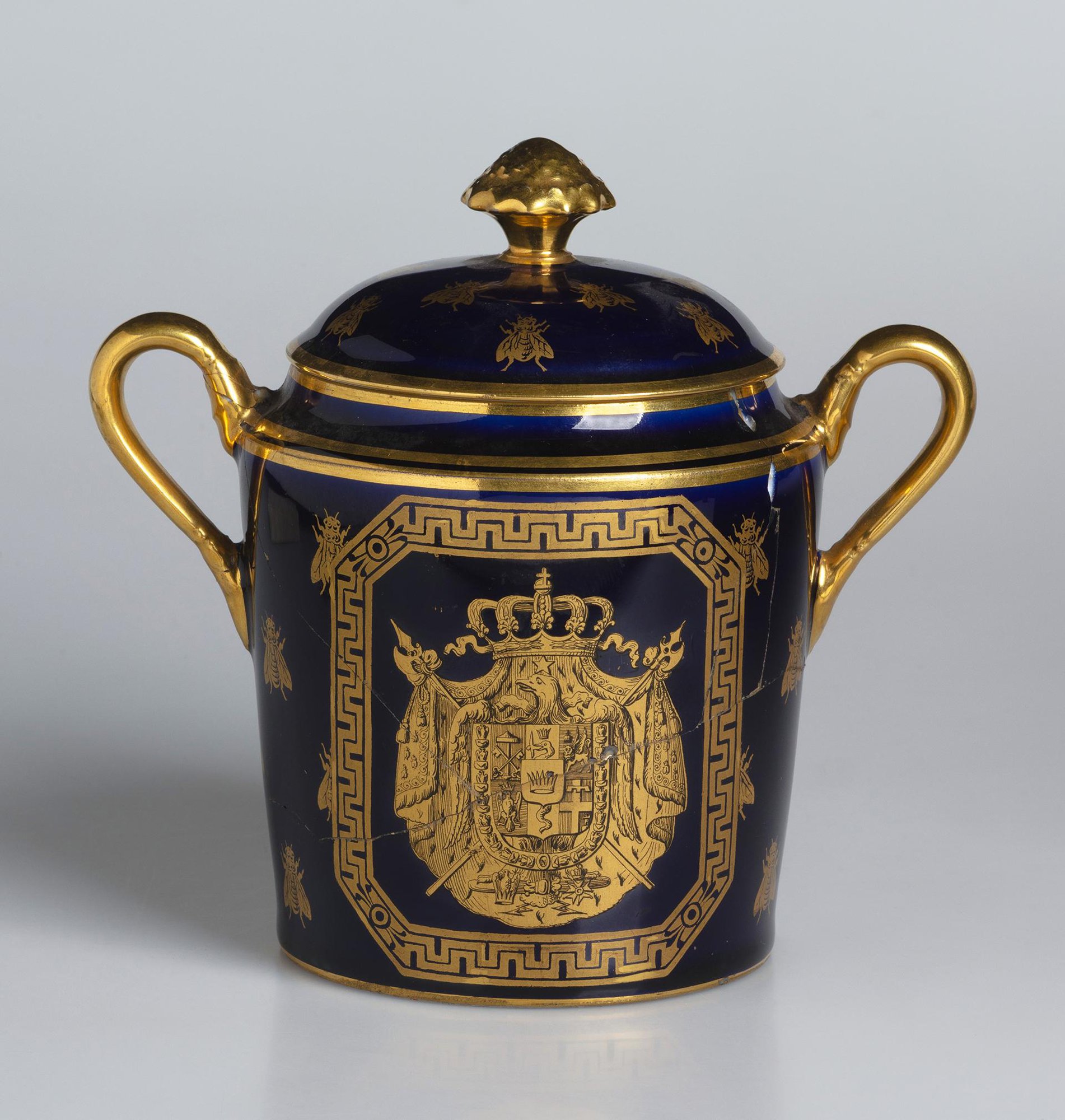
Sugar Bowl with a Lid (ZF-14983). The State Hermitage Museum.
The bowl entered the Hermitage in 1919, handed over from the collection of A. K. Rudanovsky via the Office for the Preservation of Monuments of Art and Antiquity. It is not currently on permanent display.
It is a sugar bowl with two handles and a lid — 15.5 centimetres high — with a deep blue ground and gold decoration.
The Object
The bowl is cylindrical, with a slight taper, two loop handles and a domed lid.
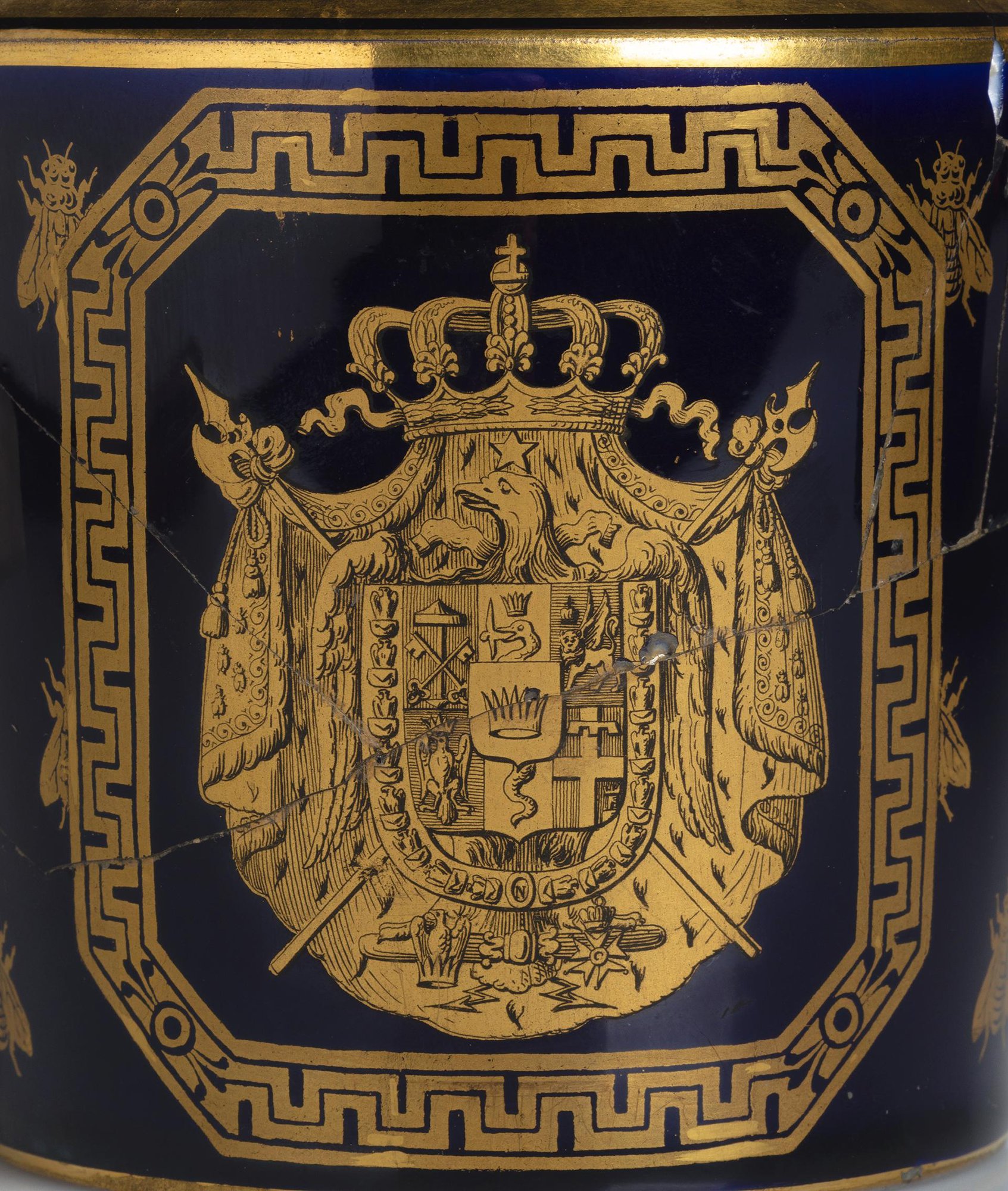
Its surface is covered with a cobalt blue ground, and it is decorated in gold: a large coat of arms on the front, a Greek-key border, scattered bees and bands around the rim and the lid.
The lid is crowned by a gilt knob, and the handles are gilded.
The Colour
The cobalt blue is the bowl’s colour.
It is a deep, saturated blue, applied as a ground over the glaze, and it is fired and polished. The blue gives the object its richness, and it makes the gold stand out.
Cobalt was one of the most expensive colours in porcelain, and its use on a whole bowl was a display of wealth.
The Arms
The coat of arms is the bowl’s centre.
It is painted in gold, and it shows a shield with several quarters, a crown above and a mantle behind. The shield includes lions, crosses and other charges, and it is framed by the collar of an order.
The arms are those of an unidentified noble family: the object gives no inscription, and the heraldry is not enough to name it.
The Bees
Bees are scattered across the ground.
They are small, gilt insects, painted in flight around the arms and the lid. The bee is a symbol of industry and order, and it was used by Napoleon as an imperial emblem.
Their presence suggests a Napoleonic or imperial connection, but the object gives no proof of it.
The Greek Key
The arms are framed by a Greek key.
It is a geometric border, painted in gold, and it runs around the coat of arms in a rectangle. The key is a classical motif, and it gives the object its architectural character.
A Greek key is a simple, legible border, and it is one of the most common ornaments in neoclassical decoration.
The Printing
The decoration is printed, not hand-painted.
The gold pattern was applied from a print or a transfer, and it was fired. Printing allowed factories to produce elaborate decoration quickly and cheaply.
The result is a precise, uniform pattern, which contrasts with the hand-painted decoration of earlier porcelain.
The Date
The bowl is dated to the 1880s or the twentieth century.
It was made in a period of industrial production, when porcelain was decorated by printing and transfer for a wide market. The style looks back to the eighteenth century, but the technique is modern.
The bowl belongs to that moment, and it shows the taste for historical revival in the late nineteenth century.
The Lid
The lid is domed and blue.
It is decorated with the same gold bands and bees as the body, and it is crowned by a gilt knob. The lid keeps the sugar dry and closes the bowl.
A lid turns a bowl into a vessel: it protects, conceals and completes the object.
The Knob
The knob is gilded.
It is a small, fluted finial, shaped like a bud or a shell, and it is the point where the lid is lifted. Its gold catches the light.
Knobs of this kind are common in nineteenth-century services, and they give the lid its finish.
The Handles
The bowl has two loop handles.
They are gilded, and they curve out from the body in a simple, elegant shape. The handles are practical — they allow the bowl to be lifted — and they give the object its symmetry.
Handles of this kind are a feature of sugar bowls of the period.
The Table
The bowl was made for a table.
It stood among cups, a teapot and a cream jug, and it was used for tea or coffee. Its blue and gold would have caught the candlelight.
That table is gone, but the bowl still carries its logic: a vessel for sugar, dressed in gold.
The Collector
The bowl came to the Hermitage with the Rudanovsky collection.
Rudanovsky collected European porcelain alongside paintings, drawings, glass and miniatures, and his collection included services and decorative objects of many kinds.
The bowl is therefore a double document: of European porcelain in the late nineteenth century and of a Russian collector’s taste.
The Border’s Rectangle
The Greek key forms a rectangle.
It surrounds the coat of arms, and it separates it from the scattered bees. The rectangle gives the arms a frame, and it makes them the object’s centre.
A rectangular frame on a round bowl is a deliberate contrast: it gives the object a formal, almost architectural structure.
The Mantle
The arms are set on a mantle.
It is a draped cloth, painted in gold, and it hangs behind the shield like a curtain. The mantle is a sign of high rank, and it turns the arms into a display of nobility.
The mantle’s folds are painted with care, and they give the arms their depth.
The Gold’s Precision
The gold decoration is precise.
The Greek key, the bees, the arms and the bands are all printed with a fine line, and their edges are sharp. This precision is a result of the printing technique.
Hand-painted gold is softer and more varied; printed gold is uniform and mechanical, and it marks the object as a product of the industrial age.
Provenance
The bowl carries the inventory number ZF-14983. It entered the Hermitage in 1919, handed over from the collection of A. K. Rudanovsky via the Office for the Preservation of Monuments of Art and Antiquity.
In the Hermitage
The bowl is preserved in the State Hermitage Museum in Saint Petersburg and is not on permanent display.
It is a rich, decorative object, and it preserves a coat of arms: a blue bowl, a gold crown and a few bees, made in Europe at the end of the nineteenth century.
It is a blue bowl with a gold crown, and it has outlived the family whose arms it carries.
It is a rich object, and it has kept its gold, its blue and its bees, and it still waits for a spoon.
It is a blue bowl, a gold crown and a handful of bees, and it is still, in its loud way, beautiful.
It is a bowl for sugar, and it has carried a coat of arms with more dignity than most. And it is still, in its way, a small monument to a family that nobody can name.