Organization: Sèvres Porcelain Manufactory (as recorded)
Origin: France, England (?)
Date: 19th century
Material: hard-paste (?) porcelain
Technique: polychrome painting, gilding
Dimensions: height 8.1 cm; diameter 21.5 cm
Current Collection: The State Hermitage Museum
Inventory Number: ZF-15087
Hermitage ID: 330087
Rudanovsky Connection: Entered the Hermitage in 1919 from the collection of A. K. Rudanovsky.
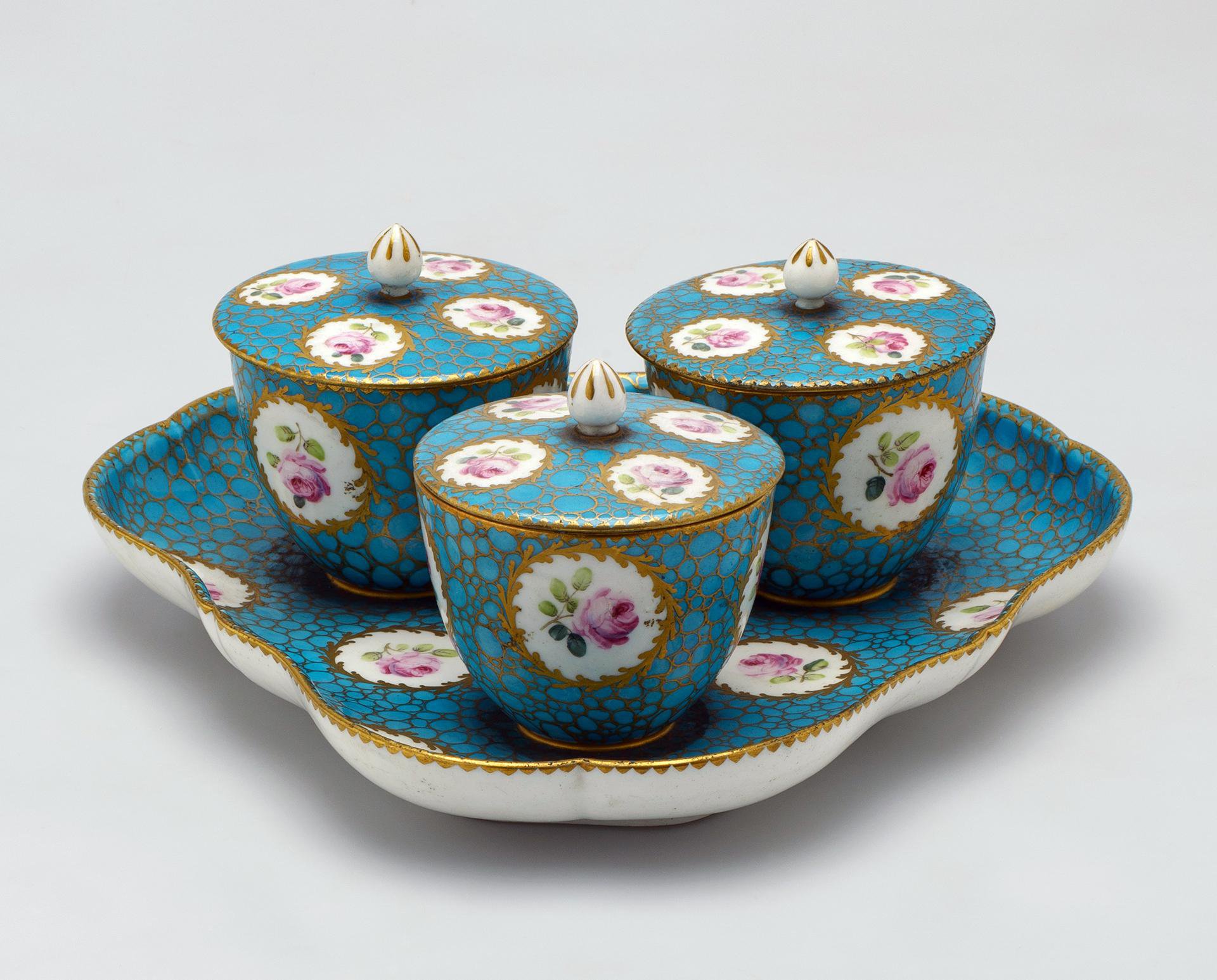
A triple tray with three covered confiture pots, made in the nineteenth century in the manner of Sèvres.
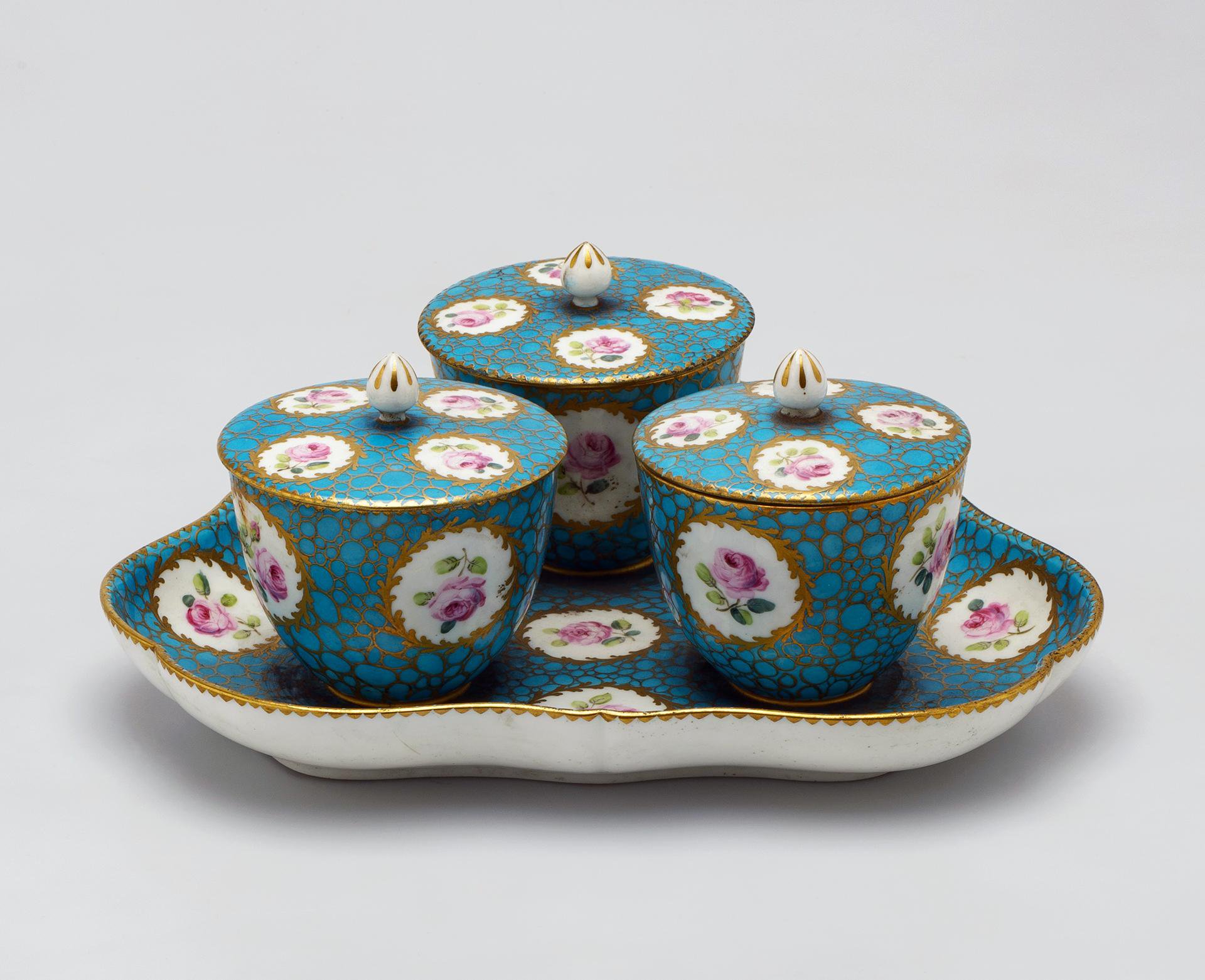
Triple Tray with Confiture Pots with Lids. The State Hermitage Museum.
The set entered the Hermitage in 1919, handed over from the collection of A. K. Rudanovsky via the Office for the Preservation of Monuments of Art and Antiquity. It is not currently on permanent display.
It is a small service — 8.1 centimetres high — of a lobed tray and three covered pots, painted in turquoise and gold.
The Object
The tray is lobed and shallow, with a white underside and a turquoise top.
On the tray stand three pots, each with a domed lid and a pointed knob. The pots and the tray are decorated with the same pattern: a turquoise ground, a gold scale pattern and white reserves containing roses.
The whole set is small, and it fits in the palm of a hand.
The Turquoise
The turquoise is the set’s colour.
It is a bright, slightly greenish blue, applied as a ground over the glaze, and it covers the tray and the pots. The colour is rich and even, and it gives the set its character.
Turquoise grounds were popular in the nineteenth century, and they were used for dessert services that were meant to look light and cheerful.
The Scales
The ground is covered with a scale pattern.
It is painted in gold, in overlapping curves, like the scales of a fish or the tiles of a roof. The pattern gives the ground its texture, and it makes the turquoise look richer.
Scale patterns of this kind are a common device in nineteenth-century porcelain: they imitate the grounds of earlier wares and add a note of luxury.
The Roses
The roses are the set’s decoration.
They are painted in white reserves, which are framed by a gold line and shaped like small clouds. Each reserve contains a rose and a few leaves, in pinks and greens.
The reserves break the scale pattern, and they give the eye a place to rest.
The Three Pots
The set has three pots.
Each pot has a lid and a pointed knob, and each is decorated with the same pattern as the tray. The three pots were probably used for different confitures, jams or sweetmeats.
A set of three is a small society: the pots are identical, but each has its own place on the tray.
Sèvres
The set is attributed to Sèvres.
The factory was the great French porcelain manufactory, and its wares were imitated across Europe. The turquoise ground, the gold scales and the rose reserves all recall Sèvres designs of the eighteenth century.
The attribution is, however, uncertain: the record gives «France, England (?)» and a nineteenth-century date.
The Nineteenth Century
The set was made in the nineteenth century.
It was a period of revival and imitation: factories across Europe reproduced the styles of the previous century, and they used new techniques to make them cheaper.
The set belongs to that production, and it shows the nineteenth-century taste for the eighteenth.
The Tray
The tray is lobed and shallow.
It is shaped like a four-leaf clover, with a wavy edge, and it has a shallow well to hold the pots. Its underside is white, and its top is turquoise.
The tray is the set’s ground: it holds the three pots, and it frames them like a small stage.
The Knobs
The pots’ knobs are pointed.
They are white, with gold lines, and they are shaped like small buds or shells. They are the points where the lids are lifted, and they give the pots their finish.
Knobs of this kind are a feature of nineteenth-century services, and they show the maker’s attention to detail.
The Reserves’ Shape
The white reserves are cloud-shaped.
They have lobed edges, and they are framed by a gold line. Their irregular shape softens the geometry of the scale pattern, and it gives the set a rococo flavour.
Cloud-shaped reserves are a common device in nineteenth-century porcelain: they frame the flowers and break the regularity of the ground.
The Underside
The underside of the tray is white.
It is unglazed at the foot ring, and it carries the factory’s marks, if any. The white underside contrasts with the turquoise top, and it shows the object’s construction.
The underside is the part that is never seen on the table, and it is where the object’s history is written.
The Table
The set was made for a table.
It held three confitures, jams or sweetmeats, and it stood at the centre of the dessert. Its turquoise and gold would have caught the candlelight.
That table is gone, but the set still carries its logic: three small pots, a tray and a field of roses.
The Collector
The set came to the Hermitage with the Rudanovsky collection.
Rudanovsky collected European porcelain alongside paintings, drawings, glass and miniatures, and his collection included services and small objects of many kinds.
The set is therefore a double document: of nineteenth-century porcelain and of a Russian collector’s taste.
The Gold’s Wear
The gold is worn.
It is rubbed on the rim of the tray, on the knobs and on the edges of the pots, and the turquoise shows through. The scale pattern is faded in places.
The wear is a sign of use: the set was handled, opened and served from, and its condition records that daily life.
The Set’s Number
The set carries an inventory number, ZF-15087.
Numbers of this kind were given by the museum, and they identify the object in the collection. They are the modern equivalent of the old owners’ marks.
The number is a small trace of the object’s life after the table: it is a museum object now.
The Reserves’ Roses
Each reserve holds a rose.
The roses are pink, with green leaves, and they are painted with a fine brush. They are small, and they are repeated on every reserve, so that the set looks like a field of roses.
A repeated rose is a device of the service: it gives the object its signature, and it unites its parts.
Provenance
The set carries the inventory number ZF-15087. It entered the Hermitage in 1919, handed over from the collection of A. K. Rudanovsky via the Office for the Preservation of Monuments of Art and Antiquity.
In the Hermitage
The set is preserved in the State Hermitage Museum in Saint Petersburg and is not on permanent display.
It is a small, charming object, and it preserves a moment of the dessert table: three pots, a tray and a field of roses on a turquoise ground.
It is a small set, and it is complete: a tray, three pots and a field of roses on turquoise.
It has done that, quietly, for a century and a half.
A tray, three pots, a lid: it is enough. And it is still waiting for a spoon.