Origin: France, Aubusson
Date: second half of the 18th century
Material: wool, silk
Technique: tapestry weaving
Dimensions: 55 × 15 cm
Current Collection: The State Hermitage Museum
Inventory Number: T-15739
Hermitage ID: 488837
Rudanovsky Connection: Entered the Hermitage in 1919 from the collection of A. K. Rudanovsky.
A small strip of plain lilac upholstery, 55 centimetres long and 15 wide — the smallest fragment of the tapestry suite.
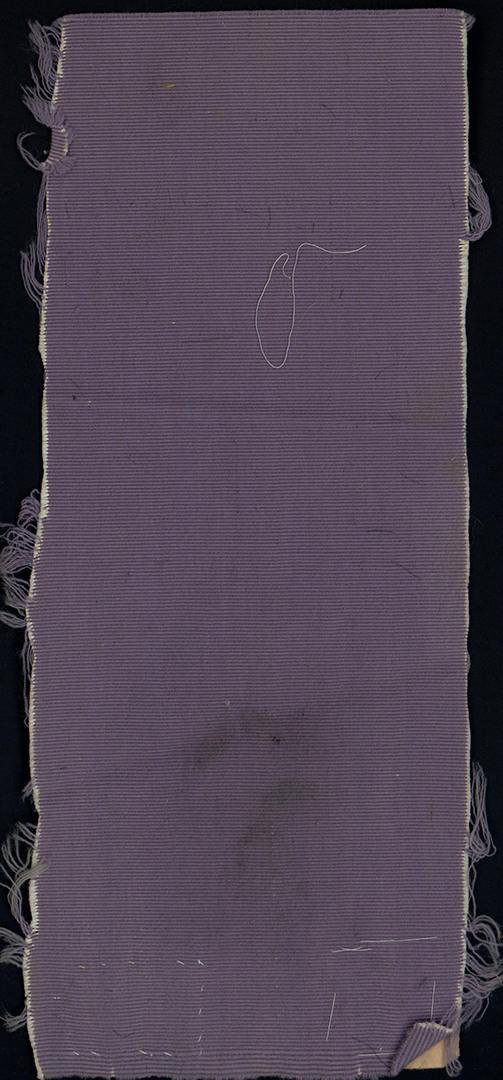
Tapestry: Fragment of Lilac-Coloured Upholstery (T-15739). The State Hermitage Museum.
The strip comes from the collection of A. K. Rudanovsky and entered the Hermitage through the Department for the Protection of Monuments. It is not currently on permanent display.
It is a plain, narrow band of lilac silk, cut at both ends, with frayed edges and a few loose threads. There is no design on it, no label in the photograph, and nothing to distinguish it from any other piece of old fabric — except its number, which places it in the same suite as the tapestry seats and backs.
The Object
The strip is pale lilac-grey, closely woven, with a fine horizontal grain and a soft, dusty sheen.
The surface is plain. There are no flowers or scrolls, only the subtle variations of the dye and the marks of age: creases, small stains, areas where the colour has faded. The ends are cut and frayed, and the warp threads hang loose.
The photograph shows the strip against a dark background, which makes the lilac look cooler and greyer than it does in daylight.
The Smallest Fragment
At 55 by 15 centimetres, the strip is small even by the standards of the suite.
It is smaller than the plain backs, much smaller than the seats, and it has no shape that could be matched to a piece of furniture. It is a piece of material rather than a piece of upholstery: something cut away and kept because it was still useful, or because it belonged to the group.
Museums keep such pieces for study. A small sample can document a colour, a weave or a fibre; it can be analysed, photographed and compared without damaging a larger object.
What Size Means
Size changes the way an object is understood.
A large panel is a picture: it has a composition, a centre and an edge. A small strip is a sample: it has no composition, only a texture. The same fabric, cut to different sizes, becomes two different kinds of object.
The strip is therefore not simply a smaller version of the backs. It is a different category of thing — a fragment that documents rather than depicts, and that asks to be examined rather than looked at.
The Colour Sample
The strip is, in effect, a colour sample for the suite.
The lilac of the plain backs and borders is preserved here in a piece small enough to be handled and studied. The colour can be compared with the lilac of the other panels, with the borders of the decorated covers and with the armrest surrounds.
Such comparisons are how textile historians establish that objects belong together. The number on the strip is one kind of evidence; the colour is another, and the two support each other.
Fragments and Value
Why keep a small plain strip?
The answer is partly scientific and partly historical. The strip documents a material and a technique; it also documents a decision — the decision to cut it away, keep it and register it with the rest of the suite.
A collection is not only a set of beautiful objects. It is an archive of materials, techniques and decisions, and the smallest fragments are often the most explicit records of how objects were made and used.
The Ends
The cut ends of the strip deserve attention.
One end is frayed into a fringe of pale threads; the other is cut more cleanly, perhaps with scissors, perhaps with a knife. The difference suggests two different moments of cutting: one when the strip was separated from its original object, and one later, when it was trimmed or divided.
Textile fragments often carry such double histories. They are cut once by the upholsterer and again by the collector or the curator, and each cut leaves its own trace. Each cut is also a decision, and decisions are what collections are made of.
A Piece of Evidence
The strip is evidence of a colour.
In a suite where so much is decorated, the plain lilac is easy to ignore; but the colour is one of the unifying elements of the whole. The strip preserves it in a pure state, without design or shadow.
For a curator, such a piece is a reference: it can be compared with the lilac of the borders, the backs and the armrests, and it can help establish that they belong together.
The Colour of a Suite
A suite is held together by colour as much as by design.
The cream ground, the lilac border, the pink and red flowers: these recur across twenty objects, and they create the impression of a single scheme. The plain strip contributes to that scheme even though it has no pattern.
Colour is also the most fragile element of a textile. Dyes fade at different rates, and the lilac of one panel may be greyer than the lilac of another. The strip is a reminder that the suite was once more uniform than it now appears.
The Ethics of Fragments
Should a fragment be kept?
The question is not rhetorical. Museums discard fragments that cannot be documented, restored or displayed; they keep those that complete a group or document a technique.
This strip was kept because it belongs to a suite. Its value is relational: it means something only in the company of the other panels. That is a fragile kind of value, but it is the kind that collections are built on.
The Shape of a Strip
A strip is a shape with a purpose.
Upholsterers cut strips for borders, rails, welt and edging — the parts of a cover that run along an edge and take the wear. A strip is therefore usually a functional piece, not a decorative one.
The proportions of this strip — fifteen centimetres wide, fifty-five long — suggest a border or a rail. It was cut to run along something, and its length is the length of that something. Even in a fragment, the shape remembers its function.
Provenance
The strip carries the inventory number T-15739 and entered the Hermitage through the Department for the Protection of Monuments from the collection of A. K. Rudanovsky.
In the Hermitage
The strip is preserved in the State Hermitage Museum in Saint Petersburg and is not on permanent display.
It is the humblest object in the suite and one of the most instructive. It shows that the collection is not only a gallery of designs but a record of materials — and that a piece of plain lilac silk, cut and frayed, can be as eloquent as a woven bouquet.
Its silence is part of its evidence: it shows what the decorated panels cannot, and it asks the viewer to look at the material rather than the picture, and to read the object as a document of a room that no longer exists.