Origin: France, Aubusson
Date: second half of the 18th century
Material: wool, silk
Technique: tapestry weaving
Dimensions: 158 × 15 cm
Current Collection: The State Hermitage Museum
Inventory Number: T-15740
Hermitage ID: 488838
Rudanovsky Connection: Entered the Hermitage in 1919 from the collection of A. K. Rudanovsky.
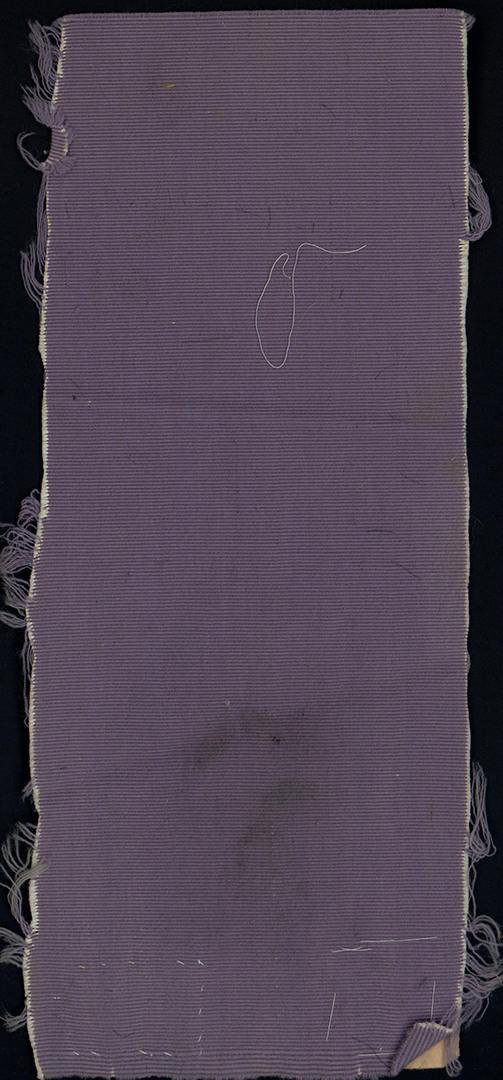
A long, narrow strip of lilac upholstery, 158 centimetres long and 15 wide, cut from a larger tapestry panel and preserved with its museum label still sewn in place.
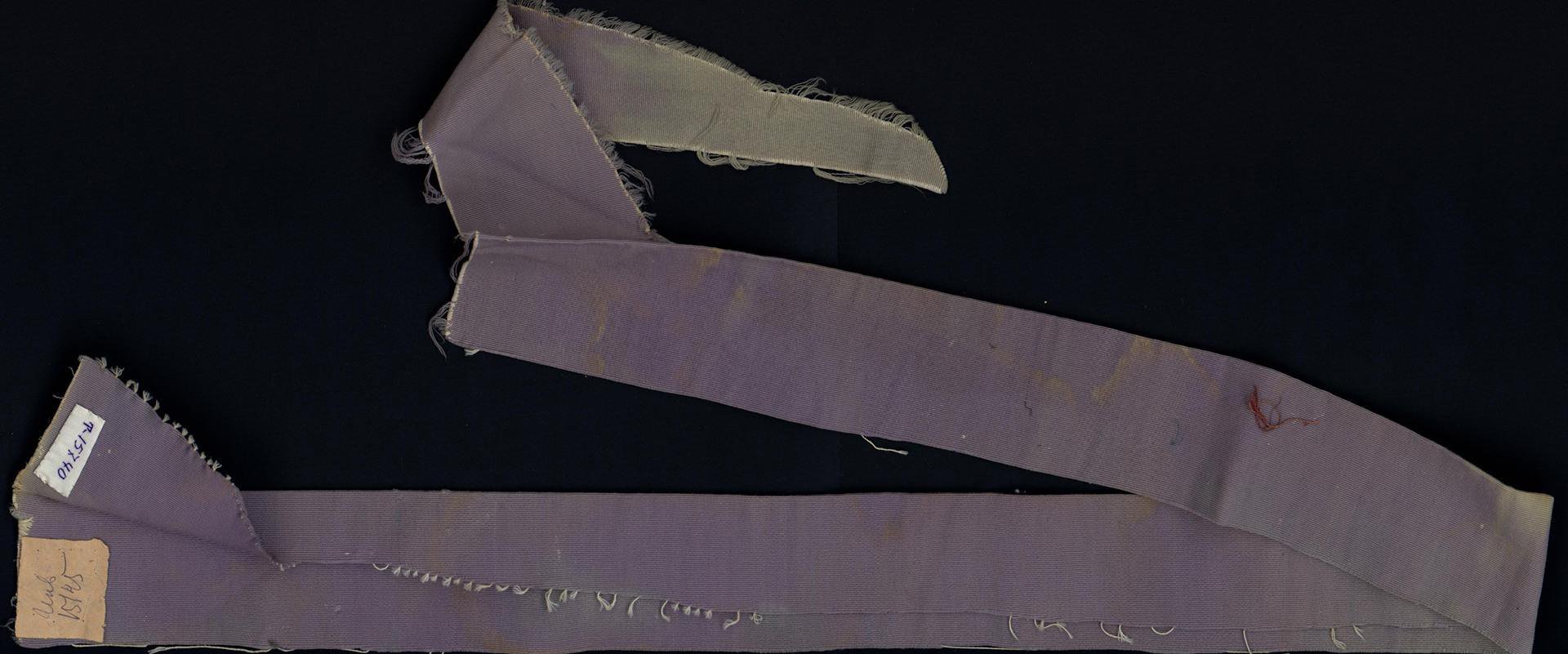
Tapestry: Fragment of Lilac-Coloured Upholstery (T-15740). The State Hermitage Museum.
The strip comes from the collection of A. K. Rudanovsky and entered the Hermitage through the Department for the Protection of Monuments. It is not currently on permanent display.
It is a fragment in the strict sense: a piece cut from something larger, without a complete design and without the shape of the object it once covered. What survives is the material — lilac silk and wool, woven in a plain ground — and the evidence of its use.
The Object
The strip is folded in two in the photograph, forming a long angle. It is pale lilac-grey, with a fine horizontal grain and a slightly uneven tone.
There are no flowers, no scrolls, no garland: the surface is plain. Along the edges the fabric is frayed, and in places the weave has opened. There are yellowish stains, creases and a few loose threads.
Two labels are attached: a small white paper tag with the number T-15740 written in ink, and a larger paper label with a handwritten inscription. They were sewn on by the museum, and they are now part of the object’s history.
A Strip of Upholstery
What was this strip?
A long narrow band of upholstery could have several functions in a suite of furniture. It could be the border of a seat cover, the rail that runs along the edge of a chair seat, the side of a cushion or a section cut from the plain ground of a larger panel.
The width — fifteen centimetres — is too narrow for a seat or a back, and too wide for a simple piping. It is the width of a border or a rail: the part of a cover that runs along an edge and takes the wear.
The length — 158 centimetres — is roughly the perimeter of a chair seat, or the width of a sofa seat plus its returns.
What It Was For
The most likely explanation is that the strip is a border.
Tapestry covers were often finished with a border of the same or a contrasting fabric, stitched around the edge to protect the weave and to frame the design. The borders of this suite are lilac, as the plain backs are lilac, and a strip of lilac upholstery would fit that scheme.
But the strip could also be a fragment of a plain ground cut from a larger panel, or a piece of lining reused for another purpose. Without the object it belonged to, the question cannot be answered with certainty.
Labels
The labels are a small archive.
Museum labels record numbers, names, dates and sometimes the history of an object. They are written by hand, sewn on with thread, and often survive long after the information they contain has been transferred to a database.
The label on this strip gives the inventory number, T-15740. Another label carries a handwritten note, perhaps a description or a former number. Both are evidence of the object’s passage through the museum, and both are now part of what the object is.
Fragments and the Museum
Museums keep fragments for reasons that are not always aesthetic.
A fragment can document a technique, a material or a colour. It can complete a group, fill a gap in a sequence or provide a sample for analysis. It can also be the only surviving evidence of an object that has otherwise disappeared.
This strip is a fragment of that kind. It has no design to admire and no shape to recognise, but it documents the colour and the weave of the suite’s plain upholstery, and it carries the number that ties it to the group.
Fragments like this are the raw material of textile history, and they are often more truthful than reconstructions.
The Colour
The lilac of the strip is the same colour as the plain backs of the chairs.
This correspondence is important. It suggests that the strip belongs to the same suite, and that the lilac was a consistent element of its scheme — used for the backs, for the borders and perhaps for other plain surfaces.
The colour has faded unevenly. Parts of the strip are grey, parts are warmer, and the stains have turned yellow with age. The variation is a record of how the strip was stored and how it was exposed to light.
The Cut
The ends of the strip are cut, not woven.
A cut edge in a textile is a moment of violence: the weave is severed, the warp and weft are left exposed, and the fabric begins to unravel. The cut is also a moment of decision: someone decided that the strip was more useful as a piece than as part of the whole.
The fraying at the ends is the consequence of that decision. It is also the reason the strip survives: a piece that was cut away could be kept, while the object it came from was used up.
The Ground
The plain ground of a tapestry is never quite plain.
Look closely at the strip and the surface breaks into fine variations: the weft threads differ slightly in tone, the dye has taken unevenly, the wear has polished some areas and abraded others. The «plain» ground is a texture, not a colour.
This is one of the differences between tapestry and printing. A printed ground is flat; a woven ground is alive. The strip preserves that life in a piece small enough to see.
What Labels Hide
A label covers a small part of the object and a large part of its history.
The paper tag on the strip hides a few centimetres of fabric, but it also hides the moment before the number was assigned — the object’s life as upholstery, before it became a museum item. The label marks the boundary between use and documentation.
Removing a label would reveal the fabric but destroy the evidence. Conservators usually leave labels in place, accepting the loss of a few centimetres for the sake of the record.
Provenance
The strip carries the inventory number T-15740 and entered the Hermitage through the Department for the Protection of Monuments from the collection of A. K. Rudanovsky.
In the Hermitage
The strip is preserved in the State Hermitage Museum in Saint Petersburg and is not on permanent display.
It is the least spectacular object in the suite, and perhaps the most typical. Most of what survives from the eighteenth century survives in fragments like this: plain, cut, labelled and stored. The fragment is not a failure of preservation; it is preservation’s normal condition.
And a strip, in the end, is a kind of sentence: a piece of a larger text, cut at both ends, still legible. It is a modest testament, but a testament nonetheless, and a true one.