Origin: France, Aubusson
Date: second half of the 18th century
Material: wool, silk
Technique: tapestry weaving
Dimensions: height 30 cm; width 27 cm
Current Collection: The State Hermitage Museum
Inventory Number: T-15734
Hermitage ID: 488828
Rudanovsky Connection: Entered the Hermitage in 1919 from the collection of A. K. Rudanovsky.
A pair of tapestry covers for chair armrests, each with a small bouquet in an oval reserve framed by scrolls.
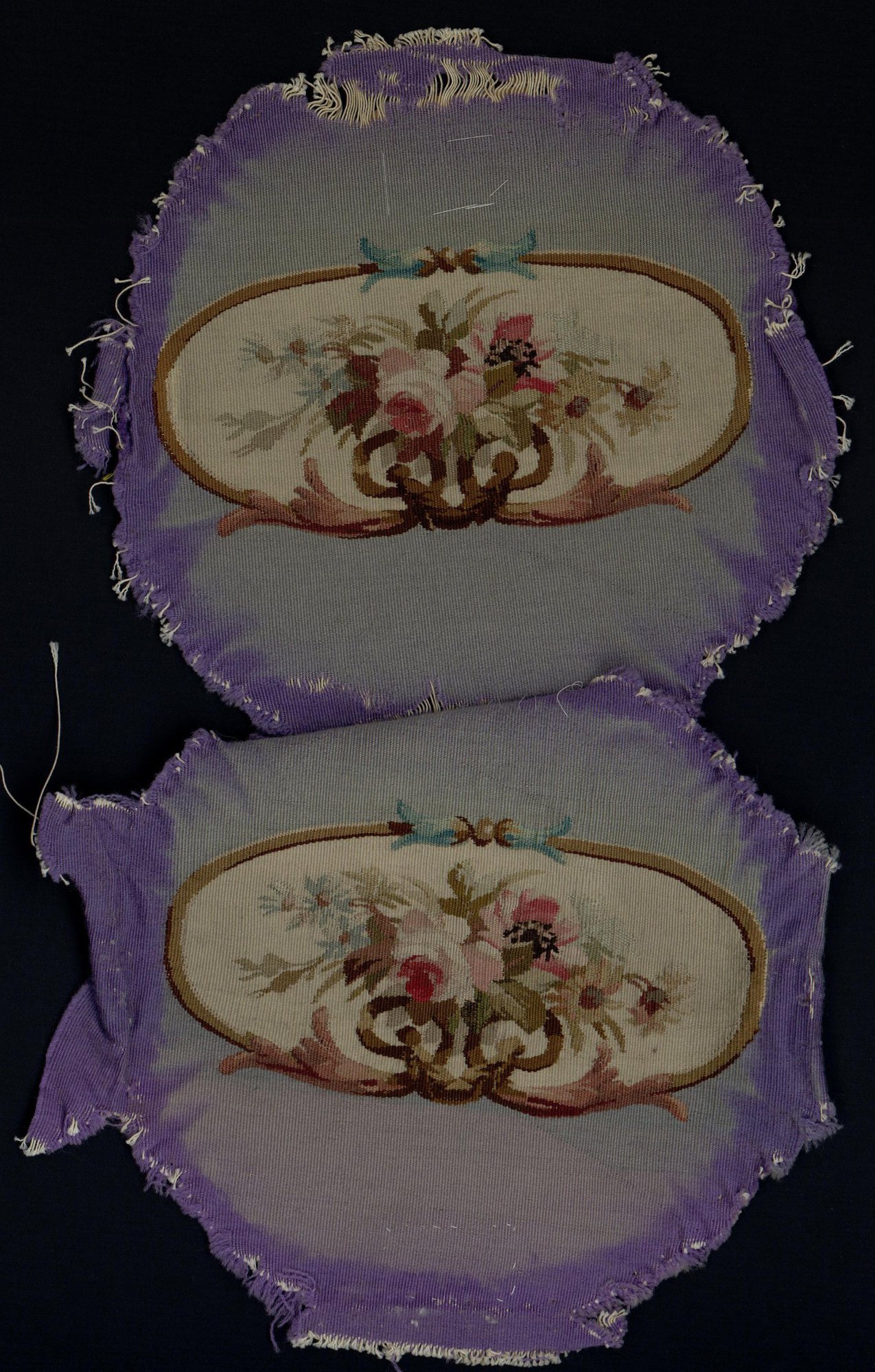
Tapestry: Upholstery for a Chair Armrest (T-15734). The State Hermitage Museum.
The covers come from the collection of A. K. Rudanovsky and entered the Hermitage through the Department for the Protection of Monuments. They are not currently on permanent display.
They belong to the same suite as the tapestry seats and backs: the same cream ground, the same lilac border, the same floral vocabulary. But the armrest is a different object from a seat or a back, and its covers are designed for a different kind of contact — the hand, the wrist and the elbow.
The Object
The photograph shows two shaped panels, one above the other. Each has a rounded, almost fan-like outline, with a lilac surround and a cream centre.
In the centre of each panel is an oval reserve, framed by a gilt-coloured border and filled with a small bouquet: roses in pink and crimson, blue flowers, daisies and trailing leaves, arranged above a base of symmetrical scrolls. A blue ribbon is tied at the top of the oval.
The panels are small — 30 by 27 centimetres — and their shape follows the curve of the armrest they covered.
The Armrest
The armrest is the most handled part of a chair.
A seat is sat upon; a back is leaned against; an armrest is touched constantly — by the hand, the wrist, the sleeve, the rings and the objects people carry. It is also the part of the chair that is seen closest up, at reading distance, when a person is seated.
For both reasons, armrest covers were designed differently from seats and backs. The design is smaller, the composition is tighter, and the materials are chosen for durability as much as for beauty.
The Oval Cartouche
The oval cartouche is the organising form of the design.
A cartouche is a framed panel, usually oval or shield-shaped, used to contain an ornament or a coat of arms. In eighteenth-century decoration it was one of the most common devices for concentrating attention: the frame isolates the motif, and the motif fills the frame.
Here the oval contains a small bouquet, and the frame around it — a gilt band with a ribbon at the top — gives the flowers a setting. The rest of the panel is filled with scrolls and leaves that spread outward from the oval and connect it to the lilac border.
A Pair
The covers are a pair, and pairs matter in upholstery.
A chair has two arms, and their covers were woven together, cut together and mounted together. The pair in the photograph is almost identical: the same oval, the same bouquet, the same scrolls. The differences are tiny — a shift in the position of a leaf, a variation in the tone of a rose.
Such pairs were the norm in eighteenth-century workshops. The weaver repeated a design with small adjustments, and the upholsterer mounted the two covers so that they mirrored each other on the chair.
Wear and Handling
The condition of the covers reflects their use.
The edges are frayed, the lilac surround is worn, and the cream ground is marked by handling. The oval reserves are relatively well preserved, because they were protected by the frame of the armrest; the surrounds, which took the contact, are more damaged.
This pattern of wear is characteristic of armrest covers. The centre survives; the edges perish.
The Design in Miniature
The armrest cover is a design in miniature.
Everything that appears on the seats and backs — the garland, the scrolls, the bouquet, the ribbon — is present here, but compressed into a panel a quarter of the size. The designer has simplified the composition without losing its character: two or three flowers, a few leaves, a scroll base, an oval frame.
This compression is a test of design. A motif that works on a large panel can become crowded or illegible when reduced; the armrest covers show that the workshop understood how to scale its vocabulary.
The Chair with Arms
An armchair is a different object from a side chair.
Arms change the way a person sits: they support the elbows, frame the body and make the chair suitable for conversation, reading or writing. In the eighteenth century the fauteuil — the armchair — was the seat of the master or mistress of the house, while side chairs were for visitors.
The armrest covers are therefore not incidental. They belong to the most sociable part of the chair, the part that frames the sitter and receives the hand.
The Miniature Bouquet
The bouquet in the oval is a reduced version of the bouquets on the seats and backs.
It contains the same flowers — roses, blue blossoms, daisies — but fewer of them, arranged more tightly, with the scroll base compressed into a small symmetrical motif. The ribbon at the top of the oval repeats the ribbon of the larger panels.
This reduction is not simply a matter of scale. A small design must be simpler to remain legible: the flowers are larger relative to the frame, the colours are stronger, and the details are fewer. The armrest covers show the workshop thinking in terms of legibility rather than fidelity.
The Shape of the Arm
The armrest has a profile of its own.
It curves forward from the back of the chair, widens toward the front, and ends in a scroll or a volute. The cover follows this profile: wide at the front, narrower at the back, with a rounded edge that wraps over the arm.
The shape of the panel in the photograph — broad, fan-like, with a curved upper edge — is the shape of the armrest seen from above. It is a small piece of furniture, but it has a silhouette, and the tapestry was cut to follow it.
Pairs in the Museum
Pairs are a problem for museums.
Two covers that were made together, used together and belong together may be stored in different drawers, photographed separately and catalogued under one number. The pair is preserved as an idea rather than as an object.
In the photograph, the two armrest covers are shown together, one above the other, which restores their relationship. It is a simple decision, but it changes the way the objects are understood: they are not two examples of a design, but two halves of a single chair.
Provenance
The covers carry the inventory number T-15734 and entered the Hermitage through the Department for the Protection of Monuments from the collection of A. K. Rudanovsky.
In the Hermitage
The covers are preserved in the State Hermitage Museum in Saint Petersburg and are not on permanent display.
They are small objects, easily overlooked beside the large seats and backs of the suite, but they complete it. Without the armrests, the reconstruction of the chair would be incomplete: the suite would have seats, backs and a sofa, but no arms — and a chair without arms is a different object.