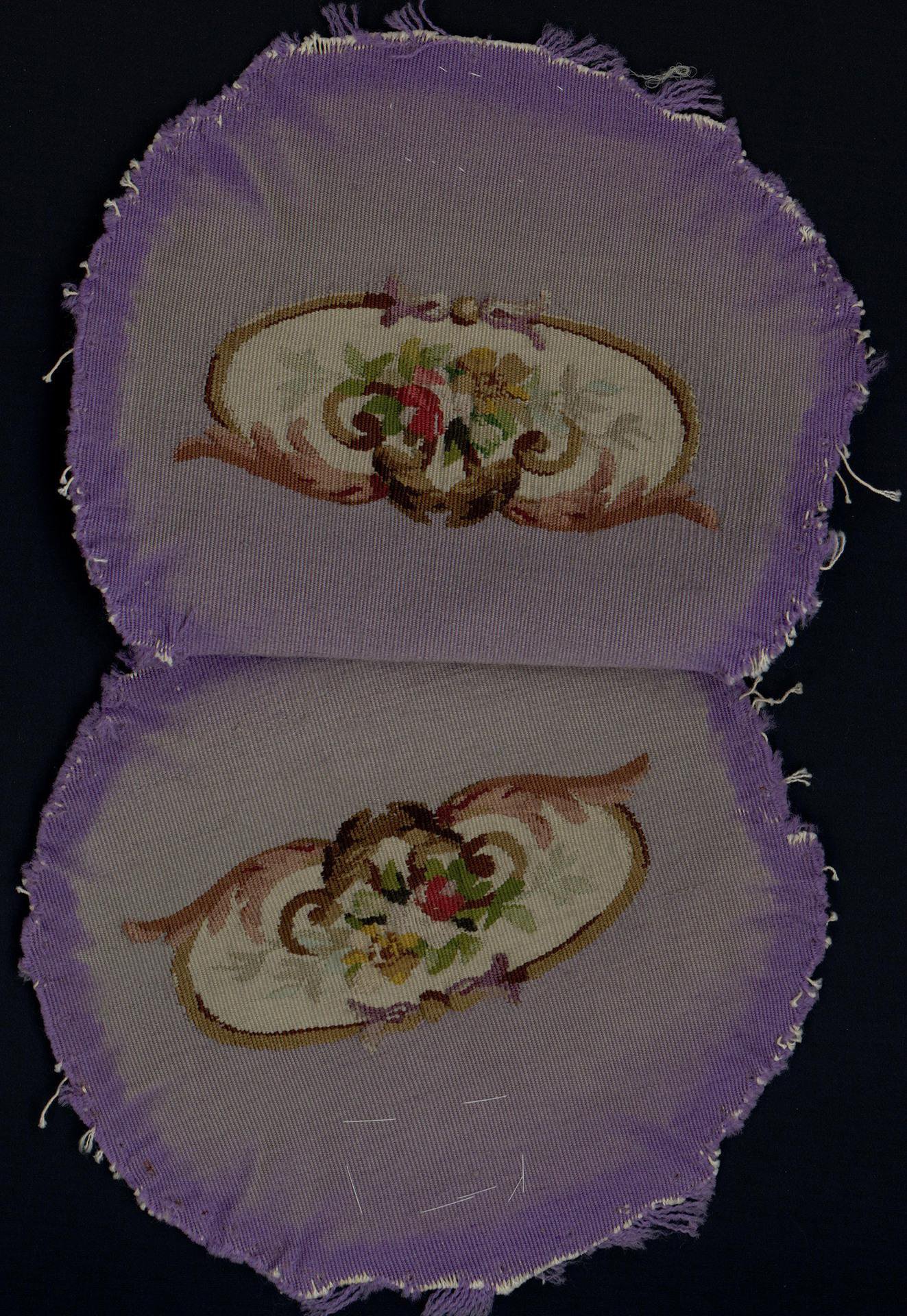
Origin: France, Aubusson
Date: second half of the 18th century
Material: wool, silk
Technique: tapestry weaving
Dimensions: height 44 cm; width 48 cm
Current Collection: The State Hermitage Museum
Inventory Number: T-15733
Hermitage ID: 488831
Rudanovsky Connection: Entered the Hermitage in 1919 from the collection of A. K. Rudanovsky.
A plain lilac silk panel for the back of a chair — the last number in a continuous run of twenty objects that once furnished a single room.
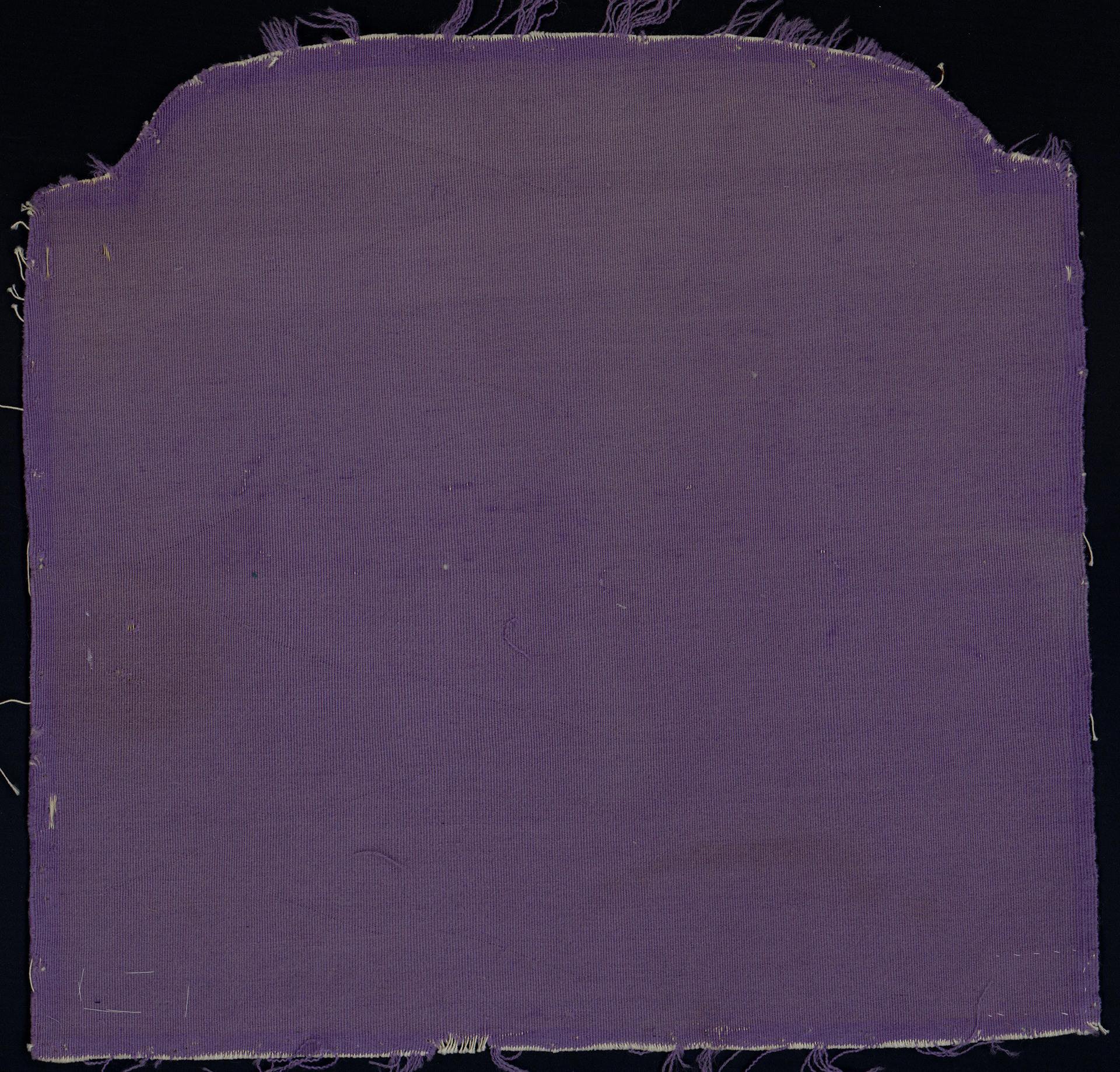
Tapestry: Upholstery for the Back of a Chair (T-15733). The State Hermitage Museum.
The panel comes from the collection of A. K. Rudanovsky and entered the Hermitage through the Department for the Protection of Monuments. It is not currently on permanent display.
It is the eighth plain silk back in the group, and its inventory number closes the sequence. Taken together, the numbers T-15718 to T-15737 describe a suite of furniture — and the arithmetic of that suite is more revealing than any single panel.
The Object
The panel is a rectangle with a curved top and stepped shoulders, cut to the profile of a chair back. The silk is plain, closely woven, in a lilac that has faded to grey-violet.
The edges are frayed and the bottom has lost its warp into a fringe; the surface is marked by creases, small stains and the pressure of the frame. There is no decoration of any kind.
Counting the Suite
The group is unusually complete, and it can be counted.
There is one sofa seat (T-15718), four chair seats (T-15719 to T-15722), three decorated chair backs (T-15723 to T-15725), eight plain chair backs (T-15726 to T-15733), and four armrest pairs (T-15734 to T-15737). Twenty numbers, twenty objects, one continuous run.
The numbers were assigned in the museum, not in the eighteenth century, but they follow the order in which the objects were registered — and that order probably reflects the order in which they were found, stored or catalogued together.
The Arithmetic of Upholstery
The arithmetic does not quite add up, and that is the interesting part.
Four chair seats but eight plain backs; three decorated backs but four seats. If every chair had one seat, one decorated back and one plain back, the numbers should match. They do not.
There are several possible explanations. Some decorated backs may have been lost, sold or registered elsewhere; some plain backs may belong to chairs whose seats are missing; or the suite may have included more chairs than the surviving covers suggest.
What the numbers show is a suite in pieces — not a complete set, but a set from which enough survives to see the whole.
What the Numbers Reveal
A continuous run of inventory numbers is a rare thing in a museum textile collection.
Textiles are usually acquired in lots, stored in groups and registered over years; their numbers are scattered. A run like this implies a single acquisition, a single act of registration and a single moment in which the objects were together.
That moment was probably the transfer of the Rudanovsky collection in 1919, or the later distribution of its contents through the State Museum Fund. The numbers preserve the memory of that moment, even when the furniture itself has disappeared.
The numbers are, in effect, a register of survival: they record what was kept, not what was made.
The Missing Pieces
What is missing is as informative as what survives.
There is no sofa back in the group, although there is a sofa seat. There are no chair frames, no upholstery, no gilding. There are no complete chairs — only their covers, cut to shape and separated from the furniture they dressed.
The reconstruction is therefore partial by necessity. We can measure the panels, match the designs and count the pieces, but we cannot see the room as it was. The suite exists as a set of surfaces, not as a set of objects.
The absence is itself a kind of evidence: it tells us which parts of a suite were valued enough to keep, and which were allowed to disappear.
The Colour of the Backs
All eight plain backs are lilac, and the colour is consistent across the group.
This consistency is evidence that they were made together, dyed in the same bath or from the same lot of silk. It also suggests that the colour was chosen deliberately for the backs, not simply inherited from the fronts.
Lilac was a fashionable colour for linings and for the reverse of upholstery, where it would be seen less often but still noticed. The choice gives the suite a unity that would otherwise be invisible: from behind, all the chairs were the same colour.
The Back of the Chair
The back of a chair is a strange place to end a story.
It is the side that faced the wall, the side that was never photographed in the eighteenth century, the side that survives in museum storage. And yet it is the side that tells us most about how the furniture was made: the cut, the stitching, the lining, the economy of materials.
This panel is the last of eight, and it closes the sequence. It is a modest object — a piece of lilac silk, cut and frayed — but it is also the final piece of a puzzle that the collection has been assembling for a century.
The Sofa and the Chairs
A sofa seat and four chair seats do not make a room, but they suggest one.
In an eighteenth-century salon, the sofa was the centre of the seating arrangement, placed against the wall or in front of the fireplace, with chairs arranged on either side. The sofa was the seat of honour; the chairs were for company.
The tapestry suite covered both, in the same design and the same colours. The result was a unified group of furniture that read as a single object from across the room — a band of cream and flowers running along the wall.
What a Suite Cost
A tapestry suite was a considerable expense.
Tapestry was among the most labour-intensive of the decorative arts: a single seat cover could take weeks of weaving, and a suite of twenty pieces represented months of work by several hands. The cost was comparable to that of a painting or a piece of silver.
This is why suites were commissioned by the wealthy and why they were carefully maintained. A set of tapestry chairs was an investment, and it was treated as such: re-covered when worn, repaired when damaged, and passed down as part of the furnishing of a house.
Provenance
The panel carries the inventory number T-15733 and entered the Hermitage through the Department for the Protection of Monuments from the collection of A. K. Rudanovsky.
In the Hermitage
The panel is preserved in the State Hermitage Museum in Saint Petersburg and is not on permanent display.
It is the kind of object that a museum keeps because it completes a group, not because it is beautiful on its own. Its value is contextual: it makes sense only when it is placed beside the seats and backs and armrests of the same suite, and when the numbers are read as a single sequence.
Read that way, the panel is not a fragment at all. It is the last word in a sentence that began in an eighteenth-century workshop and ended in a museum storeroom.