Origin: France, Aubusson
Date: second half of the 18th century
Material: wool, silk
Technique: tapestry weaving
Dimensions: 30 × 20 cm
Current Collection: The State Hermitage Museum
Inventory Number: T-15735
Hermitage ID: 488833
Rudanovsky Connection: Entered the Hermitage in 1919 from the collection of A. K. Rudanovsky.
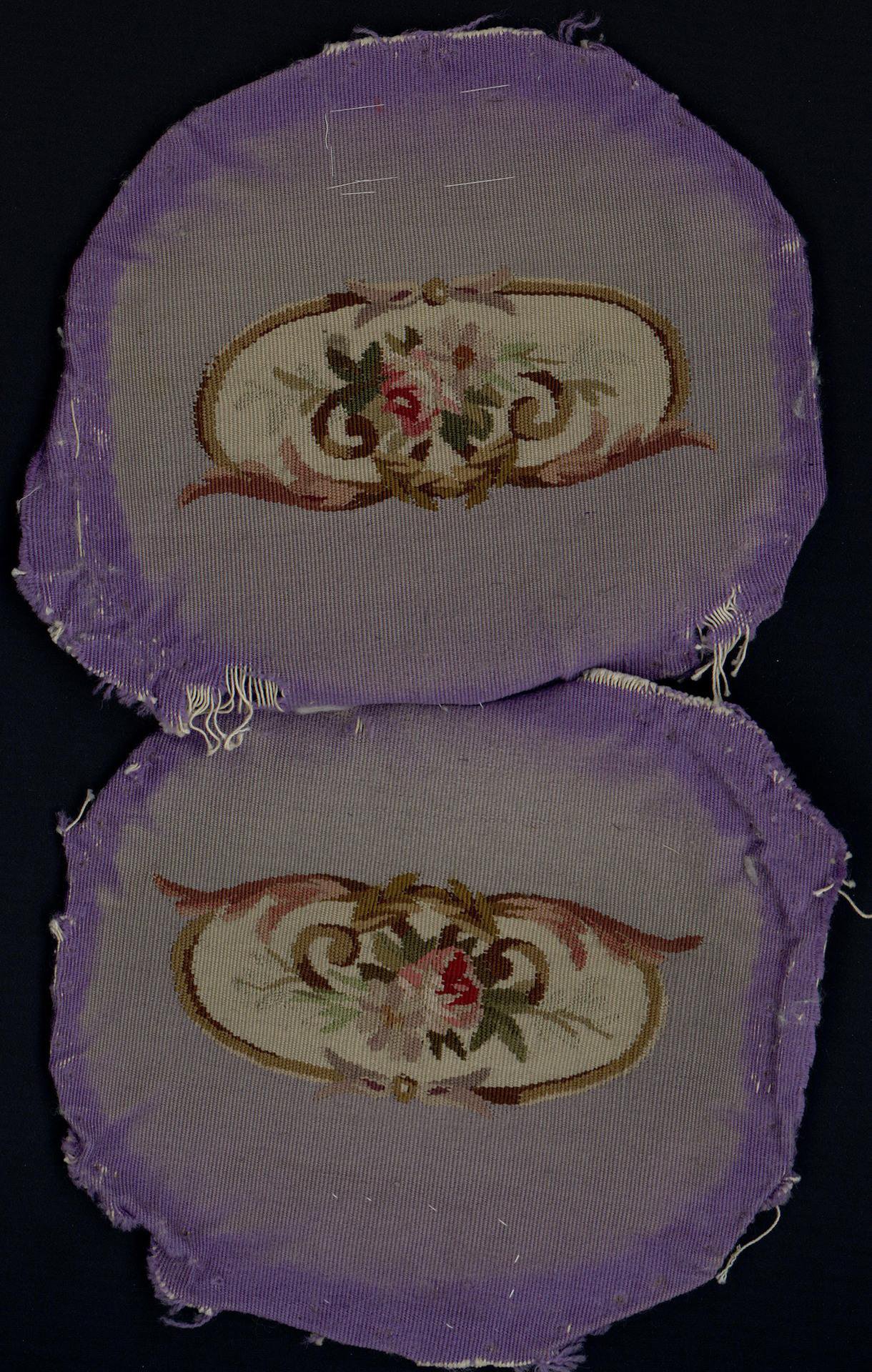
A pair of tapestry covers for chair armrests, each with a small bouquet in an oval frame and a lilac surround.
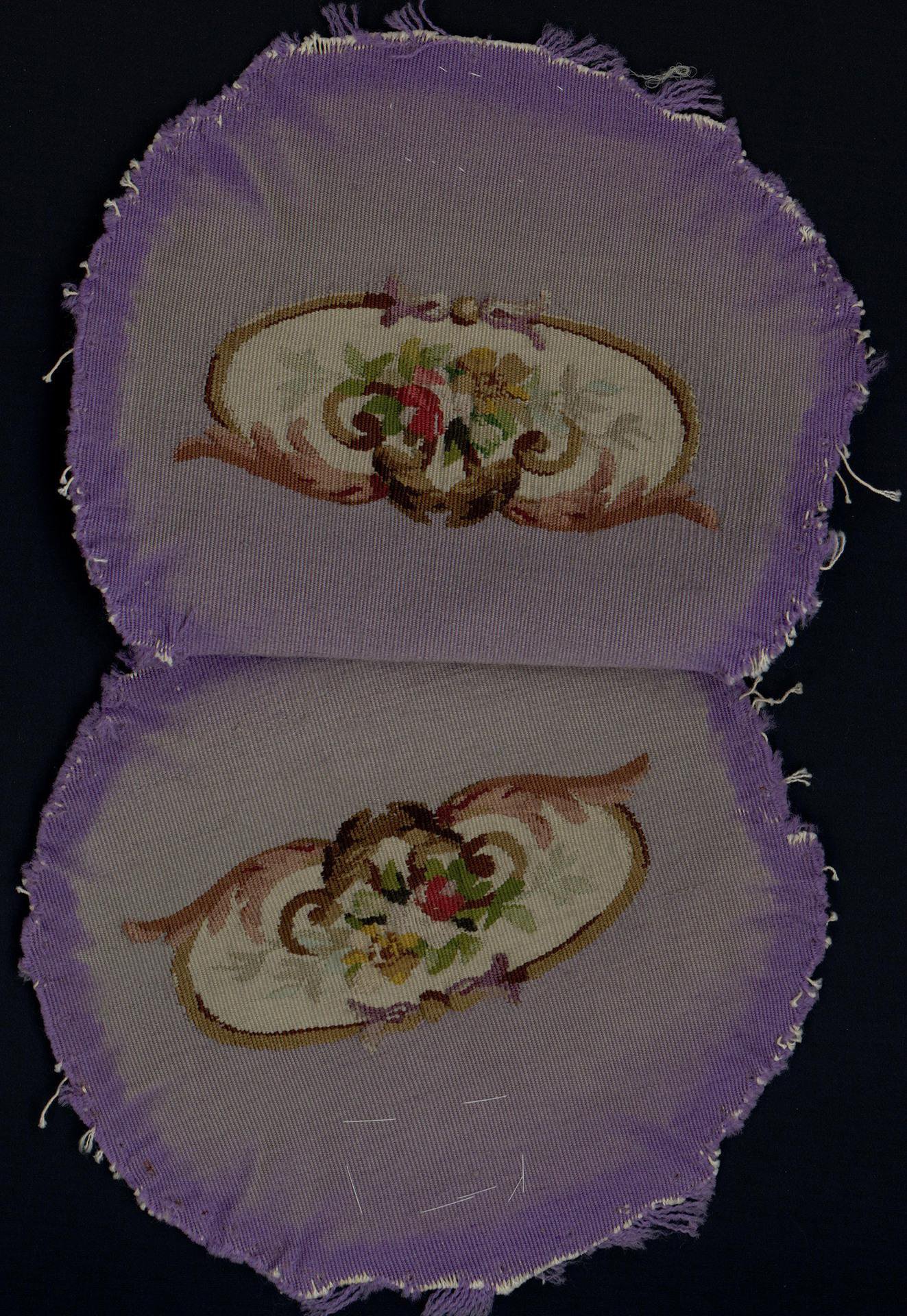
Tapestry: Upholstery for a Chair Armrest (T-15735). The State Hermitage Museum.
The covers come from the collection of A. K. Rudanovsky and entered the Hermitage through the Department for the Protection of Monuments. They are not currently on permanent display.
They belong to the suite of tapestry upholstery that includes seats, backs and armrests, and they are among the smallest objects in it: two panels, each about the size of a hand, cut to wrap around the arm of a chair.
The Object
The photograph shows two shaped panels, one above the other. Each is roughly semicircular, with a lilac surround and a cream centre.
In the middle of each panel is an oval reserve, framed by a gilt-coloured band and filled with a small bouquet: a pink rose, a crimson flower, blue blossoms, green leaves and a scroll base. A small ribbon is tied at the top of the oval.
The panels are cut to the profile of the armrest: wide at the front, narrowing toward the back, with a curved outer edge. The edges are frayed and the silk is worn.
Two Halves of One Chair
The two panels are not duplicates. They are two halves of a single object.
An armchair has two arms, and each arm needs its own cover, cut to the shape of the armrest it will wrap. The two covers were woven together — the same design, the same colours, the same oval — but they were cut and mounted separately, and they mirror each other on the chair.
In the photograph they are placed one above the other, which makes the relationship visible. Side by side, they would be mirror images; stacked, they read as two versions of the same motif.
The Oval and the Ribbon
The oval cartouche is the design’s organising device.
It concentrates the ornament in the centre of the panel and leaves the lilac surround plain, so that the eye is drawn to the flowers. The gilt band gives the oval a frame, and the ribbon at the top gives it a point of suspension — as if the bouquet were hanging in the oval rather than growing in it.
This is a miniature version of the design used on the seats and backs, where a large bouquet rises from a scroll base within a garlanded frame. On the armrest, the same idea is compressed into a space of twenty centimetres.
The ribbon is a small piece of theatre: it turns a static oval into something suspended, as if the flowers had just been hung there.
Mirroring
Mirroring is a basic principle of upholstery.
When two objects face each other — two arms of a chair, two ends of a sofa — their covers are designed as mirror images, so that the ornament flows symmetrically from the centre. The weaver works from a reversed cartoon, or the designer draws the two halves of the scheme in mirror.
The mirroring is not exact. Hand-woven tapestry always varies slightly, and the two covers differ in small ways: the position of a leaf, the tone of a rose, the curve of a scroll. These differences are the signature of handwork.
The Armrest in Use
An armrest is touched more than it is looked at.
The hand rests on it, the wrist brushes it, the sleeve rubs against it, the rings and bracelets of the sitter pass over it. Over years, the surface is compressed and polished, and the edges fray where the fabric meets the frame.
The covers in the photograph show this kind of wear: the lilac surround is rubbed, the edges are frayed, and the centre of each panel is smoother than the border.
Why the Armrest Is Small
The small size of the armrest cover is not an accident of survival; it is the size of the object.
An armrest is a narrow strip of wood, usually curved and often carved, running from the back of the chair to the front. The cover wraps around it, so the panel is long and narrow, with a rounded end where it turns over the front of the arm.
The shape of the cover therefore tells us the shape of the arm: its width, its curve and the way it ends. Like the chair backs, the armrest covers are drawings of missing furniture.
The Suite in Miniature
The armrest covers are the suite in miniature.
Everything that appears on the large panels — the oval frame, the bouquet, the scrolls, the ribbon, the lilac border — is present here, reduced to the size of a hand. The reduction is a test of design: a motif that works on a seat can become crowded or illegible when compressed.
The workshop passed that test. The armrest covers are legible at a glance and detailed at close range, and they carry the same visual identity as the rest of the suite.
The Frame of the Arm
The armrest the cover wrapped was a piece of carved wood, shaped like a scroll or a volute.
It ran from the back of the chair to the front, where it ended in a carved terminal — often a scroll, sometimes a small figure or a rosette. The upholsterer covered the arm with webbing, padding and tapestry, then wrapped the fabric around the terminal and stitched it down.
The shape of the cover in the photograph — broad at the front, narrowing toward the back — records the shape of that wooden arm. Like the chair backs, the armrest covers are drawings of missing furniture, made in cloth.
Care of Small Objects
Small textiles are the hardest to look after.
They are easily lost, easily creased and easily damaged by handling. They are also the objects most often brought out for study, because they fit on a table and can be examined under a lens.
Museums store them flat, between sheets of acid-free tissue, in drawers protected from light. Each time they are handled, they are supported on a board and touched as little as possible. The paradox of small textiles is that their size makes them both easier to study and more vulnerable to study.
Provenance
The covers carry the inventory number T-15735 and entered the Hermitage through the Department for the Protection of Monuments from the collection of A. K. Rudanovsky.
In the Hermitage
The covers are preserved in the State Hermitage Museum in Saint Petersburg and are not on permanent display.
They are small, fragile and easy to overlook, but they are essential to the reconstruction of the suite. Without the armrests, the chairs would be incomplete; without the covers, the armrests would be bare wood. The pair completes the object, and the object completes the room.
That is the quiet argument of every fragment in this collection: that the part can still speak for the whole, and that the smallest panels may carry the largest idea.