Origin: France, Aubusson
Date: second half of the 18th century
Material: wool, silk
Technique: tapestry weaving
Dimensions: 30 × 20 cm
Current Collection: The State Hermitage Museum
Inventory Number: T-15737
Hermitage ID: 488835
Rudanovsky Connection: Entered the Hermitage in 1919 from the collection of A. K. Rudanovsky.
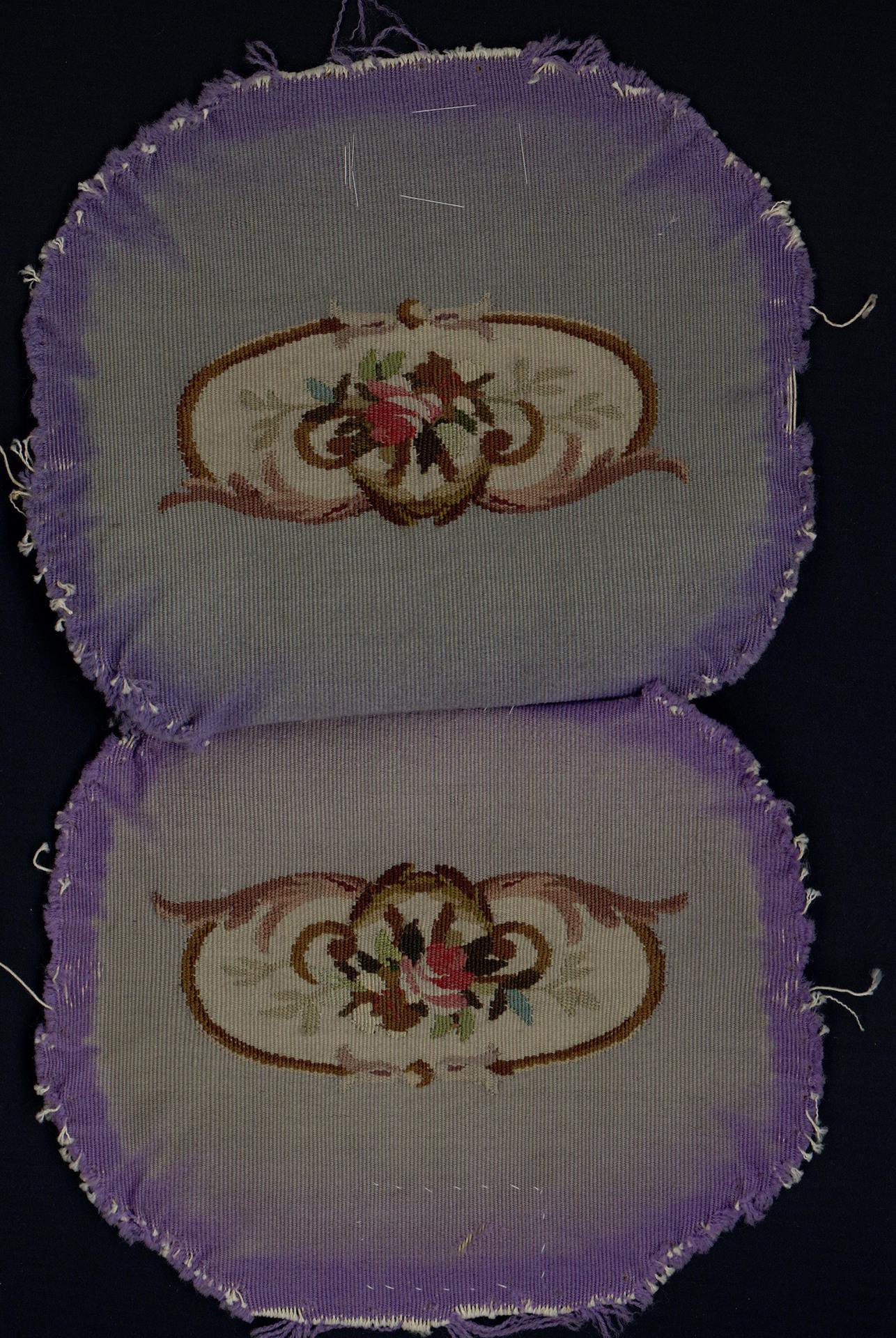
A pair of armrest covers from a tapestry suite, their small bouquets worn smooth by two centuries of hands.
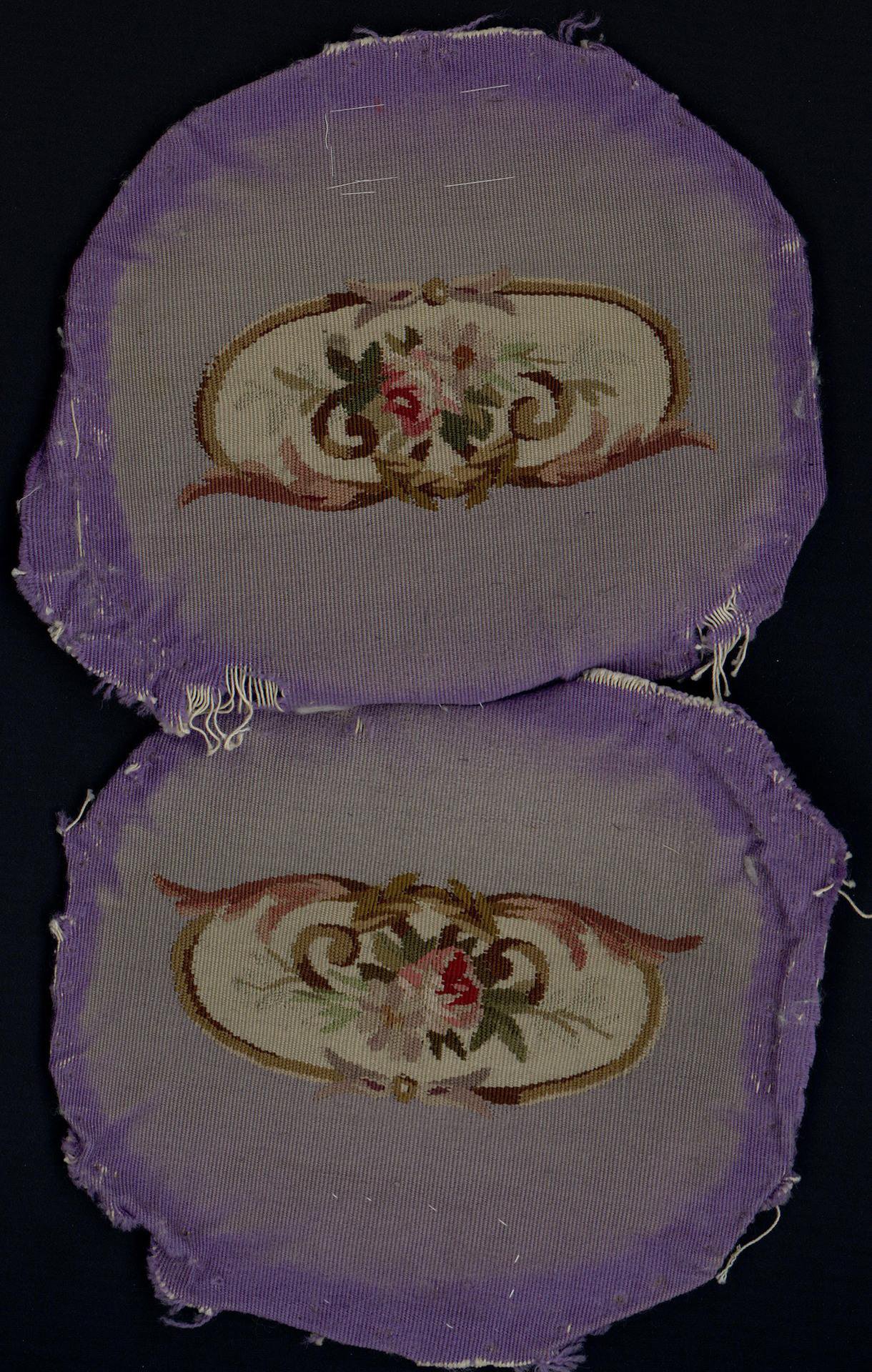
Tapestry: Upholstery for a Chair Armrest (T-15737). The State Hermitage Museum.
The covers come from the collection of A. K. Rudanovsky and entered the Hermitage through the Department for the Protection of Monuments. They are not currently on permanent display.
They are shaped panels of tapestry with lilac surrounds and oval centres, each containing a small bouquet. What distinguishes them from the seats and backs of the same suite is not their design but their condition: they are the parts of the furniture that were touched.
The Object
Two panels, one above the other. Each has a semicircular outline, a lilac border and a cream centre with an oval cartouche.
Inside the oval: a rose, a crimson flower, blue blossoms, green leaves and a scroll base, drawn in the fine, dense weave of tapestry. A small ribbon is tied at the top of the oval.
The edges are frayed, the lilac surround is rubbed, and the surface of the cream ground is smoother and slightly darker than on the larger panels.
The Hand
The armrest is the part of a chair that belongs to the hand.
A person seated in an armchair rests a hand on the arm, or a wrist, or an elbow. The hand moves, taps, grips, slides. Over years, the fabric on the armrest is compressed, polished and worn in a way that no other part of the chair experiences.
This is why armrest covers are often the most damaged elements of a suite, and why they are also the most intimate. They record the presence of bodies in a way that the seat and the back do not.
Wear Patterns
Wear is not uniform, and its patterns are informative.
On these covers, the wear is concentrated on the outer edge and on the lilac surround, where the hand rested and the sleeve rubbed. The oval centre, protected by the frame of the armrest, is comparatively well preserved.
The fraying follows the cut edge, where the fabric was stretched over the wood. The stitches that held the cover have left rows of small holes, and in places the warp has begun to open.
Cleaning and Conservation
Textiles are cleaned with great care, and often not at all.
Water can shrink silk, disturb dyes and weaken old fibres; dry cleaning can remove the evidence of use. Conservators therefore prefer minimal intervention: surface cleaning with a soft brush, careful support of weak areas, and storage in stable conditions.
The wear on these covers is part of their history. Removing it would make them look newer and tell us less. The aim of conservation is to keep the object stable, not to restore it to an imagined original state.
The Flowers
The bouquet in the oval is small but complete.
A pink rose dominates the centre; a crimson flower, perhaps a carnation or an anemone, sits beside it; blue blossoms and green leaves fill the gaps; a scroll base anchors the group; a ribbon ties it at the top.
The flowers are stylised, as everywhere in this suite, but they are drawn with care: the rose has layered petals, the leaves have veins, the ribbon has folds. At this scale, the weaver’s skill is most visible.
Silk and Wool
The covers combine wool and silk, as tapestry always does.
Wool provides the body of the fabric and most of the colour; silk provides the highlights and the sheen. In the flowers, the silk threads catch the light and make the petals turn; in the lilac surround, the silk gives the colour its soft glow.
The combination is also practical. Wool is durable and takes dye well; silk is strong but sensitive. A tapestry uses each fibre where its qualities are most useful.
The Pair
The two covers are a pair, and they have aged together.
Their wear is similar, their colours have faded in the same way, and their edges are frayed in the same places. This symmetry of condition is evidence that they were used together, on the two arms of the same chair, for the same period of time.
In a museum, pairs are often separated for storage. Photographed together, they recover their relationship: two halves of a single piece of furniture, worn by the same hands.
Textiles and Touch
Textiles are the one class of museum object that was made to be touched.
A painting is looked at; a sculpture may be circled; a chair is sat in and a table is leaned on. But fabric is touched constantly — worn against the body, gripped by the hand, brushed by clothing. This is why textiles age differently from other objects: their surfaces are not only seen but used.
These covers preserve that use in their weave. The threads are flattened, the silk is polished, the wool is matted. The object has been altered by touch in a way that a marble bust has not.
The Museum’s Gloves
In a museum, the touching stops.
Conservators wear gloves, handle textiles on padded boards and limit their exposure to light. The object that was once sat upon is now treated as something fragile — which it is, but mostly because it has already been used for two centuries.
This change of regime is one of the things that makes museum objects strange. A chair that was made to be touched is now protected from touch; a fabric that was made to be used is now preserved from use. The object survives, but its life has been reversed.
The Suite’s Later History
After the chair was re-covered or broken up, the covers were separated from the furniture. The decorated faces were kept for their beauty; the plain backs and the armrests were kept because they belonged to the group.
This is a common pattern in the survival of suites: the showpieces are preserved first, and the lesser elements follow. The armrest covers survived because someone recognised that they completed the set — a curator’s decision, made long after the upholsterer’s work was finished.
Provenance
The covers carry the inventory number T-15737 and entered the Hermitage through the Department for the Protection of Monuments from the collection of A. K. Rudanovsky.
In the Hermitage
The covers are preserved in the State Hermitage Museum in Saint Petersburg and are not on permanent display.
They are the most human objects in the suite: the parts that were touched, gripped and worn. Their damage is not a defect but a record — of hands, of use, of the long life of a piece of furniture that has outlived its room.
A museum usually tries to arrest time. These covers show that time has already done its work, and that the work is worth keeping. Their scale is small; their evidence is not, and in the end they are less about flowers than about the people who rested their hands on them, day after day.