Origin: France, Aubusson
Date: second half of the 18th century
Material: wool, silk
Technique: tapestry weaving
Dimensions: 30 × 20 cm
Current Collection: The State Hermitage Museum
Inventory Number: T-15736
Hermitage ID: 488834
Rudanovsky Connection: Entered the Hermitage in 1919 from the collection of A. K. Rudanovsky.
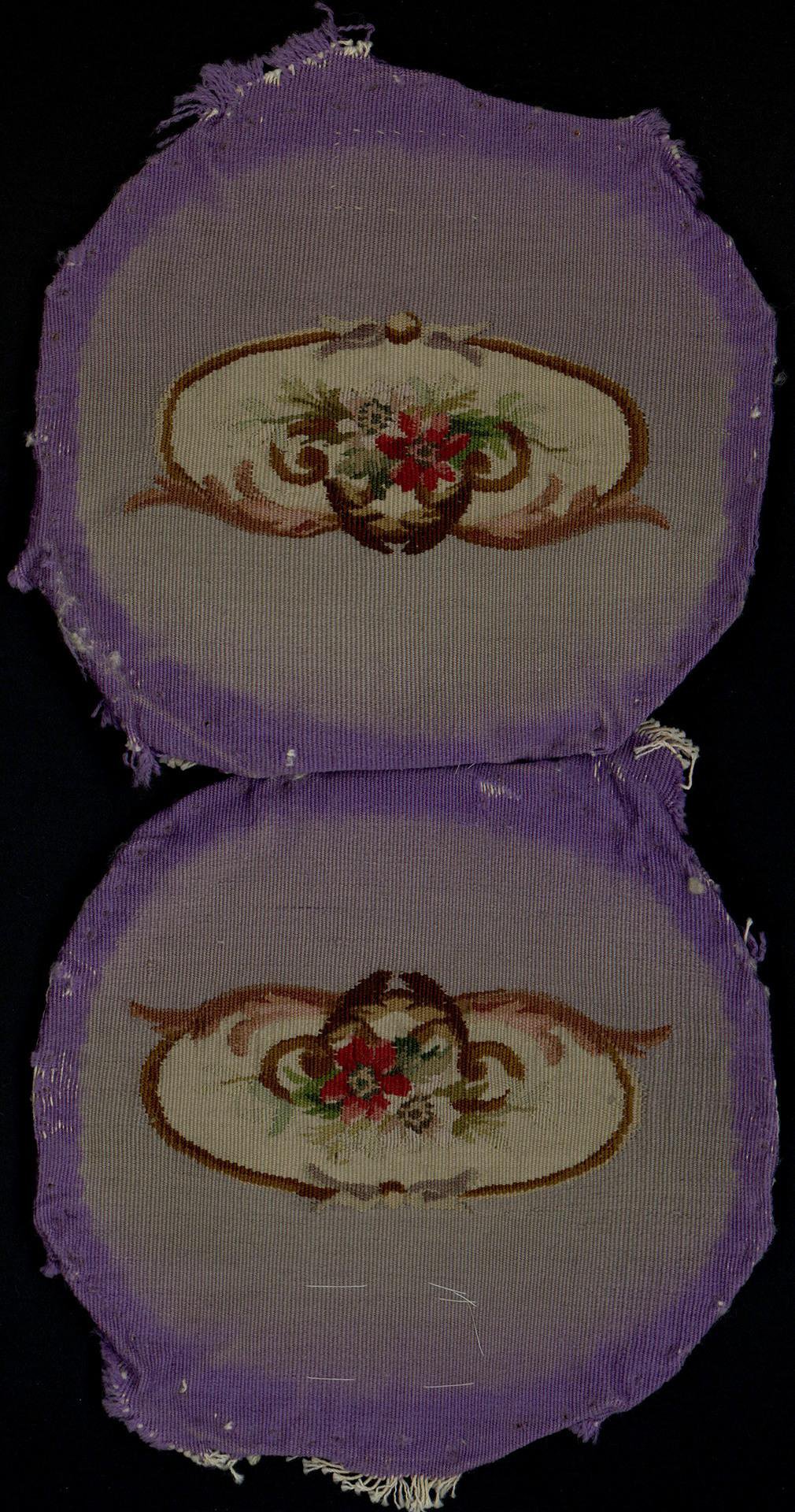
A pair of armrest covers from the tapestry suite, each carrying a small oval bouquet that repeats the design of the larger panels in miniature.
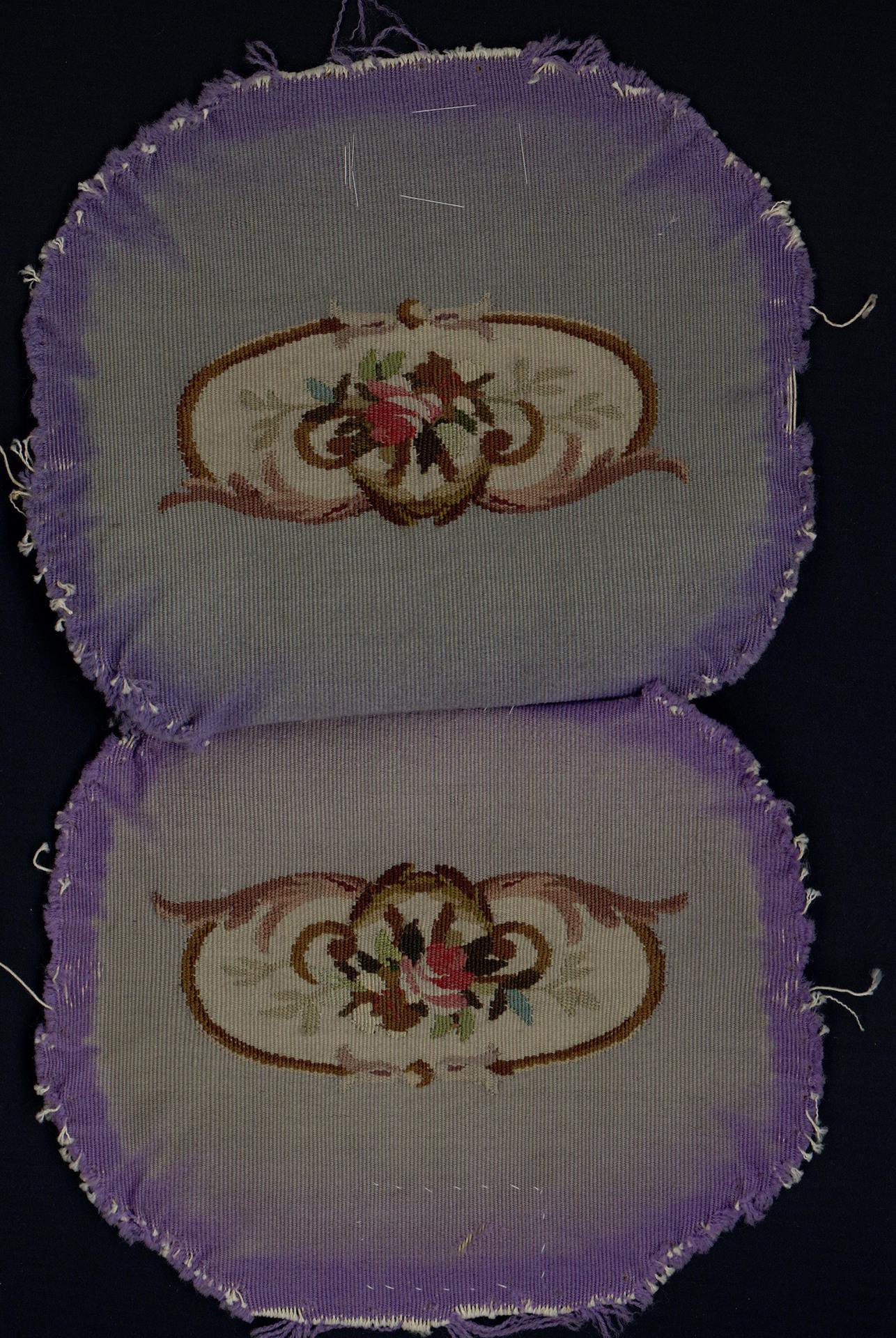
Tapestry: Upholstery for a Chair Armrest (T-15736). The State Hermitage Museum.
The covers come from the collection of A. K. Rudanovsky and entered the Hermitage through the Department for the Protection of Monuments. They are not currently on permanent display.
They belong to the same suite as the seats and backs, and their design is a compressed version of the suite’s repertory: an oval frame, a small bouquet, a scroll base, a ribbon. Looking at them closely is a lesson in how eighteenth-century workshops repeated and varied a design.
The Object
The photograph shows two shaped panels, one above the other. Each has a lilac surround and a cream centre with an oval cartouche.
Inside the oval, a small bouquet is arranged above a scroll base: a pink rose, a crimson flower, blue blossoms, green leaves, and a ribbon tied at the top. The oval is framed by a gilt-coloured band, and the surround is plain lilac.
The panels are cut to the shape of the armrest: rounded at the front, narrowing toward the back, with frayed edges.
The Drawing
Every tapestry begins with a drawing.
The designer prepared a cartoon — a full-size drawing of the composition — which the weaver placed behind the warp and followed knot by knot. For a suite of furniture, the cartoon was adapted to each panel: enlarged for a sofa seat, reduced for a chair back, compressed for an armrest.
The armrest covers are therefore not independent designs. They are reductions of a single idea, adjusted to a smaller format. The oval, the bouquet and the scrolls are the same; only the proportions change.
Repetition
Repetition was the basis of workshop production.
A suite required a consistent design across many pieces, and consistency was achieved by repeating the same motifs, the same colours and the same framing devices. The customer wanted chairs that belonged together, and the workshop wanted a design that could be reproduced efficiently.
The repetition is not mechanical. Each panel was woven by hand, and each weaver interpreted the cartoon slightly differently. The result is a family of objects that resemble one another without being identical.
Variation
Within the repetition, there is variation.
The two armrest covers differ in small ways: the angle of a leaf, the position of a flower, the curve of a scroll. These differences may be the work of different weavers, or of the same weaver on different days, or of the adaptation of the cartoon to two slightly different panels.
Variation is what makes a suite alive. A set of identical objects would look mechanical; a set of objects that vary within a common scheme looks handmade, which is exactly what it is.
The Pattern Book
Eighteenth-century workshops relied on pattern books and collections of designs.
Designers reused motifs across commissions: a bouquet, a garland, a scroll, a ribbon. The same elements appear on seats, backs, armrests, screens and wall panels, adapted to different formats and different customers.
This economy of design explains why the Rudanovsky suite looks coherent across twenty objects. It is not that a single designer drew every panel; it is that the workshop worked within a shared vocabulary, and the vocabulary was applied consistently.
The Suite’s Logic
The suite has a logic that can be read from its smallest element.
The armrest cover contains the whole system in miniature: the oval frame, the bouquet, the scrolls, the ribbon, the lilac border. Enlarge it, and you have a chair back; widen it, and you have a sofa seat.
This is the logic of ornamental design in the eighteenth century: a small number of elements, combined and recombined at different scales, to produce a unified interior. The armrest is not a lesser object; it is the system in its most concentrated form.
The Miniature Bouquet
The bouquet in the oval is worth looking at closely.
It contains a rose, a crimson flower, blue blossoms and green leaves, arranged in a tight, symmetrical group. The colours are strong — stronger, proportionally, than on the larger panels — because a small design needs more contrast to remain legible.
The ribbon at the top is a particularly fine detail: two loops and two tails, drawn in a few stitches, catching the light. At this scale, the weaver’s skill is at its most impressive.
The Colour Scheme
The suite has a colour scheme, and it is visible in the smallest panel.
Cream ground, lilac border, pink and crimson flowers, blue accents, olive and gold scrolls. The palette is limited and consistent, and it is repeated across all twenty objects of the group.
Colour is what makes a suite read as a whole. A room furnished with these pieces would have been unified by the cream and lilac long before the visitor noticed the individual designs. The armrest covers, small as they are, carry the same scheme and contribute to the same effect.
Learning from Fragments
A fragment can teach more than a complete object.
A complete chair shows us what the maker intended; a fragment shows us how the object was made, used and lost. The armrest covers are fragments in this sense: they preserve the design, the technique and the wear of a part of the furniture that is usually hidden.
Museums have learned to value such fragments, not as substitutes for missing masterpieces but as evidence in their own right. The history of the decorative arts is largely a history of fragments, and the fragments are often more eloquent than the wholes.
Smallness
There is a particular pleasure in small things.
A panel of twenty centimetres can be held in the hand, turned over, examined at close range. It reveals its weave, its stitches and its wear in a way that a large tapestry cannot. The small object is intimate; it invites the kind of looking that a museum usually reserves for jewellery.
The armrest covers are not minor because they are small. They are concentrated: the whole design of the suite, compressed into a space where every stitch counts.
Provenance
The covers carry the inventory number T-15736 and entered the Hermitage through the Department for the Protection of Monuments from the collection of A. K. Rudanovsky.
In the Hermitage
The covers are preserved in the State Hermitage Museum in Saint Petersburg and are not on permanent display.
They are small objects, but they carry the DNA of the suite: the oval, the bouquet, the scroll, the ribbon, the lilac. Seen together with the seats and backs, they show how a single design could be scaled, repeated and varied to furnish an entire room.
The system, in the end, is the meaning. A single bouquet is a decoration; a bouquet repeated at four scales, on twenty objects, is a way of thinking about a room, and the armrest covers are the smallest proof that the system worked.