Origin: France, Aubusson
Date: second half of the 18th century
Material: wool, silk
Technique: tapestry weaving
Dimensions: 30 × 20 cm
Current Collection: The State Hermitage Museum
Inventory Number: T-15738
Hermitage ID: 488836
Rudanovsky Connection: Entered the Hermitage in 1919 from the collection of A. K. Rudanovsky.
A pair of armrest covers from the tapestry suite, the fifth and last pair in a run of twenty objects, with a small bouquet of red flowers in an oval frame.
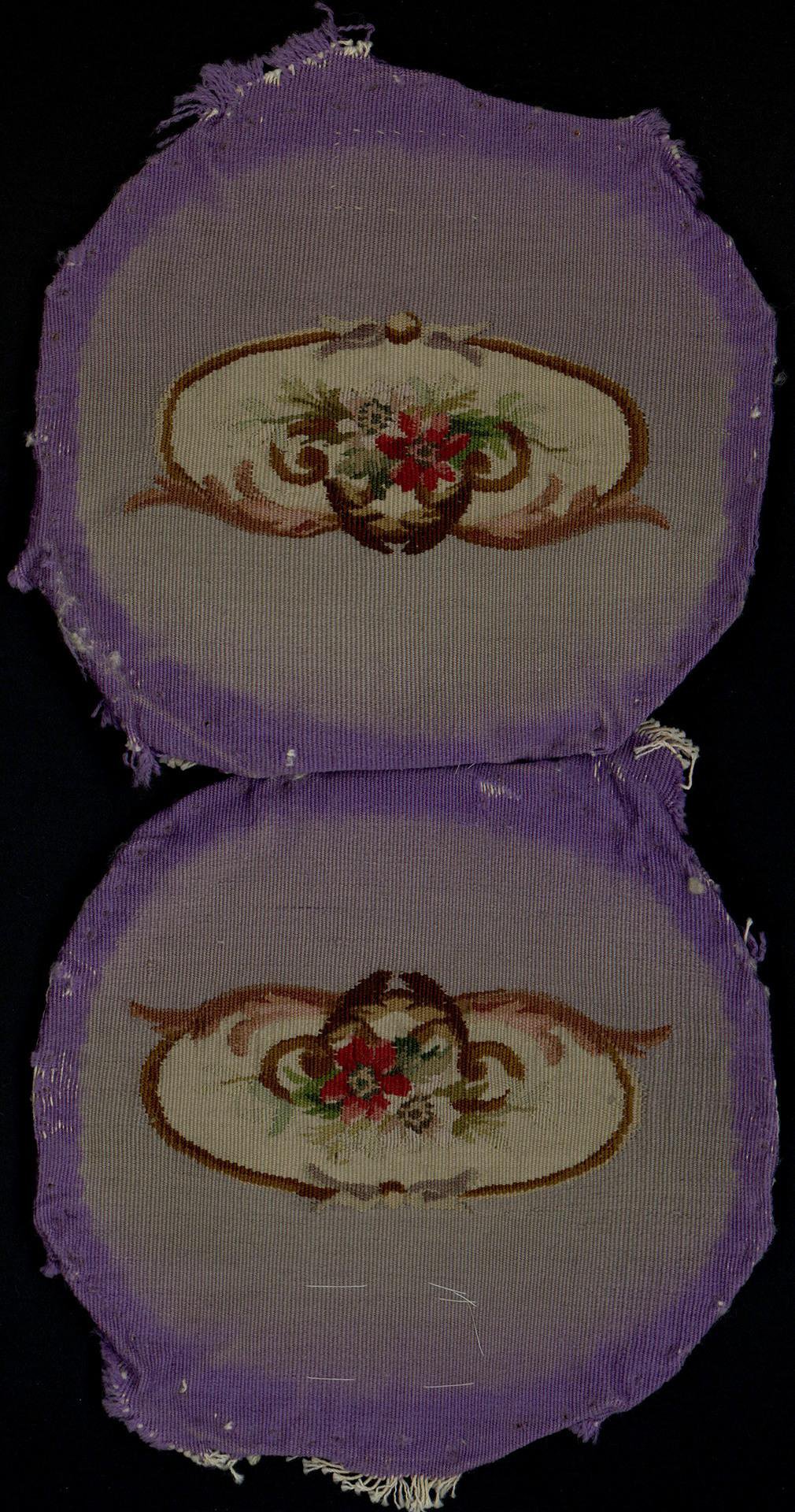
Tapestry: Upholstery for a Chair Armrest (T-15738). The State Hermitage Museum.
The covers come from the collection of A. K. Rudanovsky and entered the Hermitage through the Department for the Protection of Monuments. They are not currently on permanent display.
They are the last pair of armrest covers in the suite, and their inventory number closes the sequence that began with the sofa seat. Like the plain backs, they survive as fragments of furniture that no longer exists — but unlike the backs, they carry a design, and that design is a miniature version of the whole suite.
The Object
Two shaped panels, one above the other. Each has a lilac border and a cream centre, with an oval cartouche in the middle.
Inside the oval: a small bouquet with a red flower at its heart, pink and white blossoms, green leaves and a scroll base. A gilt-coloured band frames the oval, and a small ribbon is tied at the top.
The panels are cut to the shape of the armrest: broad and rounded at the front, narrowing toward the back, with frayed edges and worn corners.
The Fifth Pair
The suite contains five pairs of armrest covers, numbered T-15734 to T-15738.
Five pairs means ten armrests, which is more than the four chair seats and the three decorated backs would require. The numbers do not add up to a simple set of identical chairs, and the discrepancy is worth thinking about.
One explanation is that the suite included armchairs as well as side chairs, and that the armchairs had different seats and backs. Another is that some pieces were lost and others were registered separately. The covers themselves cannot resolve the question; they can only document it.
Red Flowers
The bouquet in this pair is built around a red flower.
On the other armrest covers the dominant note is pink or crimson; here the red is stronger and more central, with white and pink blossoms around it and dark green leaves below. The effect is slightly different from the other pairs, though the frame and the scrolls are the same.
Such variations are typical of a suite. The workshop repeated the design but varied the flowers, so that each pair had its own character while remaining part of the whole. The variation is small, but it is enough to make the panels individual.
The Armrests Outnumber the Chairs
The disproportion between armrests and chairs is one of the quiet puzzles of the suite.
A chair without arms has no armrest covers; an armchair has two. Five pairs of covers therefore imply at least five armchairs, while the four chair seats imply four chairs. The suite may have been larger than the surviving pieces suggest, or the armrests may have belonged to a different group within the same commission.
Museum numbering often preserves such puzzles. The numbers record what was registered, not what was made, and the gaps between them are as informative as the objects themselves.
The Cutting
Each armrest cover was cut to the shape of a specific arm.
The cut follows the curve of the armrest: wide at the front where the hand rests, narrow at the back where the arm meets the chair. The fabric was stretched over the wooden arm, folded around the terminal and stitched underneath.
The cut is irreversible, and it ties the cover to a particular piece of furniture. When the chair was dismantled, the cover became a fragment — a shaped panel with no object to fit, preserved because it belonged to the suite.
The cut is also a kind of archive: it records the shape of the arm as precisely as any drawing.
The Design in Miniature
The armrest cover condenses the design of the suite into a space of twenty centimetres.
The oval frame, the bouquet, the scrolls, the ribbon and the lilac border are all present, reduced and simplified. The flowers are fewer, the scrolls are smaller, the colours are stronger — because a small design needs more contrast to remain legible.
This compression is a test of the workshop’s skill. A design that works on a sofa seat can look crowded or empty on an armrest; these covers show that the workshop knew how to scale its vocabulary without losing its character.
The Last Pair
As the last pair in the sequence, these covers have a particular documentary value.
They complete the run of numbers and confirm that the suite was registered as a single group. They also show that the armrests were not an afterthought: they were designed, woven, cut and finished with the same care as the larger pieces.
In a museum, the last object in a sequence is often the one that makes the sequence intelligible. These covers do that for the armrests, and the armrests do it for the chairs.
The Suite’s Last Number
T-15738 is the highest number in the group, and it marks the end of the run.
Numbers are assigned in order of registration, so the last number is the last object recorded — not necessarily the last made or the least important. In this case, the armrest covers were registered after the seats and backs, perhaps because they were smaller, or because they were stored separately.
The number is a small piece of institutional history. It tells us that the suite was registered as a single sequence, and that the armrests were considered part of it.
Care of Pairs
Pairs are stored together when possible, but not always.
Two covers of the same pair may be kept in different drawers to save space, or separated when one is exhibited. The pair then exists as a catalogue entry rather than as a physical object.
For the armrests, the pair is the unit of meaning: one cover is half a chair. Museums that understand this try to keep pairs together, and photographs like this one — two panels, one above the other — are a way of restoring the relationship.
Provenance
The covers carry the inventory number T-15738 and entered the Hermitage through the Department for the Protection of Monuments from the collection of A. K. Rudanovsky.
In the Hermitage
The covers are preserved in the State Hermitage Museum in Saint Petersburg and are not on permanent display.
They are small, worn and easy to overlook, but they belong to one of the most complete surviving ensembles of eighteenth-century tapestry upholstery in the collection. Their value is not in their size but in their place in the sequence: they are the last word of a suite that has been speaking, object by object, for two hundred years.
Seen alone, they are two pieces of worn silk and wool. Seen in the sequence, they are the closing chord — a document as much as a decoration, and a last trace of a lost interior.