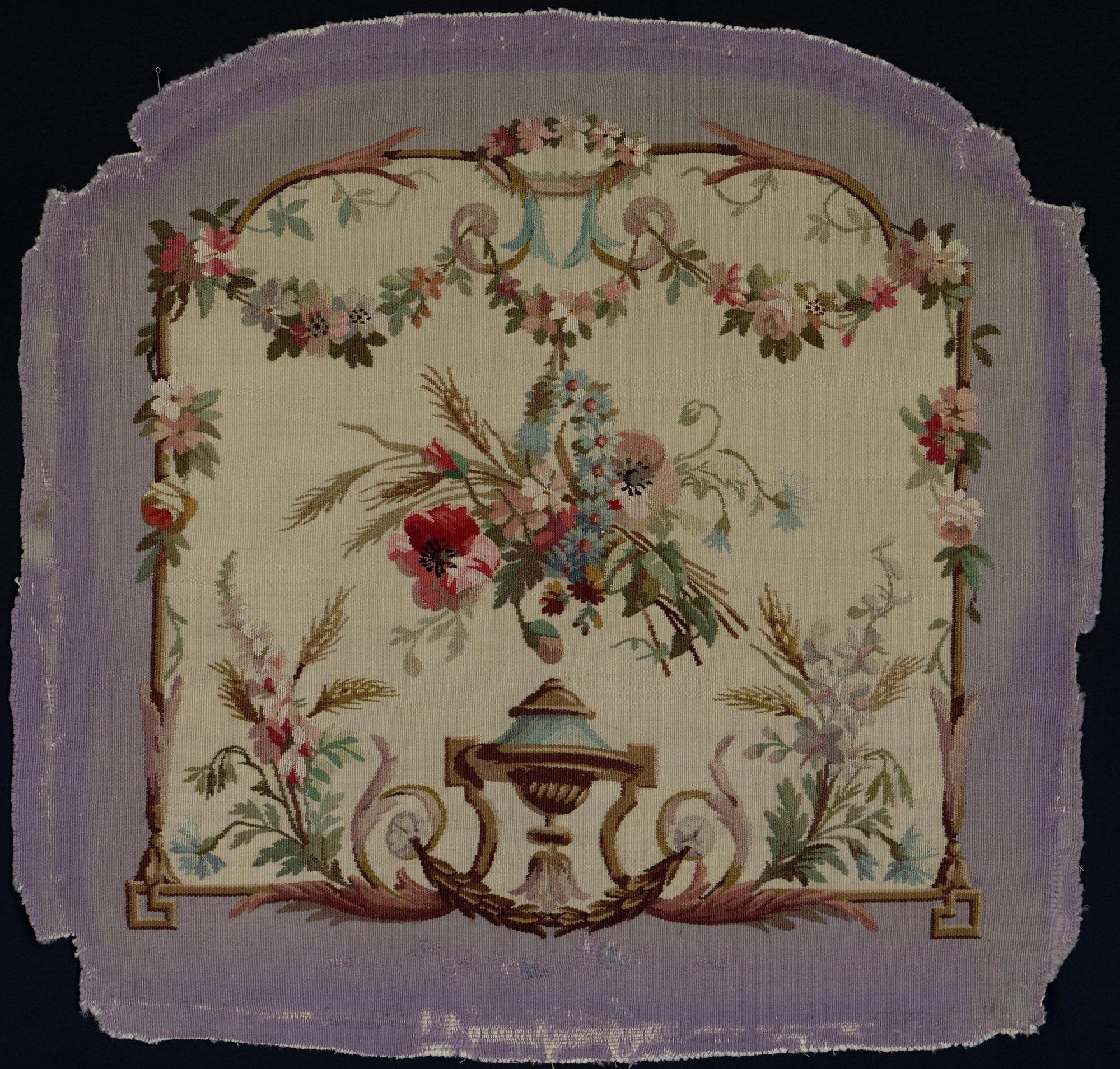
Origin: France, Aubusson
Date: second half of the 18th century
Material: wool, silk
Technique: tapestry weaving
Dimensions: height 50 cm; width 51 cm
Current Collection: The State Hermitage Museum
Inventory Number: T-15723
Hermitage ID: 488821
Rudanovsky Connection: Entered the Hermitage in 1919 from the collection of A. K. Rudanovsky.
A tapestry cover for a chair back from the second half of the eighteenth century, with a bouquet suspended above an urn and framed by an arch of flowers.
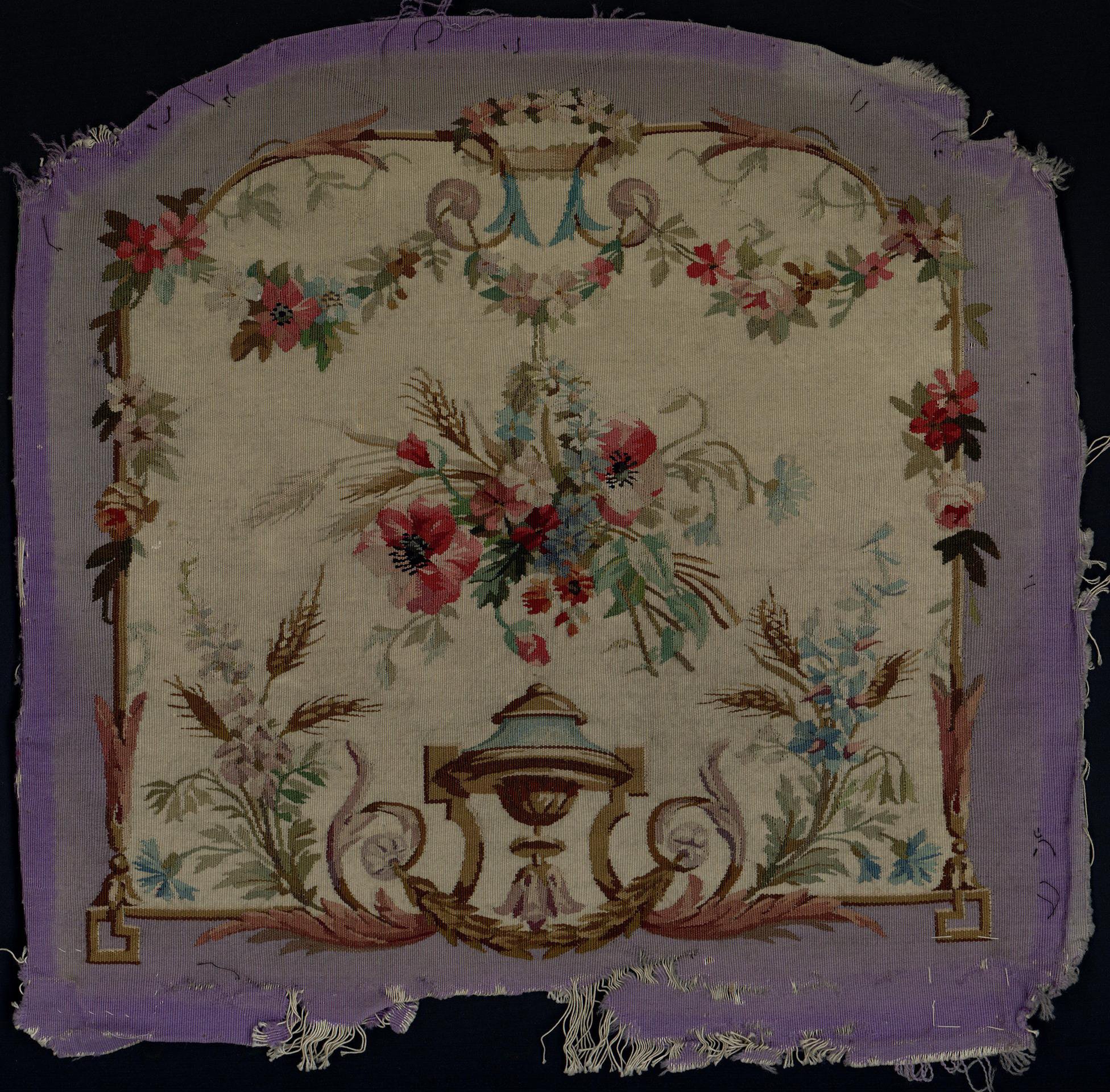
Tapestry: Upholstery for a Chair Back (T-15723). The State Hermitage Museum.
The cover comes from the collection of A. K. Rudanovsky and entered the Hermitage through the Department for the Protection of Monuments. It is not currently on permanent display.
It belongs to the suite of tapestry upholstery that includes a sofa seat and several chair seats: the same cream ground, the same lilac border, the same floral repertory. The chair backs, however, have a design of their own, adapted to a different format and to a different position in the room.
The Object
The field is cream. At the top, an arch of garlanded flowers spans the panel, dipping at the centre and rising at the corners. From the centre of the arch hangs a small wreath tied with a blue ribbon.
Below the arch, a bouquet hangs downward — not standing in a vase, but suspended, as if tied to the garland. It contains roses, anemones, blue flowers, wheat-like ears and long, trailing leaves.
At the bottom of the panel stands a small urn or tazza, with a domed lid and a fluted foot, set within a symmetrical frame of scrolls. On either side, sprays of cornflowers and grasses rise from the corners.
The whole design is enclosed in the lilac silk border that characterises the suite.
The Hanging Bouquet
The hanging bouquet is the design’s most distinctive feature.
In the seats of the suite the bouquet rises from a base; here it descends from the garland above. The flowers are arranged as if they were suspended by their stems, with the heaviest blooms at the bottom and the light sprays rising toward the wreath.
This inverted arrangement is not a caprice. It solves a compositional problem: a chair back is taller than it is wide, and a bouquet rising from the bottom would compete with the seat cushion below and crowd the centre. By hanging the bouquet from the arch, the designer keeps the lower part of the panel open and gives the composition a clear vertical movement.
The hanging bouquet also has a long history in ornament. Festoons, swags and suspended garlands were standard motifs of classical and Renaissance decoration, and they carried associations of abundance, celebration and offering.
The Urn
The urn at the bottom is a classical motif used in a decorative, not a functional, way.
It has a domed lid, a fluted body and a spreading foot, and it is framed by symmetrical scrolls that curl outward like handles. Nothing grows from it; the bouquet hangs above it, and the urn acts as a visual anchor, a counterweight to the garland at the top.
Urns of this kind were ubiquitous in eighteenth-century ornament: they appear in architecture, in furniture, in porcelain and in printed textiles. They signified antiquity, cultivation and taste, and they provided a stable, symmetrical form that could be varied endlessly.
The Chair Back as a Format
A chair back is a different problem from a chair seat.
The seat is horizontal and seen from above; the back is vertical and seen face-on. The back is also the part of the chair that frames the sitter, and its design has to work around the human body: the shoulders, the head, the space above the shoulders.
This panel is approximately square, 50 by 51 centimetres, and its composition is organised around a central axis. The arch at the top, the hanging bouquet and the urn below form a vertical sequence, and the side sprays balance the composition at the edges.
The shape of the panel — with a curved upper edge — follows the profile of the chair back. It was woven to fit, or cut to fit, and the curve is a trace of the frame it once covered.
The Garland Arch
The arch of flowers across the top is the design’s architectural element.
It behaves like a canopy or a baldachin: it frames the space below, defines the top of the composition and provides a support from which the wreath and the bouquet can hang. The flowers of the arch are smaller than those of the bouquet — roses, daisies, blue blossoms — and they are arranged in a continuous ribbon of colour.
The blue ribbon that ties the wreath reappears at the centre of the arch, and its cool tone is repeated in the cornflowers at the sides and in the small blue flowers of the bouquet. This repetition of blue across the panel is one of the details that holds the design together.
The Urn and the Garden
The urn at the bottom of the panel belongs to the visual language of the classical garden.
Eighteenth-century gardens were furnished with urns, vases and pedestals, and the same forms migrated into interiors through prints, porcelain, furniture and textiles. An urn signified cultivation: it was the vessel of the garden, the container in which nature was arranged and displayed.
In this design the urn does not hold the bouquet. It stands below it, empty, while the flowers hang above. The arrangement is decorative rather than logical, and it allows the designer to combine two motifs — the classical vase and the suspended garland — without having to make them physically consistent.
The Border
The lilac silk border is the quietest element of the design and one of the most important.
It frames the woven field, separates it from the wooden rail of the chair and gives the composition a limit. Without it, the flowers would run to the edge of the tapestry and the design would lose its focus.
The colour is unusual for tapestry upholstery, where borders were often red, green or gold. Lilac was fashionable in the later eighteenth century and appears in silk, porcelain and painted furniture. Against the cream ground it reads as a cool, slightly grey shadow, and it makes the flowers appear warmer than they are.
Symmetry and the Hinge
The composition is symmetrical in its architecture and asymmetrical in its detail.
The arch, the urn and the scroll frame are mirrored around the central axis. The bouquet, by contrast, is irregular: the flowers lean, the leaves trail, the wheat ears point in different directions. This combination of a stable frame and a lively centre is characteristic of the style.
The symmetry has a practical origin. Chair backs were woven in pairs and sets, and a symmetrical design could be repeated with minimal adjustment. The asymmetry of the bouquet allowed each panel to feel individual without changing the overall scheme.
Provenance
The cover carries the inventory number T-15723 and entered the Hermitage through the Department for the Protection of Monuments from the collection of A. K. Rudanovsky.
In the Hermitage
The cover is preserved in the State Hermitage Museum in Saint Petersburg and is not on permanent display.
It survives as one element of a dispersed suite, and its design can only be fully understood in relation to the seats that accompanied it. Seen together, the panels reconstruct the visual rhythm of an eighteenth-century room: garlands above, bouquets below, flowers repeated from chair to chair.