Origin: France, Aubusson
Date: second half of the 18th century
Material: wool, silk
Technique: tapestry weaving
Dimensions: height 50 cm; width 51 cm
Current Collection: The State Hermitage Museum
Inventory Number: T-15725
Hermitage ID: 488823
Rudanovsky Connection: Entered the Hermitage in 1919 from the collection of A. K. Rudanovsky.
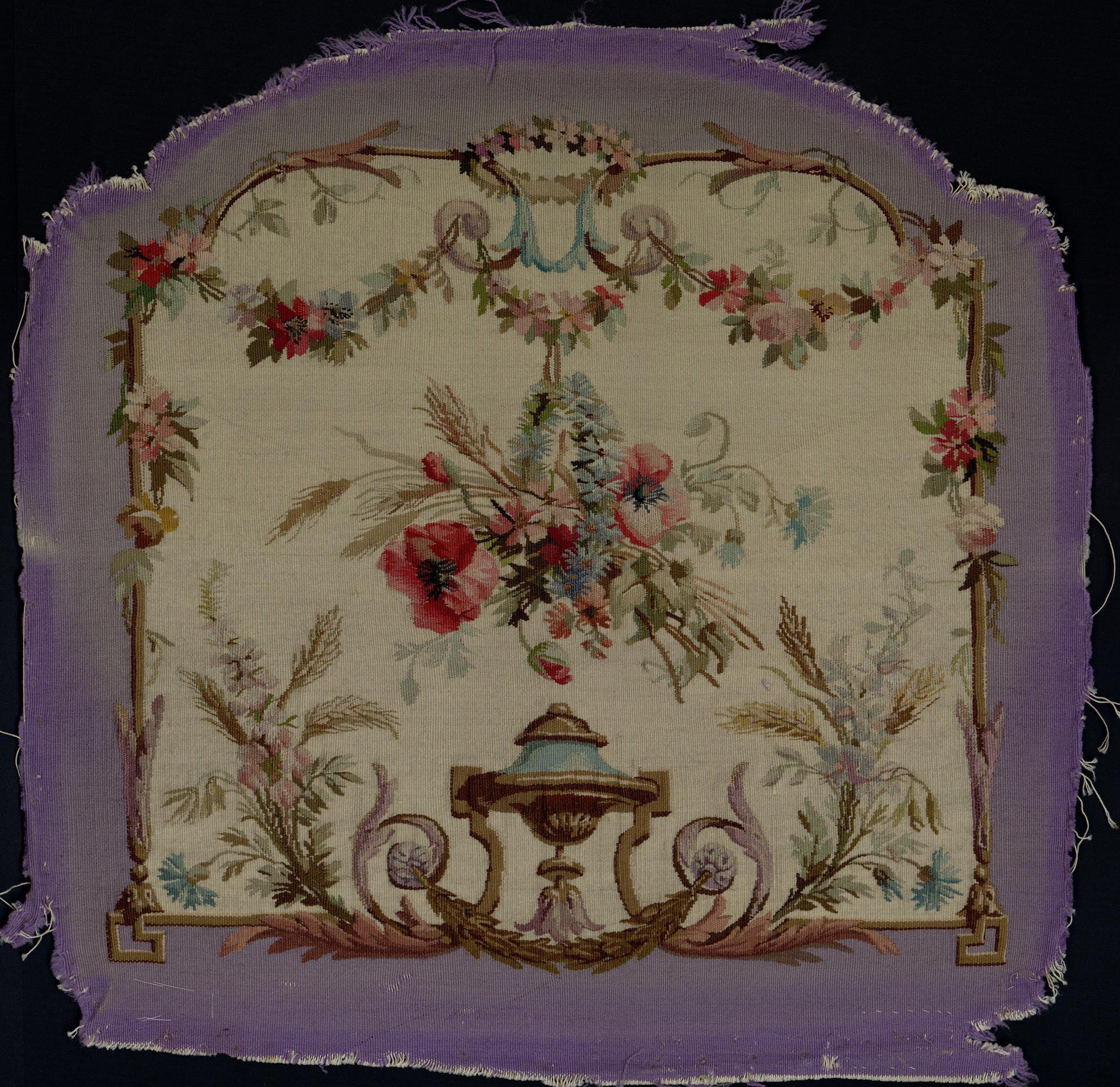
A tapestry cover for a chair back from the second half of the eighteenth century, in which a hanging bouquet of roses and poppies is mixed with cornflowers, wheat ears and meadow grasses.
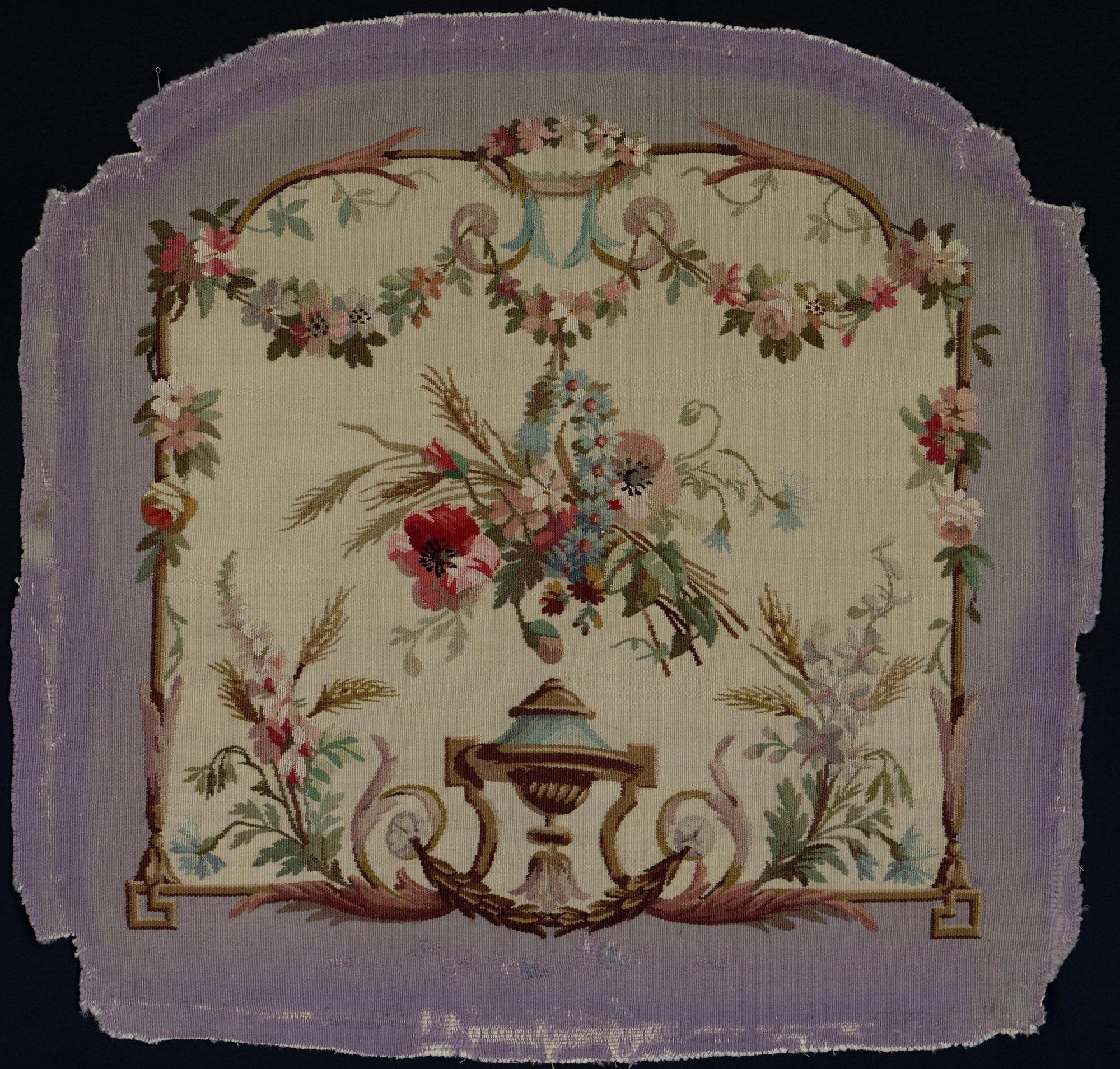
Tapestry: Upholstery for a Chair Back (T-15725). The State Hermitage Museum.
The cover comes from the collection of A. K. Rudanovsky and entered the Hermitage through the Department for the Protection of Monuments. It is not currently on permanent display.
Like its companions, it belongs to the suite of tapestry upholstery that includes a sofa seat, chair seats and several chair backs. The cream ground, the lilac border, the garlanded arch and the hanging bouquet are shared; what distinguishes this panel is the strong presence of field flowers — cornflowers, wheat and grasses — among the garden blooms.
The Object
The panel is approximately square, with a curved upper edge that follows the profile of the chair back.
An arch of flowers spans the top, dipping at the centre, where a small wreath is tied with a blue ribbon. Below it, a bouquet hangs downward: two large poppies with dark centres, roses and rosebuds in pink and crimson, and a crowd of small blue cornflowers scattered through the leaves.
At the bottom stands a small urn with a domed lid, framed by symmetrical scrolls. Sprays of cornflower and wheat rise from the lower corners on either side, giving the composition a broad base.
The border is lilac silk, as in the rest of the suite.
Cornflowers and Wheat
The cornflower, Centaurea cyanus, is a field weed that became one of the most popular flowers of eighteenth-century ornament.
It grows in cornfields, its blue flowers appearing among the stalks in summer, and it was associated with the countryside, with harvest and with simplicity. In decorative bouquets it provided a small, brilliant blue note that contrasted with the larger, warmer garden flowers.
The wheat ears in this panel carry a different set of associations. Wheat is the emblem of abundance, of the harvest and of the goddess Ceres; in ornament it signals plenty and the fertility of the land. Its form — a slender stalk with a serrated ear — also provides a useful linear element in a composition dominated by round blossoms.
The combination of cornflower and wheat is not accidental. Together they bring the field into the drawing room: a bouquet that includes both garden flowers and wild plants, arranged as if gathered in the same basket.
Blue in the Tapestry
Blue is the colour that holds this panel together.
The cornflowers, the ribbon, the small blossoms and the shadows of the leaves are all variations on the same range, from pale sky blue to a deep, almost violet tone. Against the cream ground and the warm reds and pinks of the roses, the blue reads as cool and slightly sharp.
In tapestry, blue was one of the most difficult colours to control. It came from indigo or woad, both of which produced deep, stable tones but required careful dyeing to achieve lighter shades. A pale blue could be made by using a weaker dye bath, but the result was often slightly grey, and the weaver had to compensate by placing it against warmer colours.
The blues in this panel have survived well. They are clear and slightly cool, and they give the composition a freshness that the reds, softened by time, have partly lost.
The Meadow in the Bouquet
The presence of field flowers changes the character of the bouquet.
A bouquet of roses and anemones alone would be a formal, garden arrangement. The addition of cornflowers, wheat and grasses makes it informal — a bunch gathered in the countryside rather than arranged in a hothouse. This shift toward the natural was part of a broader movement in eighteenth-century taste: the fashion for the pastoral, the rustic and the unforced.
The designer, however, is not aiming at realism. The flowers are still arranged symmetrically, the wheat is still drawn as ornament, and the composition is still governed by the scroll frame and the arch. The naturalism is a matter of suggestion, not of observation.
This balance between the natural and the ornamental is one of the achievements of the period. It allows a decorative object to feel fresh and unstudied while remaining strictly designed.
Wheat and Abundance
The wheat ears in the bouquet are the oldest symbol in the panel.
Wheat is the emblem of the harvest, of the earth’s fertility and of the goddess Ceres, and it has been used in European art since antiquity to signify abundance. In the eighteenth century it appears in allegories of the seasons, in the attributes of summer and in the ornament of rooms devoted to dining and entertainment.
In a bouquet on a chair back, the wheat is decorative rather than allegorical. But it carries a residue of meaning: it connects the flowers of the drawing room to the fields outside, and it gives the composition a note of plenty that a bouquet of roses alone would not have.
The Urn and the Scrolls
At the base of the panel, the small urn is framed by symmetrical scrolls that curl outward like handles.
The scroll is one of the fundamental units of eighteenth-century ornament. It comes from the volute of classical architecture and from the acanthus leaf of antiquity, and it was developed by Rococo designers into a vocabulary of curling, reversing and intertwining forms.
Here the scrolls perform a structural role. They give the urn a base, connect it to the sides of the panel and balance the arch above. Without them, the bottom of the design would be a single small object floating on the cream ground; with them, it becomes a frame within the frame.
The Wreath
At the top centre of the arch, a small wreath is tied with a blue ribbon.
The wreath is a condensed version of the garland: a circle of small flowers and leaves, bound with a ribbon whose ends hang down. It marks the centre of the composition and provides the point from which the bouquet appears to hang.
Wreaths were among the most ancient of festive ornaments, and in the eighteenth century they were still associated with celebration, victory and remembrance. In a domestic context they were simply decorative, but their form carried a residue of ceremony that made them appropriate for the most formal part of the chair.
Provenance
The cover carries the inventory number T-15725 and entered the Hermitage through the Department for the Protection of Monuments from the collection of A. K. Rudanovsky.
In the Hermitage
The cover is preserved in the State Hermitage Museum in Saint Petersburg and is not on permanent display.
Among the Rudanovsky tapestries it is one of the panels in which the floral design is most varied: garden and field, red and blue, formal frame and loose bouquet. It is a small object, but it contains a complete pictorial world — the eighteenth-century idea of nature, arranged for a chair.