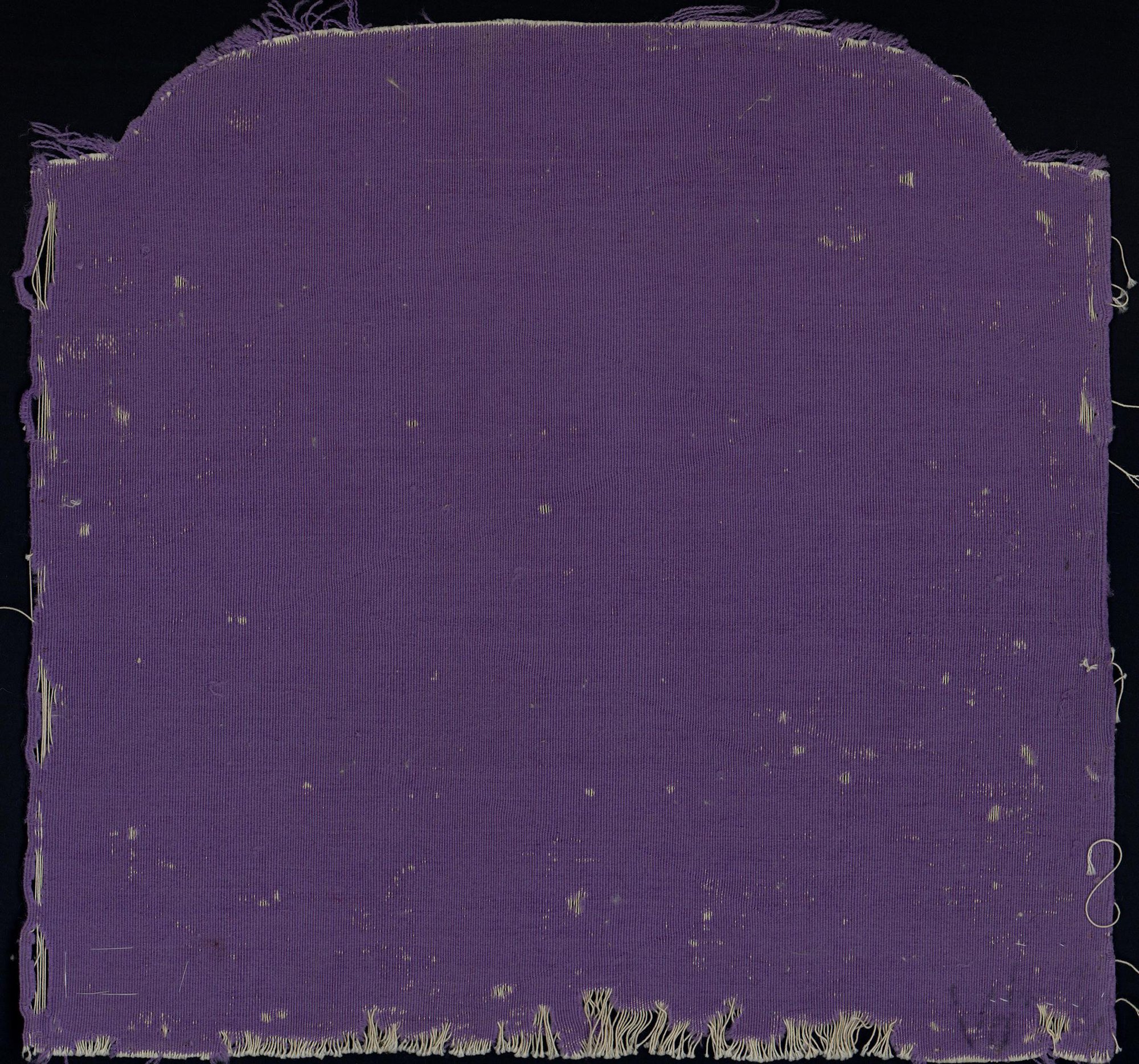
Origin: France, Aubusson
Date: second half of the 18th century
Material: wool, silk
Technique: tapestry weaving
Dimensions: height 50 cm; width 51 cm
Current Collection: The State Hermitage Museum
Inventory Number: T-15724
Hermitage ID: 488822
Rudanovsky Connection: Entered the Hermitage in 1919 from the collection of A. K. Rudanovsky.
A tapestry cover for a chair back from the second half of the eighteenth century, with a hanging bouquet above an urn, cut to the curved profile of the chair.
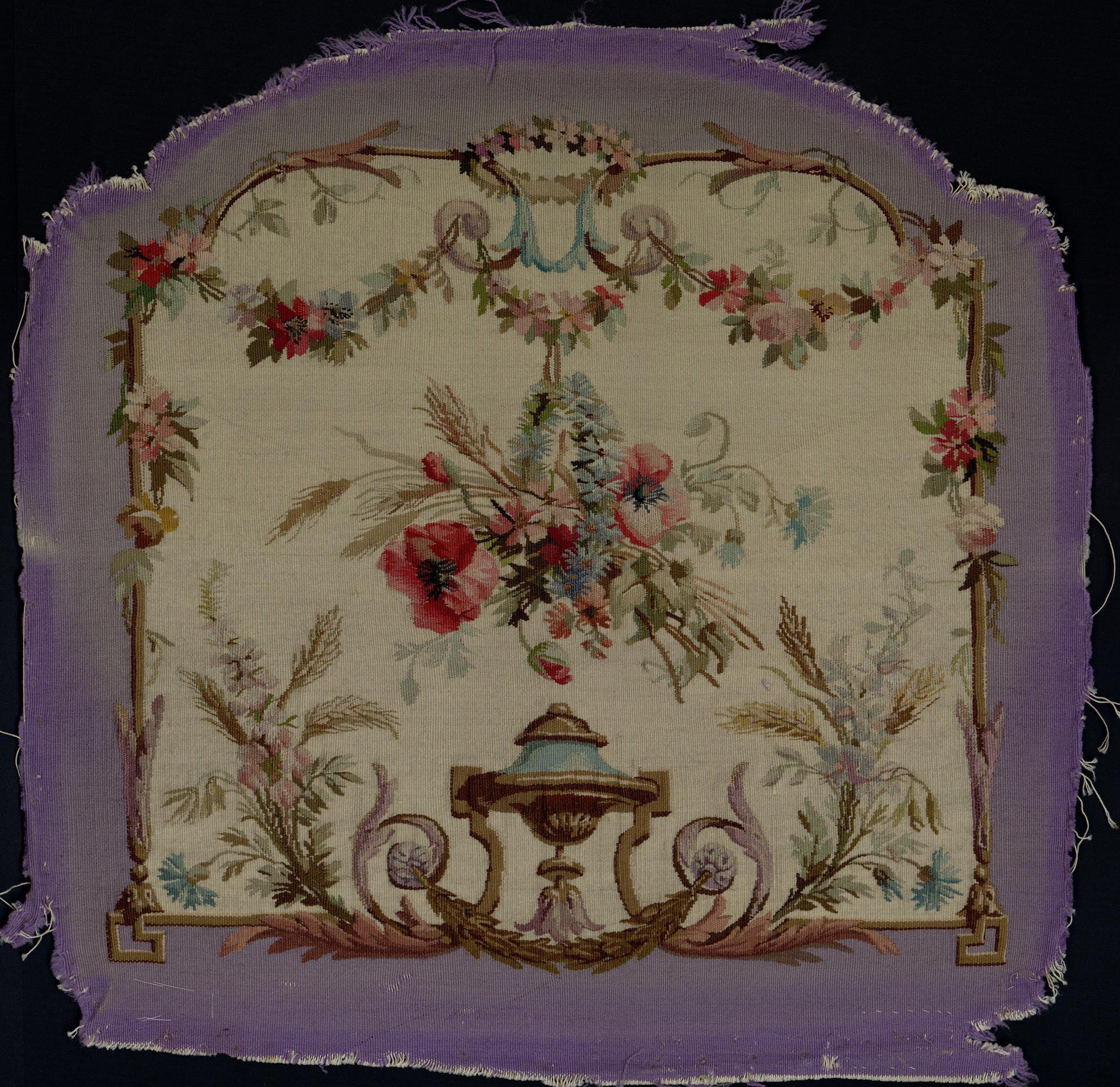
Tapestry: Upholstery for a Chair Back (T-15724). The State Hermitage Museum.
The cover comes from the collection of A. K. Rudanovsky and entered the Hermitage through the Department for the Protection of Monuments. It is not currently on permanent display.
It is one of several chair backs from the same suite, and it shares their design: a garlanded arch, a wreath with a blue ribbon, a hanging bouquet, an urn below, a lilac border. Its particular interest lies in its shape — in the way the woven panel has been cut and finished to fit a piece of furniture that no longer exists.
The Object
The field is cream, with the soft tonal variation of hand-dyed wool. The garland arch spans the top, dipping at the centre, and the wreath with its blue ribbon marks the middle of the arch.
The bouquet hangs beneath: poppies with dark centres, roses and rosebuds, cornflowers and sprays of wheat, trailing leaves and grasses. At the bottom, a small urn with a domed lid sits within a symmetrical frame of scrolls, and sprays of flowers rise from the lower corners.
The panel is bordered with lilac silk, and its upper edge is curved, following the shape of the chair back it was made for.
The Shape of the Panel
The curved top edge is the most eloquent detail of the object.
A tapestry panel is woven as a flat rectangle. If it is destined for a chair back, it must be cut to the profile of the frame — curved at the top, sometimes shaped at the shoulders, sometimes with a notch for the crest rail. The cut is made after weaving, and it is irreversible: once the tapestry is cut, the design cannot be extended or altered.
The shape of this panel tells us what kind of chair it covered. The curve is shallow and symmetrical, rising toward the centre and falling at the corners, a profile characteristic of the chairs of the Louis XV and Louis XVI periods.
The cut edges have been turned and stitched, and the lilac border conceals the seam. The result is an object that looks complete but is, in fact, a remnant: the woven rectangle has been trimmed to fit a frame that has disappeared.
Cutting and Mounting
In the eighteenth century, tapestry covers were mounted by upholsterers, not by weavers.
The upholsterer received the woven panel, measured it against the chair, cut it to shape and fixed it to the frame with tacks, cord and stitching. He added the border, the lining and any trimmings, and he was responsible for the final appearance of the chair.
This division of labour explains why so few covers survive in their original dimensions. The panel was never a finished object in itself; it was a material, and the upholsterer treated it as such.
The lilac border of this cover is part of that process. It may be original, added at the time of mounting, or it may be a later replacement. Either way, it is the work of an upholsterer adapting a woven image to a piece of furniture.
Wear and Repair
The condition of the panel records its use.
The cream ground is worn in the centre, where the back of the sitter pressed against the tapestry. The lilac border is frayed at the edges, and the stitching that holds it is visible in places. The colours are softened, especially the pinks and greens, which are more sensitive to light than the blues.
There are signs of repair as well: small darns, re-stitched edges, places where the weave has been consolidated. These interventions are part of the object’s history, not a departure from it. A textile that was used for two centuries was necessarily mended.
The Suite Dispersed
The panel belongs to a group of covers that were almost certainly made for a single room.
The inventory numbers — T-15718 for the sofa seat, T-15719, T-15720, T-15721 and T-15722 for the chair seats, T-15723, T-15724 and T-15725 for the chair backs — form a nearly continuous sequence, and the designs share a common vocabulary. It is reasonable to suppose that they were acquired together and that they came from the same house.
In the eighteenth century such a suite would have furnished a salon: a sofa, four or six chairs, perhaps a screen, all covered in the same tapestry and arranged around a fireplace or a table. The room would have had a unified colour scheme, and the tapestries would have been the largest and most expensive element in it.
Today the suite exists only as a set of panels, dispersed among museum storerooms. The frames, the room and the house are gone, and the covers are studied as textiles rather than used as furniture.
The Back and the Body
A chair back is designed around a person.
The sitter’s shoulders and head occupy the centre of the panel, and the design has to work around that presence. This is why the bouquet hangs from the top rather than rising from the bottom: the lower half of the panel is the part most covered by the body, and the designer leaves it relatively open.
The garland and the wreath sit at the top, where they remain visible above the sitter’s shoulders, and the urn at the bottom anchors a part of the design that is often hidden. The composition is therefore organised by the body, even though the body is absent from it.
This is a quiet kind of functional design, and it is easy to miss. The panel looks like a decorative bouquet; in fact it is a carefully calculated arrangement of visible and hidden zones.
What the Numbers Tell
The inventory numbers of the group are unusually informative.
T-15718 (sofa seat), T-15719, T-15720, T-15721 and T-15722 (chair seats), T-15723, T-15724 and T-15725 (chair backs) form a nearly continuous sequence. In museum registration, such a sequence usually means a single acquisition: a group of related objects registered together, numbered in order.
The numbers therefore support what the designs already suggest — that these panels came from one suite, made for one room, and entered the museum as a group. They also suggest that the suite was larger than the surviving pieces: the sequence is not complete, and some numbers are missing.
Reconstructing a dispersed suite from inventory numbers is one of the quieter forms of art-historical detective work. It requires patience, a good registrar’s book and an eye for the small variations that distinguish one panel from another.
Provenance
The cover carries the inventory number T-15724 and entered the Hermitage through the Department for the Protection of Monuments from the collection of A. K. Rudanovsky.
In the Hermitage
The cover is preserved in the State Hermitage Museum in Saint Petersburg and is not on permanent display.
It is an object at the end of a long life: woven in the eighteenth century, used in a house, cut and mounted, worn, mended, removed from its frame, collected, nationalised, transferred to a museum and stored. Each of those stages has left a trace, and the traces are as important as the design.