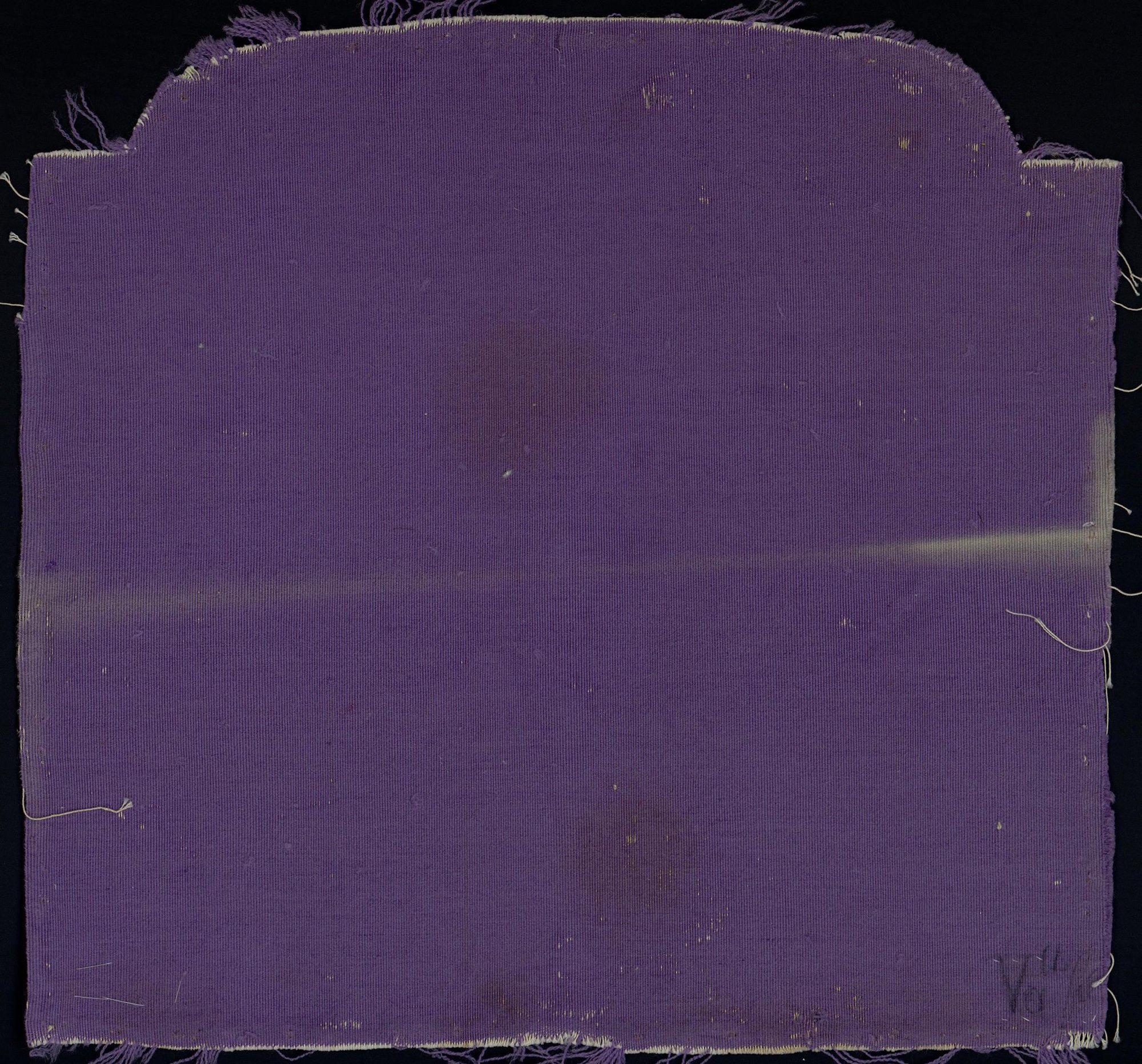
Origin: France, Aubusson
Date: second half of the 18th century
Material: wool, silk
Technique: tapestry weaving
Dimensions: height 44 cm; width 48 cm
Current Collection: The State Hermitage Museum
Inventory Number: T-15727
Hermitage ID: 488825
Rudanovsky Connection: Entered the Hermitage in 1919 from the collection of A. K. Rudanovsky.
A plain lilac silk panel shaped like the back of a chair — the undecorated side of an object that was never meant to be seen from behind.
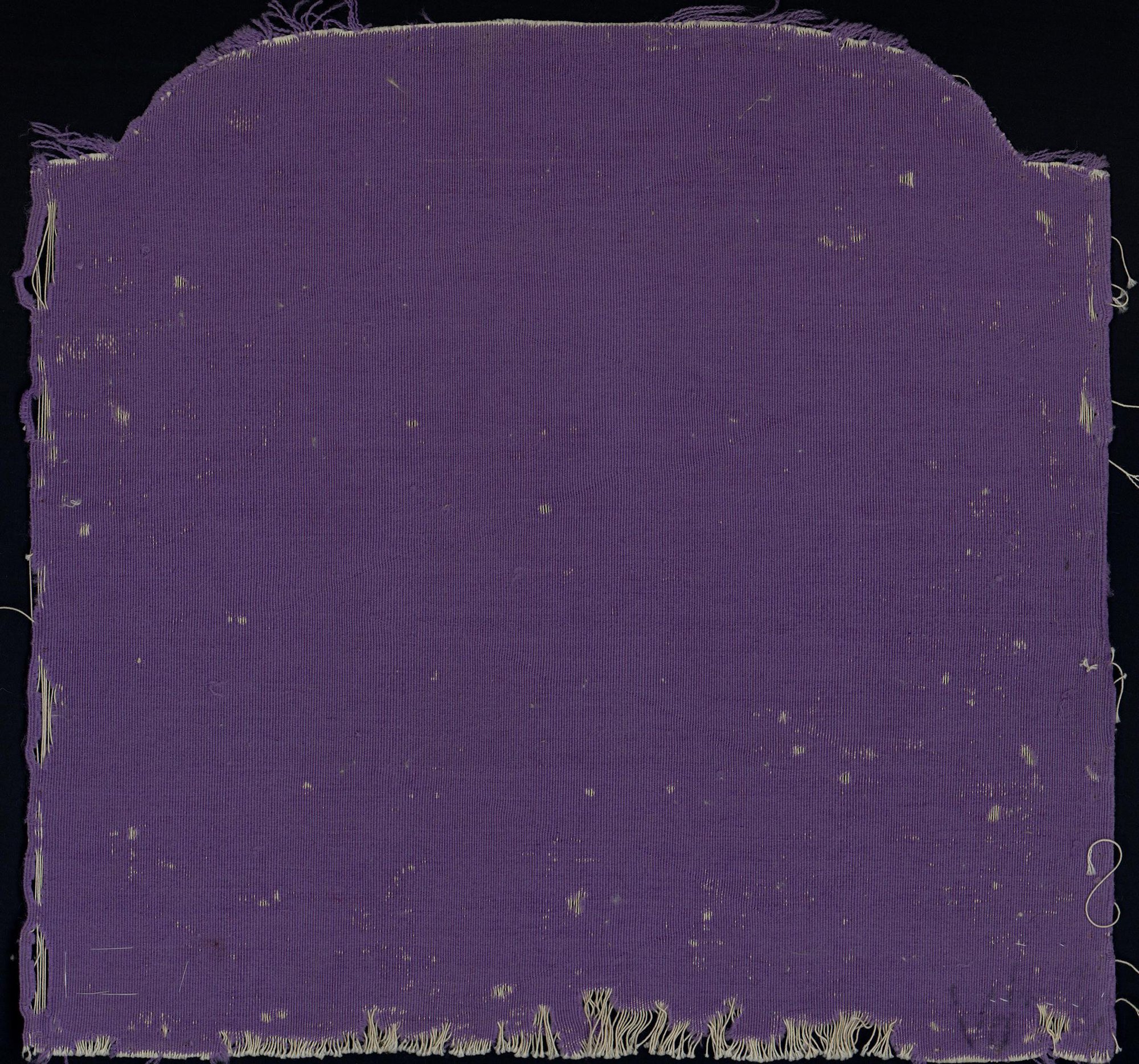
Tapestry: Upholstery for the Back of a Chair (T-15727). The State Hermitage Museum.
The panel comes from the collection of A. K. Rudanovsky and entered the Hermitage through the Department for the Protection of Monuments. It is not currently on permanent display.
There is no picture on it. No bouquet, no garland, no scrollwork — only a sheet of lilac silk, cut into a shape with a curved top and shoulders, with frayed edges and a few loose threads.
The Object
The panel is almost square, a little wider than it is tall, and its outline follows the profile of a chair back: a shallow curve across the top, a step down at each shoulder, then straight sides.
The surface is a plain weave in lilac silk, with a fine, regular grain and a soft sheen that changes with the angle of the light. There are no woven figures, no embroidery, no printed pattern.
The edges are raw and frayed. Along the bottom, the warp threads hang loose in a fringe; along the top, the fabric has been cut and has begun to ravel. There are faint stains, a few creases and a scatter of small light marks where the surface has been rubbed.
Nothing on the surface tells us which chair it came from, or in what room it hung. The panel is anonymous, and its anonymity is part of what makes it typical: it is the kind of object that survives by accident, not by design.
Two Sides of a Chair Back
A chair back is a sandwich.
On the front, facing the room, is the decorative cover — in this suite, a tapestry with a hanging bouquet above an urn. Behind it is padding: horsehair, wool, sometimes a layer of linen. Behind that is the wooden frame. And on the back, facing the wall, is a plain lining: a sheet of silk, linen or cotton, stitched to the frame to close the sandwich and hide its contents.
The lining is the least considered part of the object and the most revealing. It shows how the upholsterer worked: where the fabric was cut, how it was stretched, where it was tacked and stitched. It also shows what the maker thought was worth spending money on. The face of the chair was tapestry; the back was plain silk.
The Lining
Linings were made of whatever was appropriate to the quality of the piece.
On ordinary furniture they were linen or a cheap worsted. On expensive chairs they could be silk, as here, in a colour chosen to harmonise with the face. Lilac was a fashionable colour in the second half of the eighteenth century, and it appears in the borders of the tapestry covers of this same suite.
The function of the lining was practical: to protect the padding, to keep the dust out, to give the back of the chair a clean finish. But it was also aesthetic. A chair is seen from behind as well as from the front, especially in a room where furniture stands away from the wall, and the back had to look deliberate.
What the Reverse Reveals
The plain side is a record of work.
The shape of the panel shows where the upholsterer cut the silk to fit the frame. The seams show where pieces were joined. The fraying shows how the fabric was stressed in use, and the stains show what happened to it over two centuries.
There are also traces of stitching: rows of small holes where the lining was attached, and in places the remains of the thread. These are the marks of a craft that leaves few monuments. The upholsterer is invisible in the finished chair; the reverse of the lining is where his hand can still be seen.
The Colour
Lilac is an unusual choice for a lining, and it is worth pausing on.
In the eighteenth century, purple and lilac were associated with luxury and with the fashionable interior. They were difficult colours to dye consistently, and they faded in light. A lilac lining was therefore a small statement of quality: a colour that only the front of the chair was supposed to show, used on the side that faced the wall.
The colour has survived as a soft, slightly greyish violet. It is not the bright lilac of a modern textile; it is the colour of old silk, muted by time and by the natural yellowing of the fibre.
The Frame Beneath
Behind the lining is the frame.
Chair frames were made of beech or walnut, joined with mortise and tenon, and shaped with a plane and a chisel. The back was usually a separate frame, tenoned into the seat rails, and its profile — the curve, the shoulders — dictated the shape of both the tapestry and the lining.
Over the frame went webbing: strips of strong linen stretched in a lattice to support the padding. Over the webbing came the stuffing, and over the stuffing the cover. The lining closed the assembly from behind.
None of this is visible in the panel. But the shape of the silk is a tracing of the frame, and the marks on its surface are the marks of the frame’s edges pressing through the fabric.
Why the Back Matters
The back of a chair is a social surface.
In a drawing room, furniture stands away from the walls; guests walk around it; a chair is seen from behind as often as from the front. The back of a chair therefore has to be finished, and the choice of a silk lining rather than a cheap linen is a statement about the quality of the piece.
It is also a statement about honesty. A well-made chair does not pretend that its back is its front; it gives the back a material of its own, appropriate to its lower status but still dignified. The lilac silk is that compromise: plain, inexpensive relative to tapestry, and perfectly adequate.
The Unseen Side
The history of furniture is usually written from the front.
Photographs show the carved crest, the tapestry seat, the gilded legs; the back is left in shadow or cropped out of the frame. This panel is a corrective. It reminds us that every chair has two faces, and that the one facing the wall is as carefully made as the one facing the room — even if the care is of a different kind: not the care of ornament but the care of construction.
Provenance
The panel carries the inventory number T-15727 and entered the Hermitage through the Department for the Protection of Monuments from the collection of A. K. Rudanovsky.
In the Hermitage
The panel is preserved in the State Hermitage Museum in Saint Petersburg and is not on permanent display.
It is one of the objects that make a museum collection more than a gallery. The face of the chair is in another panel, with its flowers and garlands; this is the side that held the whole construction together — plain, strong and almost never photographed.