Origin: France
Date: second half of the 18th century
Material: wool, silk
Technique: tapestry weaving
Dimensions: height 78 cm; width 70 cm
Current Collection: The State Hermitage Museum
Inventory Number: T-15719
Hermitage ID: 488817
Rudanovsky Connection: Entered the Hermitage in 1919 from the collection of A. K. Rudanovsky.
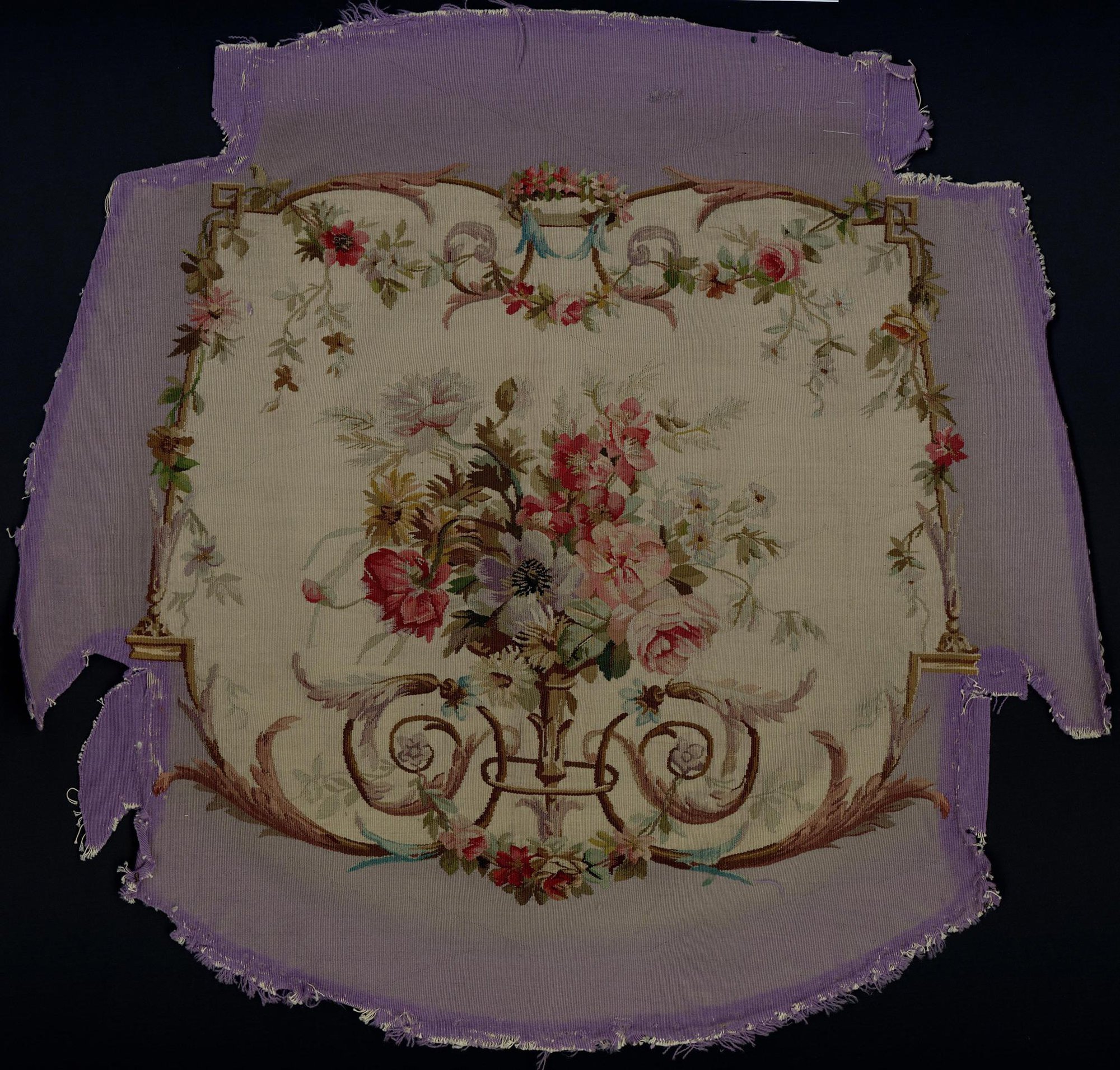
A tapestry cover for a chair seat, woven in the second half of the eighteenth century, with a central bouquet of tulips and roses enclosed in a scrolling border of flowers.
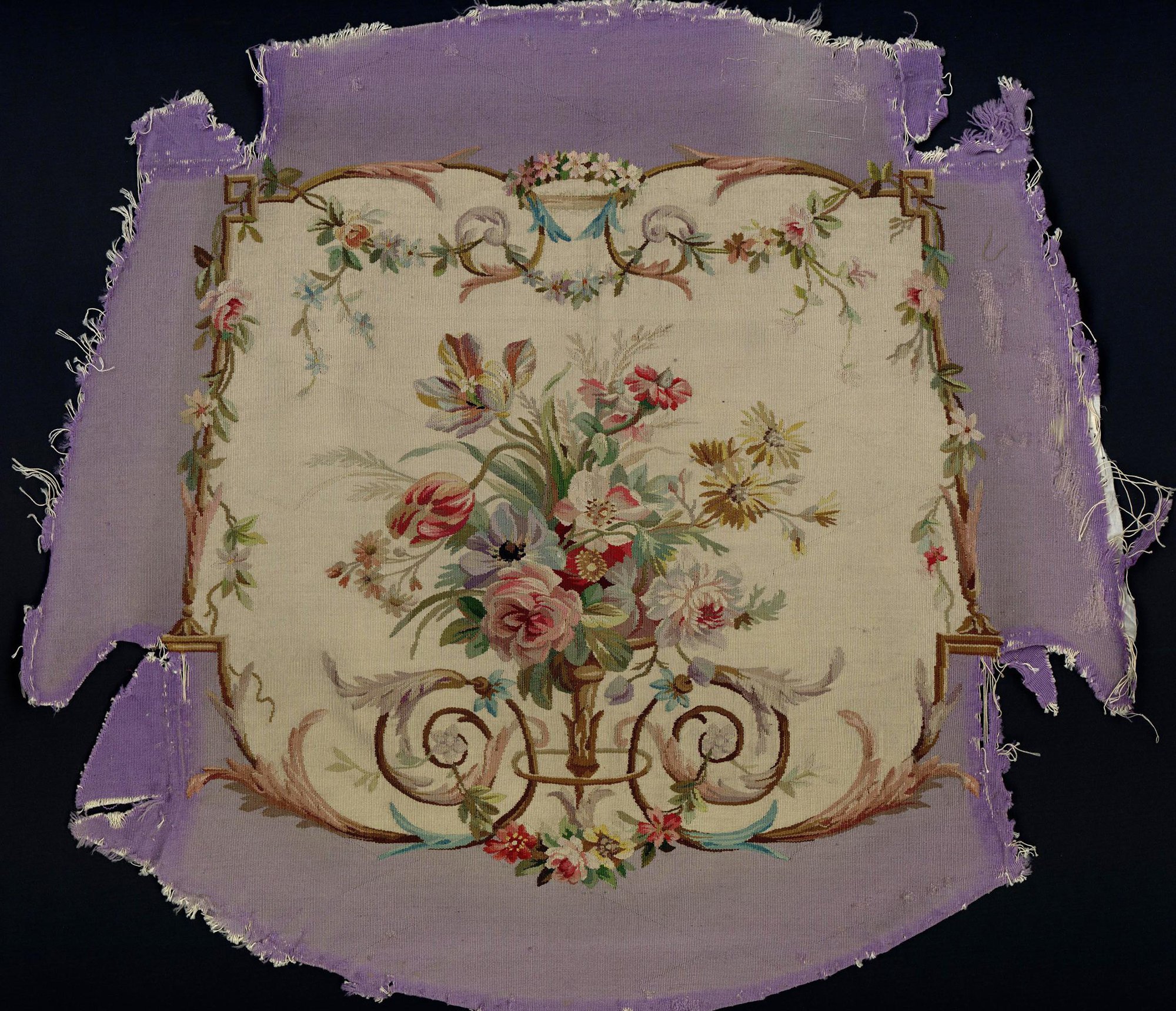
Tapestry: Upholstery for a Chair Seat (T-15719). The State Hermitage Museum.
The cover comes from the collection of A. K. Rudanovsky and entered the Hermitage through the Department for the Protection of Monuments. It is not currently on permanent display.
It is one of several related covers in the collection: a sofa seat and a group of chair seats, all with the same cream ground, the same floral vocabulary and the same scrolling framework. Together they reconstruct, piece by piece, the upholstery of a single eighteenth-century room.
The Object
The woven field is cream, with the pale, slightly uneven tone of undyed or lightly dyed wool. In the centre stands a bouquet: a striped tulip leaning to the left, roses and rosebuds in the middle, a pale blue flower with a dark centre, daisies, small blossoms and long, feathery leaves.
The bouquet is enclosed in a frame of gilt-coloured scrolls that curl outward at the base, forming a kind of cartouche. Above, a garland of roses and small flowers runs along the upper edge, dipping in the middle and rising at the corners. At the top centre sits a small wreath tied with a blue ribbon.
Around the tapestry is a border of lilac silk, plain and slightly shiny, which frames the woven panel and separates it from the wooden frame of the chair.
The Chair
A chair seat is a small stage.
The cover was woven to fit the seat exactly, and its design had to work in a format that is seen from above, at an angle, and usually partly covered by the sitter. The bouquet is placed centrally so that it remains visible when the chair is in use, and the garland runs along the edge that the eye meets first.
Eighteenth-century chairs were designed as part of suites: a set of chairs, a sofa, sometimes a screen and a fire screen, all covered in the same tapestry. The covers were woven together, mounted together and used together, and their designs were varied just enough to avoid monotony.
The Bouquet
The flowers are chosen for their shapes rather than their botanical accuracy.
The tulip provides a strong vertical accent and a brilliant, broken colour. The roses provide mass and a soft, rounded silhouette. The blue flower — probably a convolvulus or a morning glory — provides a cool note in a warm palette. The daisies and small blossoms fill the gaps and give the composition its lightness.
This mixture is characteristic of the flower pieces of the second half of the eighteenth century. It is not a still life, arranged in a vase on a table, but a decorative bouquet, composed to fill a defined space and to be read as a pattern.
The colours are softly modulated: the reds move from crimson to pink, the greens from olive to a cool grey-green, and the whites are never pure but always tinted by their neighbours. This is the effect of tapestry weaving, where every transition of tone must be built from separate threads.
The Frame
The scrollwork that surrounds the bouquet is as important as the flowers.
It belongs to the vocabulary of the Rococo: asymmetrical curves, shell-like forms, tendrils that turn back on themselves. In tapestry upholstery the scroll frame performs a practical function as well as a decorative one. It defines the edge of the design, keeps the eye within the composition and provides a transition between the bouquet and the plain border.
The frame is woven in olive, gold and pale brown, with touches of blue and pink in the leaves. It is lighter than the bouquet, so that the flowers remain the centre of attention, but it gives the design its structure.
A Series, Not a Single Work
This cover is not an isolated object. It belongs to a series.
The Hermitage collection contains a sofa seat and several chair seats from the same suite, with inventory numbers close to one another: T-15718, T-15719, T-15721, T-15722. The numbers suggest a single acquisition, and the designs confirm it: the same cream ground, the same lilac border, the same repertory of flowers and scrolls, varied from piece to piece.
In the eighteenth century such a suite would have been commissioned as a whole. The weaver worked from a set of cartoons, adapting the design to the dimensions of each seat, and the upholsterer mounted the covers on frames made to match. The result was a room in which every chair was part of a single visual scheme.
The dispersal of such suites is one of the ordinary tragedies of the decorative arts. Chairs are re-covered, broken up, sold separately; the tapestry is cut away and survives as a panel without its furniture. What remains here is enough to reconstruct the scheme, but not the room.
The Garlands
Two garlands frame the composition.
The first runs along the top edge, dipping in the middle and rising at the corners, and it is tied at the centre with a small wreath and a blue ribbon. The second is implicit: the scroll frame around the bouquet curls into leaf forms that echo the garland above.
This doubling is characteristic of the style. The design is built on repetition with variation — the same motifs return at different scales, so that the eye is led around the composition rather than fixed on a single point.
The Wooden Frame
The tapestry was only the visible part of the chair.
Beneath it lay a wooden frame, carved and usually gilded, made by a menuisier. The frame gave the chair its structure and its silhouette: the curve of the back, the shape of the seat, the turn of the legs. The tapestry was stretched over the seat and fixed to the frame, and the two crafts — carving and weaving — were planned together.
Most of the frames have disappeared. Wood is more vulnerable than wool: it burns, it is broken up, it goes out of fashion. The survival of the covers without their frames is one of the reasons why tapestry upholstery is so often studied as a flat image rather than as part of a piece of furniture.
Upholstery and Wear
The condition of the cover tells its own story.
The surface is worn, the colours are softened, and the edges are frayed where the tapestry was attached to the frame. The lilac border has been folded and stitched, and in places the weave is exposed.
Wear in a tapestry is not random. It concentrates where the body touches the fabric, where the frame rubs against the edge, and where light falls most strongly. Conservators read these patterns as evidence of use, and they are as much a part of the object as its design.
Provenance
The cover carries the inventory number T-15719 and entered the Hermitage through the Department for the Protection of Monuments from the collection of A. K. Rudanovsky.
In the Hermitage
The cover is preserved in the State Hermitage Museum in Saint Petersburg and is not on permanent display.
Seen alone, it is a rectangle of woven flowers. Seen with its companions, it becomes part of a room: a suite of furniture, a scheme of colour, a way of living that has disappeared but can still be reconstructed from its surfaces.