Origin: France
Date: second half of the 18th century
Material: wool, silk
Technique: tapestry weaving
Dimensions: height 78 cm; width 70 cm
Current Collection: The State Hermitage Museum
Inventory Number: T-15721
Hermitage ID: 488819
Rudanovsky Connection: Entered the Hermitage in 1919 from the collection of A. K. Rudanovsky.
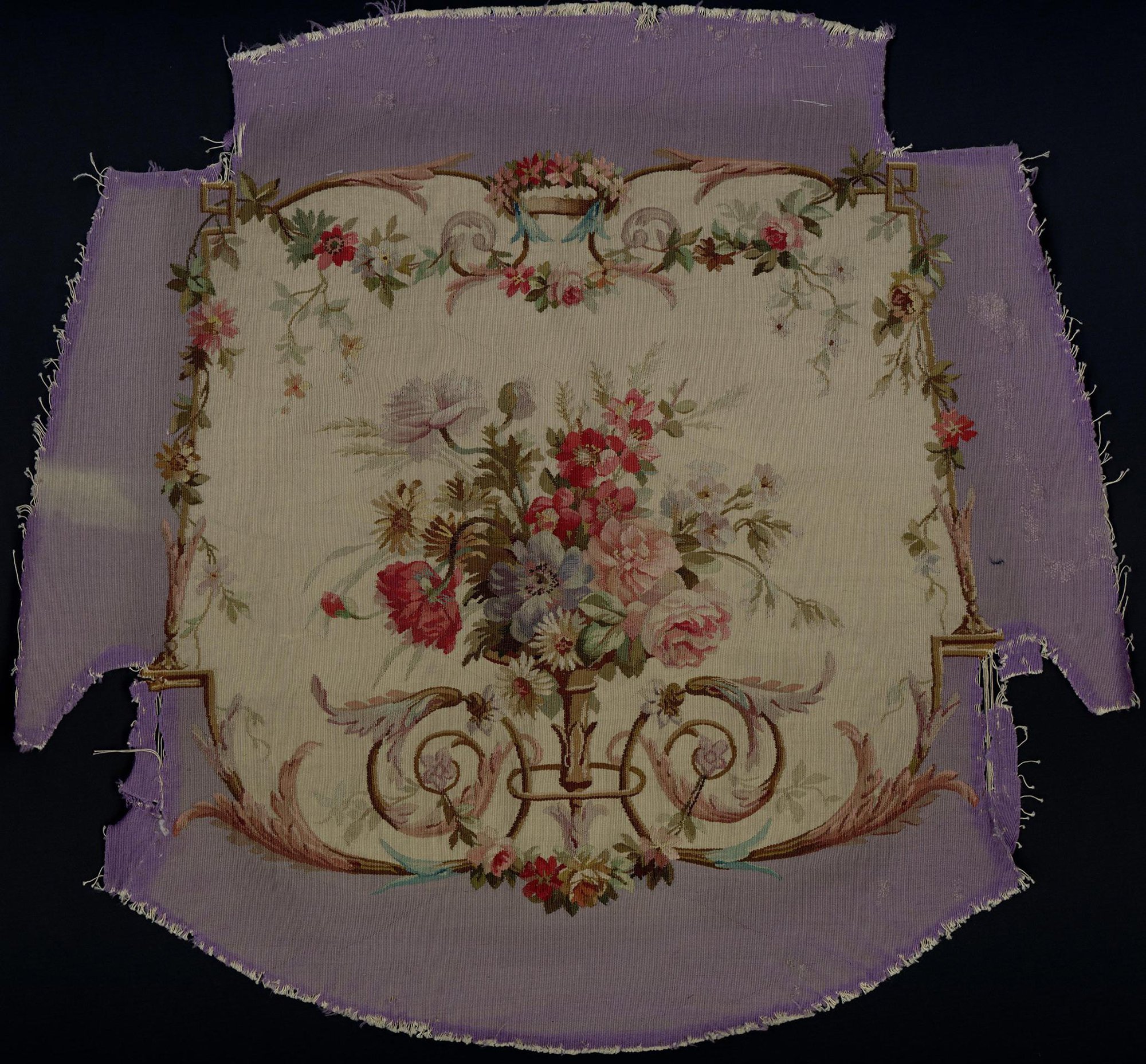
A tapestry cover for a chair seat from the second half of the eighteenth century, with a central bouquet of roses and anemones and a small wreath tied with a blue ribbon at the top.
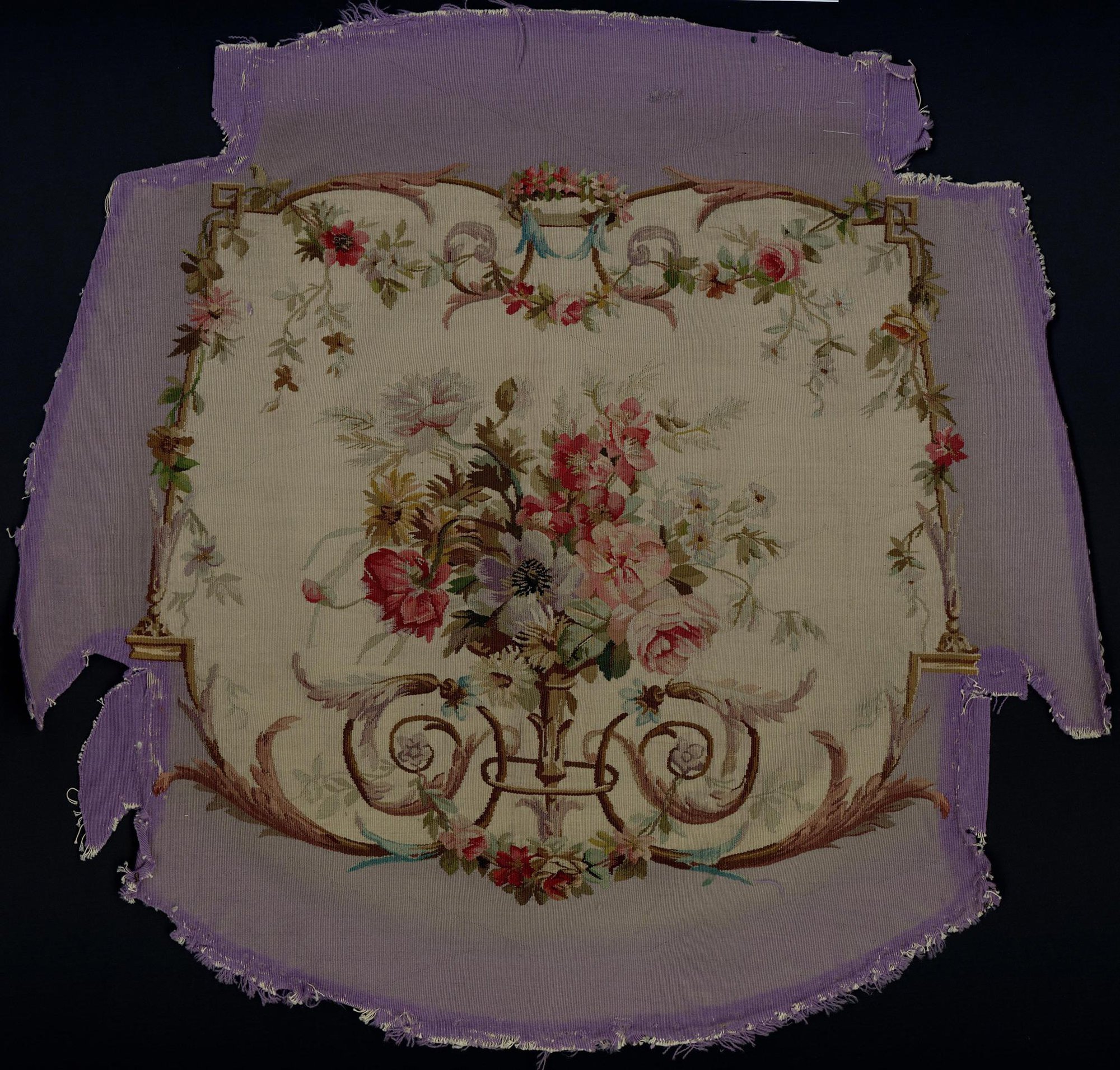
Tapestry: Upholstery for a Chair Seat (T-15721). The State Hermitage Museum.
The cover comes from the collection of A. K. Rudanovsky and entered the Hermitage through the Department for the Protection of Monuments. It is not currently on permanent display.
It is closely related to two other chair covers in the same collection and to a sofa seat, all of them woven to the same recipe: a cream ground, a central bouquet inside a scroll frame, a garland along the top, a lilac border. The differences between them are small, and those small differences are the subject of this text.
The Object
The field is cream, softly shaded, with the irregular tone of hand-dyed wool. In the centre stands a bouquet of roses, anemones, daisies and small blossoms, rising from a scroll base of olive and gold.
The roses are the dominant note: full, rounded blooms in pink and crimson, with buds and half-open flowers among them. The anemones add a deeper red and a dark centre; the daisies lighten the composition with small white stars; the leaves curl and feather at the edges.
Above the bouquet, a garland runs along the upper edge, dipping in the middle. At the top centre, a small wreath of flowers is tied with a blue ribbon, whose tails hang down over the garland. The whole design is enclosed in a border of lilac silk.
The Wreath and the Ribbon
The wreath at the top is a small detail with a long history.
Wreaths of flowers were among the oldest festive ornaments of European art: they crowned statues, decorated doors, marked weddings and funerals, and served as the frames of Renaissance paintings. In eighteenth-century ornament the wreath became lighter and more playful, often tied with a ribbon and suspended as if by chance.
The blue ribbon in this design is a particularly eighteenth-century touch. It introduces a cool colour into a warm scheme, and it gives the wreath a pretext: the flowers are not growing but hanging, tied to the garland below. The ribbon is painted in two tones of blue, with a darker shadow where it turns, and its ends curl in the air.
Such details were the work of the designer rather than the weaver, but the weaver had to translate them into thread. A ribbon is a difficult form in tapestry: it has no texture of its own, and its folds must be described entirely by changes of tone.
Repetition and Variation
The existence of several almost identical covers raises the question of how eighteenth-century workshops thought about originality.
A suite of furniture required a consistent design, not a series of unique works. The customer wanted chairs that belonged together, and the workshop wanted a design that could be repeated efficiently. The solution was a common framework — garland, scrolls, border, palette — within which the central bouquet could vary.
The variations are not random. In this cover the bouquet is tighter and more vertical than in its companion; the anemones are more prominent, and the wreath is larger. The designer was adjusting the same scheme to different seats, keeping the family resemblance while avoiding exact repetition.
This is a different idea of authorship from the one that dominates painting. The tapestry designer works within a series; the value of the object lies partly in its conformity and partly in the small decisions that distinguish it.
The Weaver’s Palette
The colours of the cover are the colours of the eighteenth-century dye house.
Reds came from madder root, which gives a warm, slightly brownish red, and from cochineal, which gives a cooler crimson. Blues came from indigo, greens from a combination of yellow and blue dyes, yellows from weld and other plants. Each dye had its own behaviour: some were light-fast, some faded, some changed tone with the mordant used to fix them.
A tapestry weaver worked from a fixed set of dyed wools and silks, numbered and arranged in a palette. The subtle transitions in the roses — from deep crimson at the heart to pale pink at the edge — were made by selecting threads from this palette, not by mixing colours.
This is why tapestry has a particular quality of light. The colours do not blend optically as paint does; they sit side by side, and the eye combines them at a distance. The result is a surface that seems to vibrate, especially in the pinks and greens.
Aubusson in the Late Eighteenth Century
By the second half of the eighteenth century, Aubusson was producing on an almost industrial scale.
The town supplied furnishing tapestries to much of Europe: complete suites for salons, wall panels, screens, bed hangings. Its workshops were numerous and its designs were adapted to the taste of the market — lighter, more floral, more intimate than the grand mythological tapestries of the previous century.
The last decades of the century brought difficulties. The French Revolution disrupted patronage and trade, and the fashion for printed cottons offered a cheaper alternative to woven furnishings. Many workshops closed, and the industry that survived into the nineteenth century was smaller and more commercial than the one that had flourished under the monarchy.
The covers in the Hermitage belong to the confident period, before those disruptions. They are the product of a mature industry that knew exactly what its customers wanted.
The Border
The lilac silk border is a small but significant element.
In tapestry, the border is the frame: it separates the woven image from its architectural setting and gives the composition a limit. Eighteenth-century borders were often elaborate, with cartouches, trophies and scrolling ornament. This one is plain, and its plainness is deliberate — it allows the bouquet and garland to carry the whole design.
The colour is unusual. Lilac and pale purple were fashionable in the later eighteenth century, and they appear in silk, porcelain and painted furniture of the period. Against the cream ground and the warm flowers, the lilac reads as a cool shadow, and it makes the tapestry appear brighter than it is.
What Survives
The cover survives without the chair it was made for, and without the room it furnished.
This is the ordinary condition of the decorative arts. Furniture is used until it breaks; textiles are cut away when they wear; rooms are redecorated. What remains is a fragment, and the fragment has to be read for what it can tell us: about design, about manufacture, about taste.
The value of such an object is not diminished by its fragmentary state. It is simply a different kind of value — the value of evidence as well as the value of beauty.
Provenance
The cover carries the inventory number T-15721 and entered the Hermitage through the Department for the Protection of Monuments from the collection of A. K. Rudanovsky.
In the Hermitage
The cover is preserved in the State Hermitage Museum in Saint Petersburg and is not on permanent display.
Among the Rudanovsky textiles it represents a particular kind of object: not a masterpiece, not a unique work, but a well-made piece of furnishing that has survived because someone thought it worth keeping. Its interest lies precisely in that ordinariness — in what it tells us about how rooms were furnished, how suites were designed and how a modest object could carry the taste of an entire period.