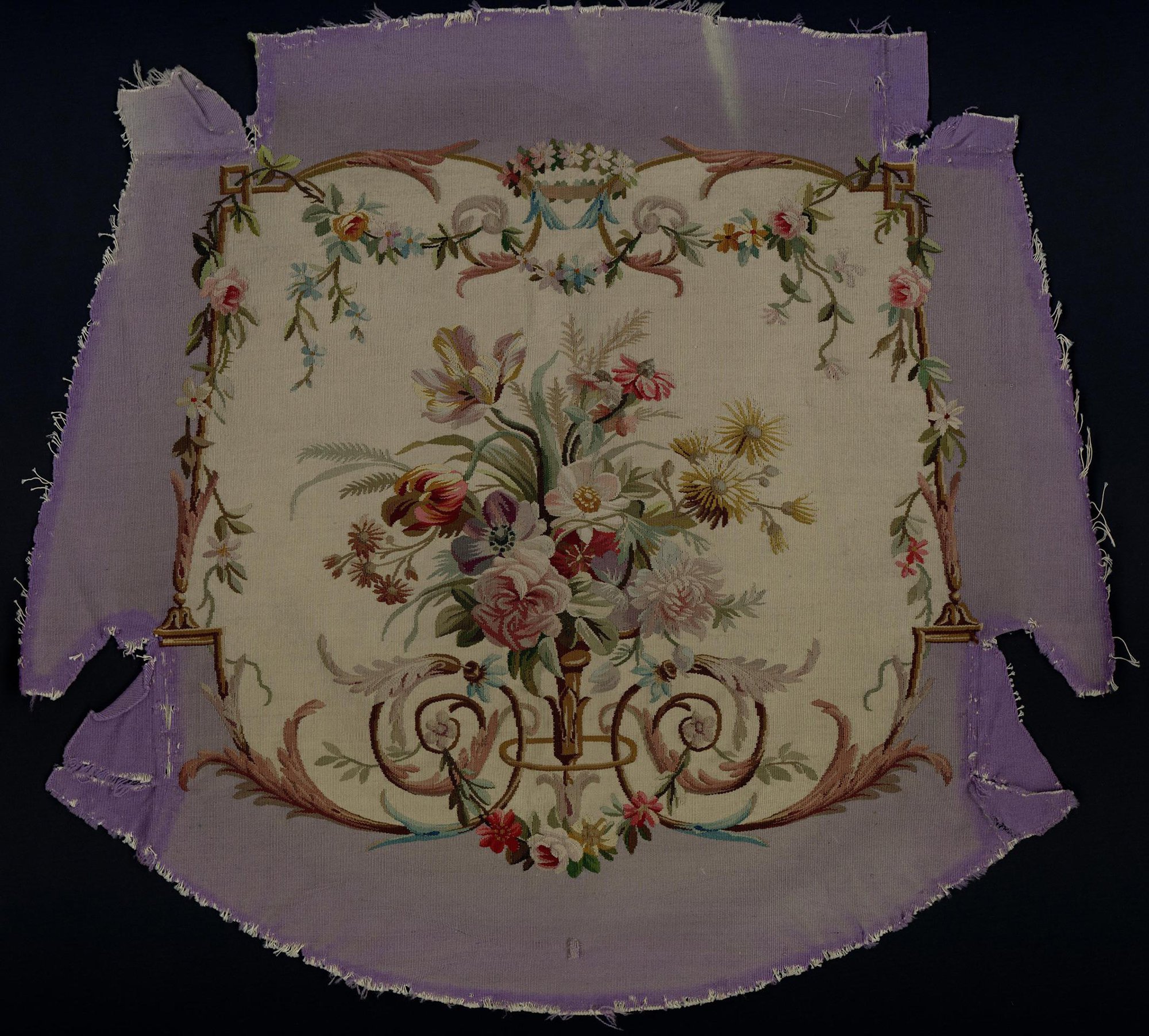
Origin: France, Aubusson
Date: second half of the 18th century
Material: wool, silk
Technique: tapestry weaving
Dimensions: height 78 cm; width 70 cm
Current Collection: The State Hermitage Museum
Inventory Number: T-15722
Hermitage ID: 488820
Rudanovsky Connection: Entered the Hermitage in 1919 from the collection of A. K. Rudanovsky.
A tapestry cover for a chair seat from the second half of the eighteenth century, with a central bouquet of poppies, roses and daisies on a cream ground, woven in Aubusson.
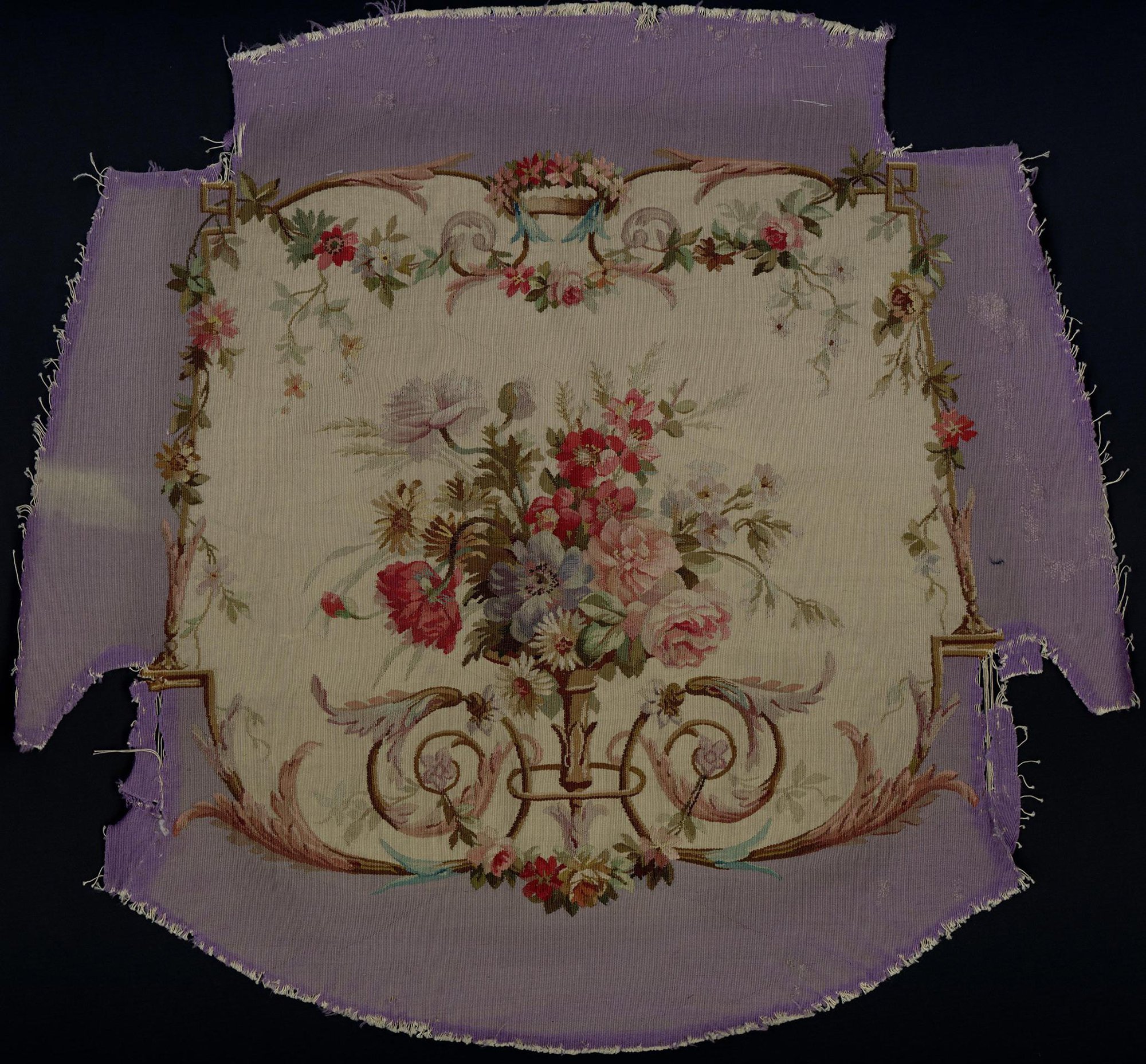
Tapestry: Upholstery for a Chair Seat (T-15722). The State Hermitage Museum.
The cover comes from the collection of A. K. Rudanovsky and entered the Hermitage through the Department for the Protection of Monuments. It is not currently on permanent display.
It is the fourth surviving cover of a suite that once furnished a single room: a sofa seat and at least three chair seats, all woven in the same style, all bordered in lilac silk, all built around a bouquet of garden flowers. The suite is dispersed, but its parts are close enough in design to be read together.
The Object
The field is cream, with a faint horizontal grain from the weave and a soft, uneven tone. In the centre, a bouquet rises from a base of gilt scrolls: a large pale poppy or anemone on the left, roses in pink and crimson in the middle, daisies, small blue flowers and feathery leaves.
The composition is framed by a scroll border of olive and gold, and above it a garland of roses and small blossoms runs along the top edge. At the centre of the garland is a small wreath tied with a blue ribbon. A border of lilac silk surrounds the tapestry.
The bouquet is less dense than in some of its companions. The flowers are spaced, the leaves are given room, and the cream ground shows through between the stems. This openness is characteristic of the later eighteenth-century floral style, where the bouquet is conceived as a light, airy arrangement rather than a solid mass.
A Bouquet of Species
The flowers in the cover belong to the standard repertory of the eighteenth-century decorative bouquet.
The large pale flower on the left, with its thin, crumpled petals, is probably a poppy or an anemone. Its colour is a soft, greyish pink, almost the tone of old silk, and its petals are described with long, curving stitches that follow their folds.
The roses are the anchor of the composition: full, rounded blooms in several stages of opening, from tight buds to wide, flat flowers. Their colour moves from deep crimson at the centre to pale pink at the edges, a transition made by selecting successive threads rather than by blending.
The daisies and small blue flowers provide contrast in scale and colour. They are the supporting cast of the bouquet, and they give it the lightness that distinguishes eighteenth-century floral design from the heavier, more formal flower pieces of the previous century.
The Cream Ground
The ground is as carefully designed as the flowers.
A cream or ivory field was a common choice for tapestry upholstery because it made the colours of the bouquet sing and because it suggested daylight. It also created a practical advantage: a light ground reflects the light in a room, whereas a dark one absorbs it.
But a cream ground is difficult to weave. Any irregularity in the tone is visible, and any dirt or wear shows immediately. The weaver had to maintain an even surface across the whole field, using wools that were close in tone but not identical, so that the ground would have life without spotting.
In this cover the ground has aged into a warm, slightly yellowish cream, with subtle variations that are partly the original dyeing and partly the effect of time.
Colour and Light
Tapestry is an art of reflected light.
The wool absorbs light and returns it softly; the silk catches it and returns it sharply. In a bouquet like this, the weaver uses silk for the highlights of the petals and wool for the shadows, so that the flowers seem to turn toward the viewer as the light changes.
The palette is restricted: reds, pinks, greens, blues, yellows and whites, each in several tones. The art lies in the transitions — the way a rose moves from crimson to pink, the way a leaf turns from olive to grey-green, the way a blue ribbon is described in two tones of blue and a shadow.
At a distance these transitions disappear into a single impression of colour. At close range they separate into hundreds of individual stitches, each one a decision.
The Suite and Its Numbers
The inventory numbers of the group — T-15718, T-15719, T-15721, T-15722 — are close enough to suggest that the covers entered the museum together.
They may have come from a single house, a single room or a single sale. The designs confirm the relationship: the same cream ground, the same lilac border, the same scroll frame and garland, the same repertory of flowers. The differences are those of adaptation rather than of authorship.
In the eighteenth century such a suite would have been commissioned as a whole and mounted on frames made to match. The covers would have been seen in use, on chairs arranged around a room, and their repetition would have created a rhythm of colour across the interior.
Today the suite exists only as a set of panels. The frames, the room and the house are gone, and the covers are studied as textiles rather than used as furniture. But the rhythm is still visible when they are seen together.
The Frame Around the Seat
A chair seat is a frame within a frame.
The tapestry is stretched over the seat, but the seat itself is enclosed by the carved wooden rail of the chair. In the eighteenth century that rail was often gilded, and the gold of the frame echoed the gold of the scrollwork woven into the tapestry.
The relationship between the woven frame and the carved frame was carefully considered. The tapestry designer left a plain border — here the lilac silk — so that the carved wood would not compete with the ornament. The result was a layered edge: wool, silk, gilding, wood.
Tapestry in a Museum
When a tapestry enters a museum, it changes its nature.
On a chair, it was a surface to be sat on, seen at an angle, touched. In a museum it becomes a flat image, hung or stored, examined under raking light. The colours that were designed for candlelight are now seen under electric light; the scale that was right for a room is now judged against a wall.
This change is not a loss, but it is a translation. The museum object allows us to see the weaving, the dyeing and the drawing in a way that the original setting never did. It also asks us to imagine the room that the object has lost.
Provenance
The cover carries the inventory number T-15722. It entered the Hermitage through the Department for the Protection of Monuments from the collection of A. K. Rudanovsky.
The provenance is typical of the collection’s textile group. The Rudanovsky interiors were dispersed after 1917, and their furnishings were distributed to museums according to material and quality. Tapestry covers, fragile and unfashionable, were often among the objects that survived precisely because they were not sold.
In the Hermitage
The cover is preserved in the State Hermitage Museum in Saint Petersburg and is not on permanent display.
It is an object that exists at the intersection of art and use. As a design, it is a carefully composed floral picture; as an object, it is a piece of upholstery that was sat upon, rubbed and worn. Both identities are present in the surface, and both are part of what makes it worth preserving.