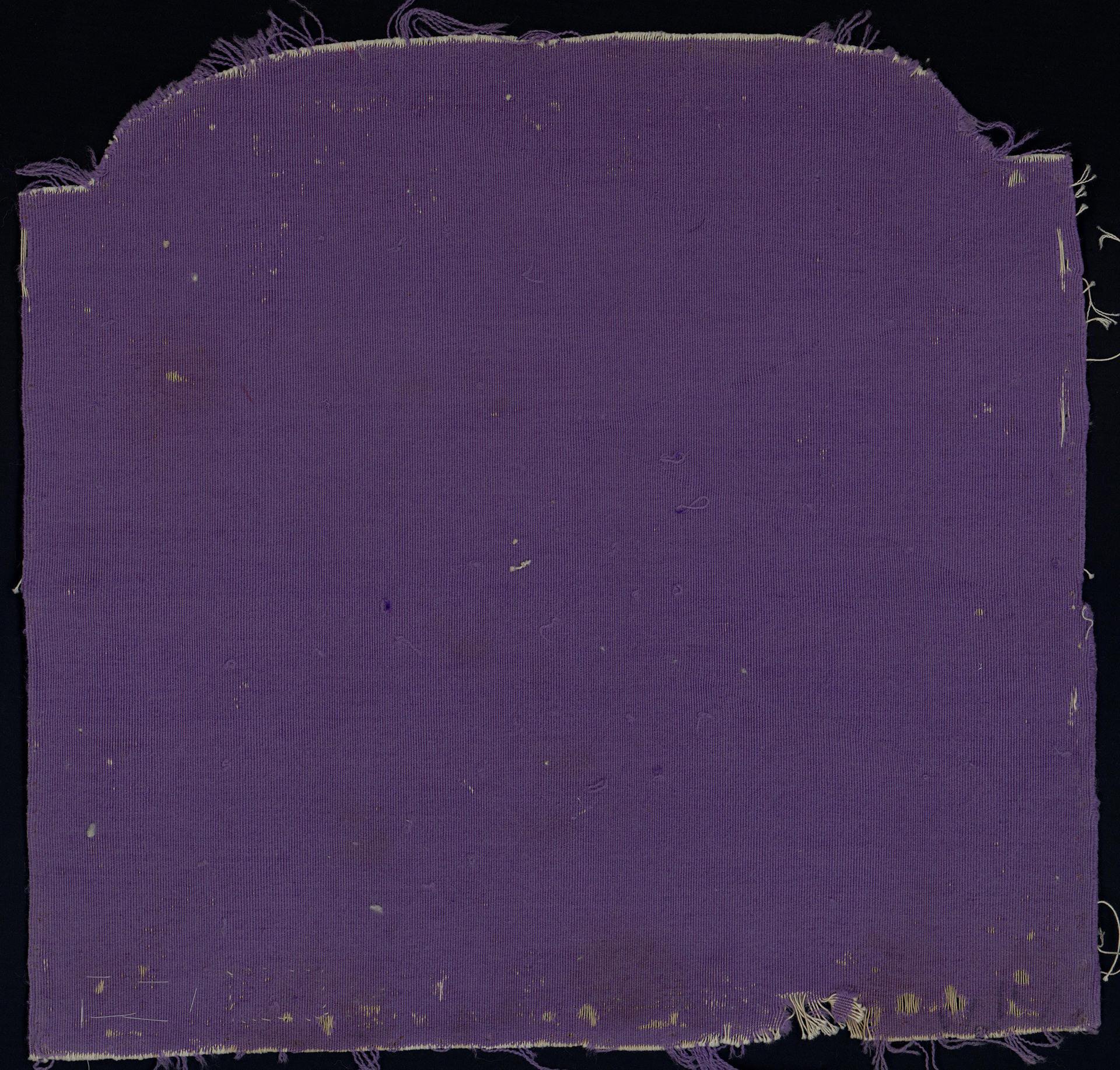
Origin: France, Aubusson
Date: second half of the 18th century
Material: wool, silk
Technique: tapestry weaving
Dimensions: height 44 cm; width 48 cm
Current Collection: The State Hermitage Museum
Inventory Number: T-15726
Hermitage ID: 488824
Rudanovsky Connection: Entered the Hermitage in 1919 from the collection of A. K. Rudanovsky.
A plain lilac silk panel cut and stitched for the back of an eighteenth-century chair, its edges frayed and its surface marked by use.
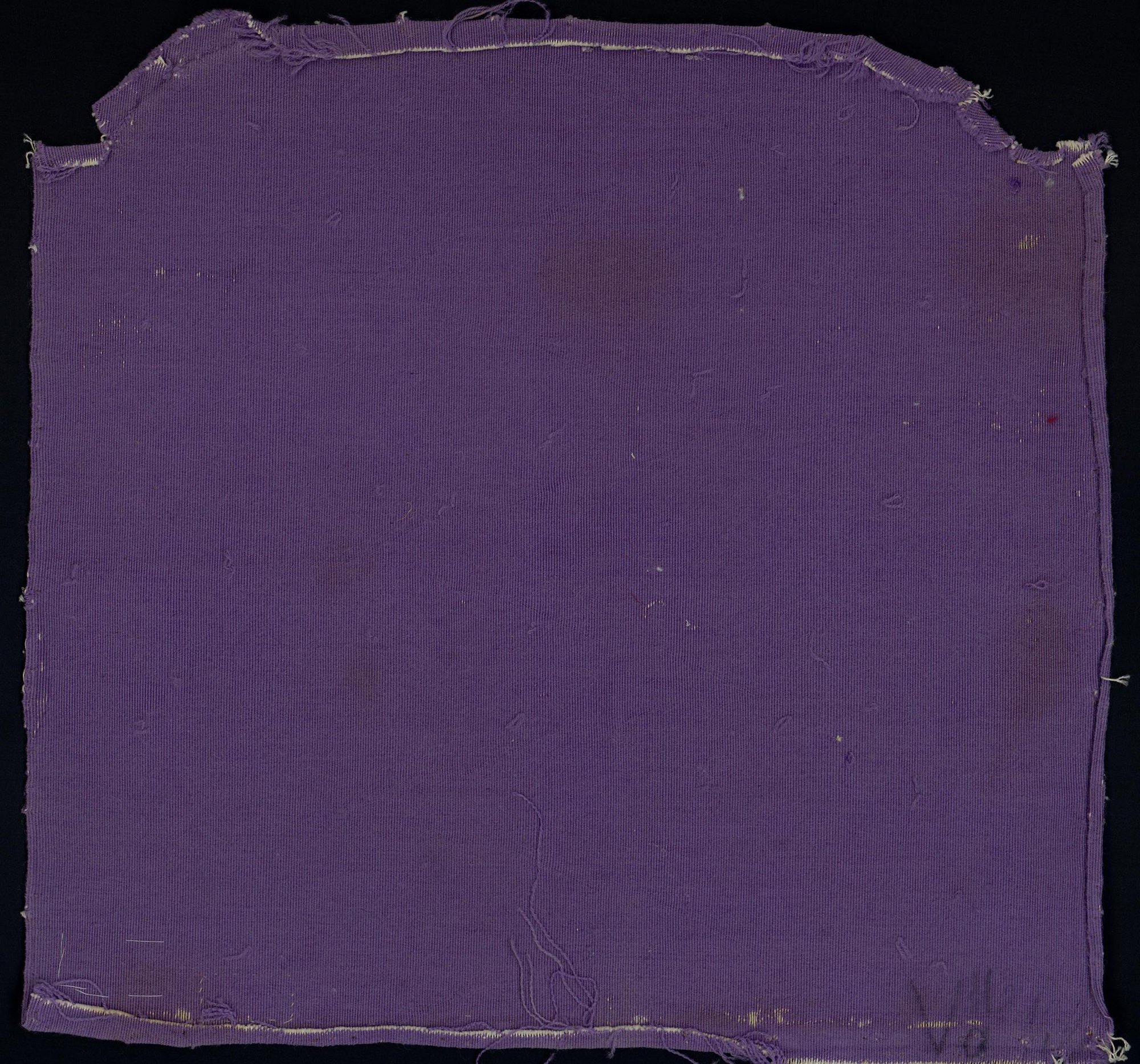
Tapestry: Upholstery for the Back of a Chair (T-15726). The State Hermitage Museum.
The panel comes from the collection of A. K. Rudanovsky and entered the Hermitage through the Department for the Protection of Monuments. It is not currently on permanent display.
It is the plain side of a chair back: a sheet of lilac silk, cut to the shape of the frame, hemmed and stitched. There is no decoration on it, and that is precisely what makes it interesting. It is a record of the upholsterer’s work rather than the weaver’s.
The Object
The panel is approximately square, with a curved top edge and stepped shoulders that follow the profile of a chair back. The silk is closely woven, with a fine grain and a soft sheen, and the colour is a muted lilac that shifts toward grey in the folds.
The edges are raw. Along the bottom, the warp threads have unravelled into a fringe; along the sides, the fabric has been cut and has begun to fray. There are creases, small stains and a few areas where the surface has worn thin.
The Cut
The first operation in making a chair back was the cut.
A length of silk was laid over the frame, marked and cut to shape: curved at the top, stepped at the shoulders, straight at the sides. The cut had to be accurate, because the fabric could not be stretched far without distorting the weave, and because the edges would be hidden under the frame’s moulding.
The shape of this panel is a record of that operation. The curve and the shoulders are the profile of the chair; the straight sides are where the fabric was carried around the frame. The panel is, in effect, a drawing of a piece of furniture made in cloth.
The cut was also a moment of risk. A mistake could ruin a length of silk that had already been woven, dyed and finished at considerable expense, and there was no way to undo it.
The Seams
Upholstery is a craft of seams.
The lining of a chair back was usually made from several pieces of fabric, joined to fit the shape and to use material economically. The seams were placed where they would be least visible: along the edges, under the frame, in the shadow of the crest rail.
On this panel the seams are visible as faint lines and slight ridges in the silk. They are not decorative; they are structural. They show how the upholsterer solved the problem of covering a three-dimensional form with a flat textile.
The Stitching
The panel was attached to the frame with stitches and tacks.
The stitching was done with linen or silk thread, in small, regular stitches along the edges. The tacks were driven into the wood, and the fabric was folded over them and stitched down to hide the metal.
The traces of this work survive as rows of small holes and, in places, as fragments of thread. They are the signature of the upholsterer, a craftsman whose name is almost never recorded but whose hand is present in every chair.
Wear
The wear on the panel is the wear of the back of a chair.
The centre is rubbed where the chair stood against a wall or was handled; the edges are worn where the fabric met the frame; the bottom is frayed where the silk hung free and caught on clothing.
There is also a horizontal band of discolouration across the middle, perhaps from a period of storage or from contact with the frame. Such marks are common in old textiles and are part of their history.
The Hidden Craft
Upholstery is one of the least visible of the decorative arts.
The weaver’s work is seen; the carver’s work is seen; the upholsterer’s work is mostly hidden under the fabric, behind the frame, beneath the seat. And yet the chair depends on it: without the lining, the padding would escape; without the stitching, the cover would slip; without the cut, the fabric would not fit.
This panel is a rare chance to see that hidden work. It is not a picture, but it is a document — of a craft, a technique and a way of making furniture that has almost entirely disappeared.
Tacks and Tools
The upholsterer’s toolkit was simple and has changed little in two centuries.
A hammer for tacks, a magnetic hammer for holding them, a skewer for stretching, a webbing stretcher, needles, waxed thread, scissors and a knife. The tacks were of iron or brass, with large flat heads; the thread was linen or silk, waxed to make it slide and hold.
The work was done on a trestle or a bench, with the frame held steady and the fabric stretched by hand. Every chair was assembled from the frame outward: webbing, stuffing, cover, lining. The order could not be reversed, and a mistake in the first stage would show in the last.
The Chair as a Machine
A chair is a machine for sitting, and its upholstery is its engine.
The frame carries the load; the webbing distributes it; the stuffing shapes it; the cover protects it; the lining hides it. Each layer has a function, and each depends on the others.
The genius of eighteenth-century chair-making lay in the fit between these layers. The frame was shaped to the body; the stuffing was built up to support it; the cover was cut to follow the frame; the lining closed the whole. The result was a piece of furniture that could be comfortable and beautiful at the same time.
This panel is the last layer of that machine. It is the part that closed the back, hid the stuffing and gave the chair its finished appearance from behind.
The Marks of Time
Every mark on the panel is a date.
The fraying at the bottom dates from the years when the silk hung free; the creases date from a period of folding; the stains date from storage or from the room. Conservators read these marks the way archaeologists read strata: as a sequence of events.
The panel is not simply worn; it is annotated by use. Each mark is evidence of a decision — to keep the chair, to re-cover it, to store the fabric, to preserve it.
Provenance
The panel carries the inventory number T-15726 and entered the Hermitage through the Department for the Protection of Monuments from the collection of A. K. Rudanovsky.
In the Hermitage
The panel is preserved in the State Hermitage Museum in Saint Petersburg and is not on permanent display.
Museums usually photograph the front of an object. This panel survives as a photograph of the back — the side that faced the wall, the side that no visitor was meant to see. It is a useful corrective to the way we look at furniture: the chair, after all, is a construction as well as an image.