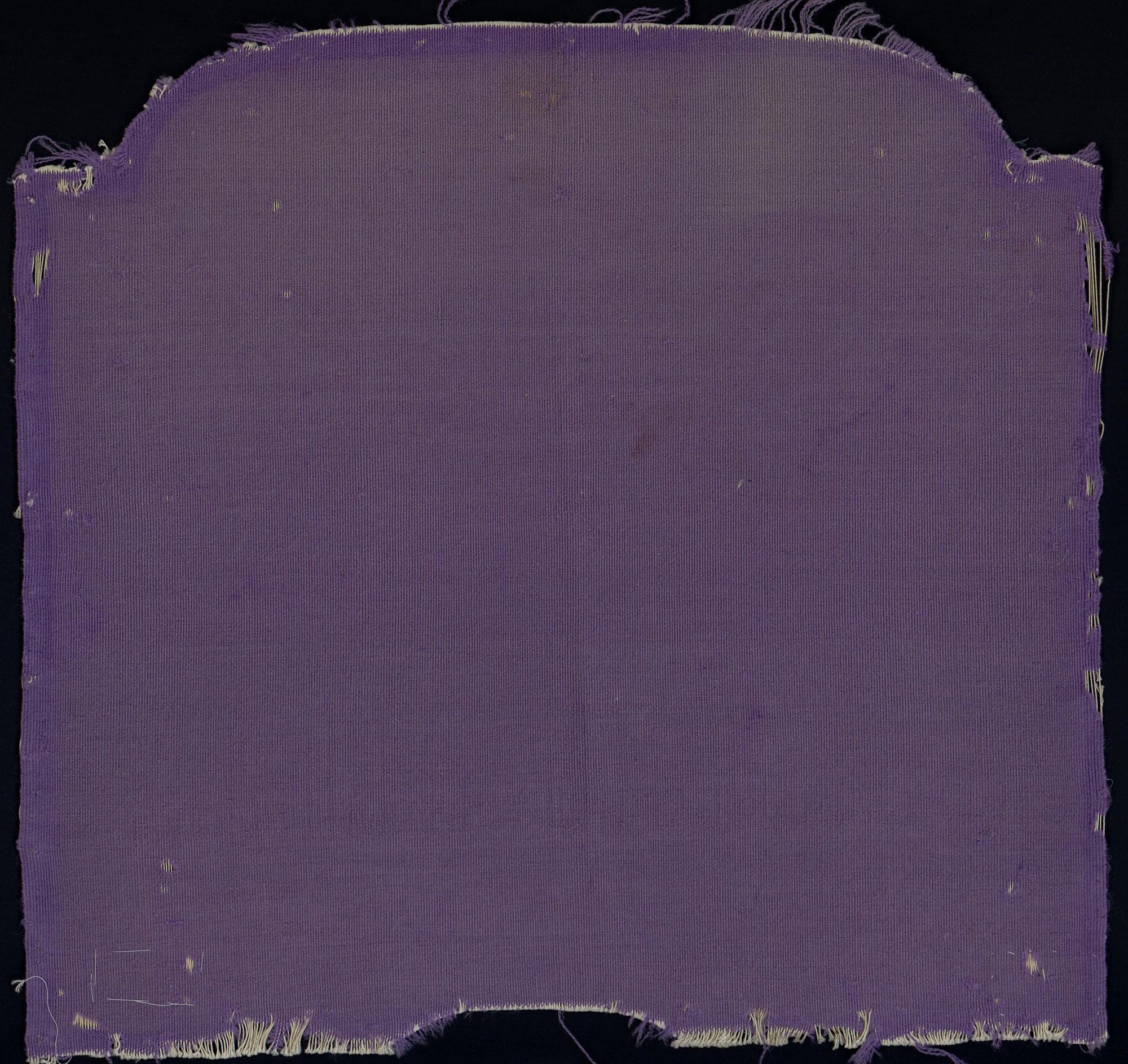
Origin: France, Aubusson
Date: second half of the 18th century
Material: wool, silk
Technique: tapestry weaving
Dimensions: height 44 cm; width 48 cm
Current Collection: The State Hermitage Museum
Inventory Number: T-15730
Hermitage ID: 488828
Rudanovsky Connection: Entered the Hermitage in 1919 from the collection of A. K. Rudanovsky.
A plain lilac silk panel for the back of a chair, preserved in the Hermitage as part of the Rudanovsky textile collection.
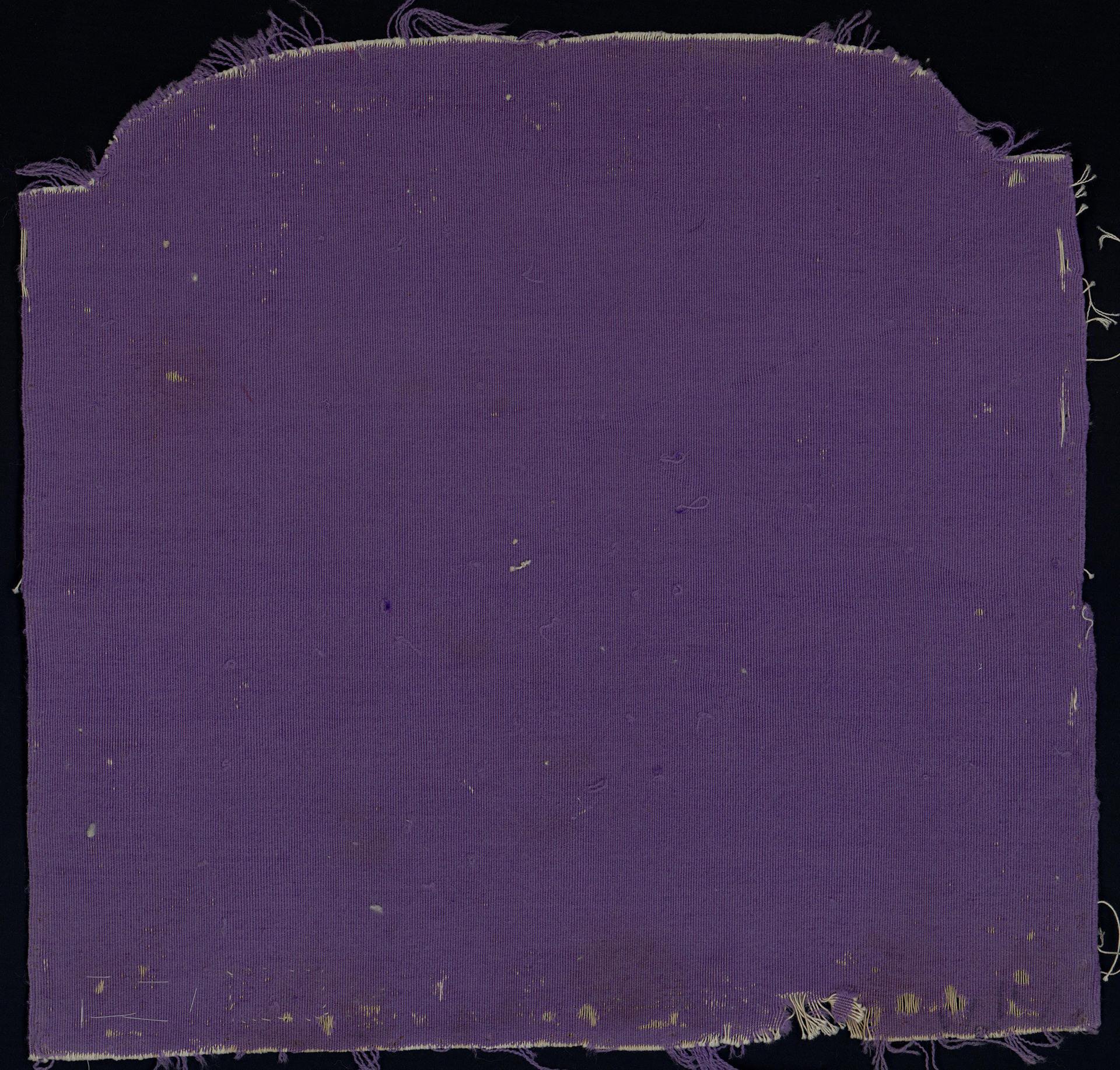
Tapestry: Upholstery for the Back of a Chair (T-15730). The State Hermitage Museum.
The panel comes from the collection of A. K. Rudanovsky and entered the Hermitage through the Department for the Protection of Monuments. It is not currently on permanent display.
Like its companions, it is plain: a sheet of lilac silk, shaped for a chair back, with no woven ornament. Its interest is partly material and partly documentary — it belongs to a group of panels that, taken together, allow us to reconstruct a whole suite of furniture.
The Object
The panel is nearly square, with a curved top edge and stepped shoulders. The silk is plain, closely woven and softly lustrous, and the colour is a faded lilac.
The edges are worn and frayed, and there are loose threads at the bottom where the warp has unravelled. The surface carries small marks and creases, and the colour is uneven, lighter in the centre and darker near the edges. The silk has the slightly stiff handle of old fabric, and its surface is marked by the pressure of the frame along the sides. The colour is not uniform: it shifts with the angle of the light, from a cool violet to a warmer mauve.
The Group
The panel is one of a series.
The inventory numbers T-15726, T-15727, T-15728, T-15729 and T-15730 belong to five plain silk panels of the same size and shape, all for the backs of chairs. With them belong the tapestry covers T-15718 to T-15725: a sofa seat, chair seats and decorated chair backs.
The sequence is almost continuous. In museum registration such a run of numbers usually indicates a single acquisition — a suite of furniture acquired together, registered in order, and later divided between the decorated faces and the plain backs.
The Suite Reconstructed
Taken together, the numbers describe a room.
A sofa with a tapestry seat, four or six chairs with tapestry seats and backs, and a set of plain silk linings for the backs. The furniture would have been arranged around a fireplace or a table, covered in matching tapestry, and finished on the reverse with lilac silk.
This is the kind of reconstruction that textile collections make possible. The objects themselves are fragments; the numbers and the measurements allow the fragments to be assembled into a scheme.
The Photograph
The panel is known to us mainly through a photograph of its plain side.
Museum photography usually concentrates on the face of an object — the side with the design, the side that will be reproduced in catalogues. A photograph of the reverse is a different kind of document: it records the construction, the lining and the marks of use that the front conceals.
In this case the reverse is the whole object. There is no decorated face to photograph; the plain silk is the panel. The photograph is therefore not a record of the back of something else but a portrait of the object itself.
Storage and Survival
Textiles survive by being protected.
Light, dust, insects and handling are the enemies of silk, and most museum textiles spend the greater part of their lives in storage: wrapped in acid-free tissue, laid flat in drawers, protected from light and from fluctuations of humidity.
The condition of this panel — faded, frayed, but structurally sound — suggests that it was protected for much of its life. It was probably removed from its chair early, perhaps when the furniture was re-covered, and kept as part of a group of textiles rather than used.
Textiles are among the most demanding of museum collections. They must be monitored for insects, kept at a stable humidity, protected from light and handled with gloves; even then, they change slowly, the silk weakening and the dyes shifting with every decade.
The Colour Again
The lilac has faded to a colour that is difficult to name: grey-violet, dusty mauve, the colour of old paper in shadow.
It is a reminder that the colours of the eighteenth century were not fixed. They were dyes, and dyes change. The bright lilac of a new lining, seen in candlelight, would have been a different colour altogether from the muted tone that survives today.
Cataloguing Textiles
A museum record for a textile is a compressed history.
The entry for this panel gives the place of manufacture, the date, the materials, the technique, the dimensions, the inventory number and the provenance. Each of these is a decision: what to call the object, how to describe its technique, which measurements to take, how to date it.
«Tapestry weaving» is the technique recorded, although the visible side is plain silk. The record describes the object as part of a tapestry suite, and the technical term refers to the group rather than to the surface we see. Cataloguing textiles often involves this kind of negotiation between the object and its context.
The dimensions — 44 by 48 centimetres — are the dimensions of the panel as it survives, not of the chair it covered. Measurements of textiles are always measurements of a fragment.
Fragments and Wholes
A collection of fragments is not the same thing as a collection of objects.
The Rudanovsky textiles survive as panels: seats without chairs, backs without frames, linings without their tapestries. Each is a fragment, and each fragment is complete in itself — a woven surface, a cut shape, a piece of silk.
The art of the textile curator lies in moving between the two scales: the fragment as an object, and the fragment as part of a whole. The inventory numbers, the dimensions and the designs allow the whole to be imagined; the condition, the materials and the marks of use keep the fragment concrete.
The Unseen in Art History
Art history has a bias toward the visible.
It studies what can be photographed, reproduced and compared, and it tends to ignore the parts of objects that were never meant to be seen. The backs of chairs, the linings of textiles, the undersides of tables: these are the shadow territories of the decorative arts.
They are not less carefully made, and they are often more informative, because they were not designed for display. A lining shows how a chair was built; a back shows what the maker thought was worth spending money on. The unseen side is where the craft leaves its evidence.
Provenance
The panel carries the inventory number T-15730 and entered the Hermitage through the Department for the Protection of Monuments from the collection of A. K. Rudanovsky.
In the Hermitage
The panel is preserved in the State Hermitage Museum in Saint Petersburg and is not on permanent display.
It is a modest object, and its value is not obvious at first sight. But it is part of a group that documents an entire furnishing scheme, and it preserves the hidden side of a craft — the lining, the stitching, the cut — that the decorated face of the suite was designed to conceal.