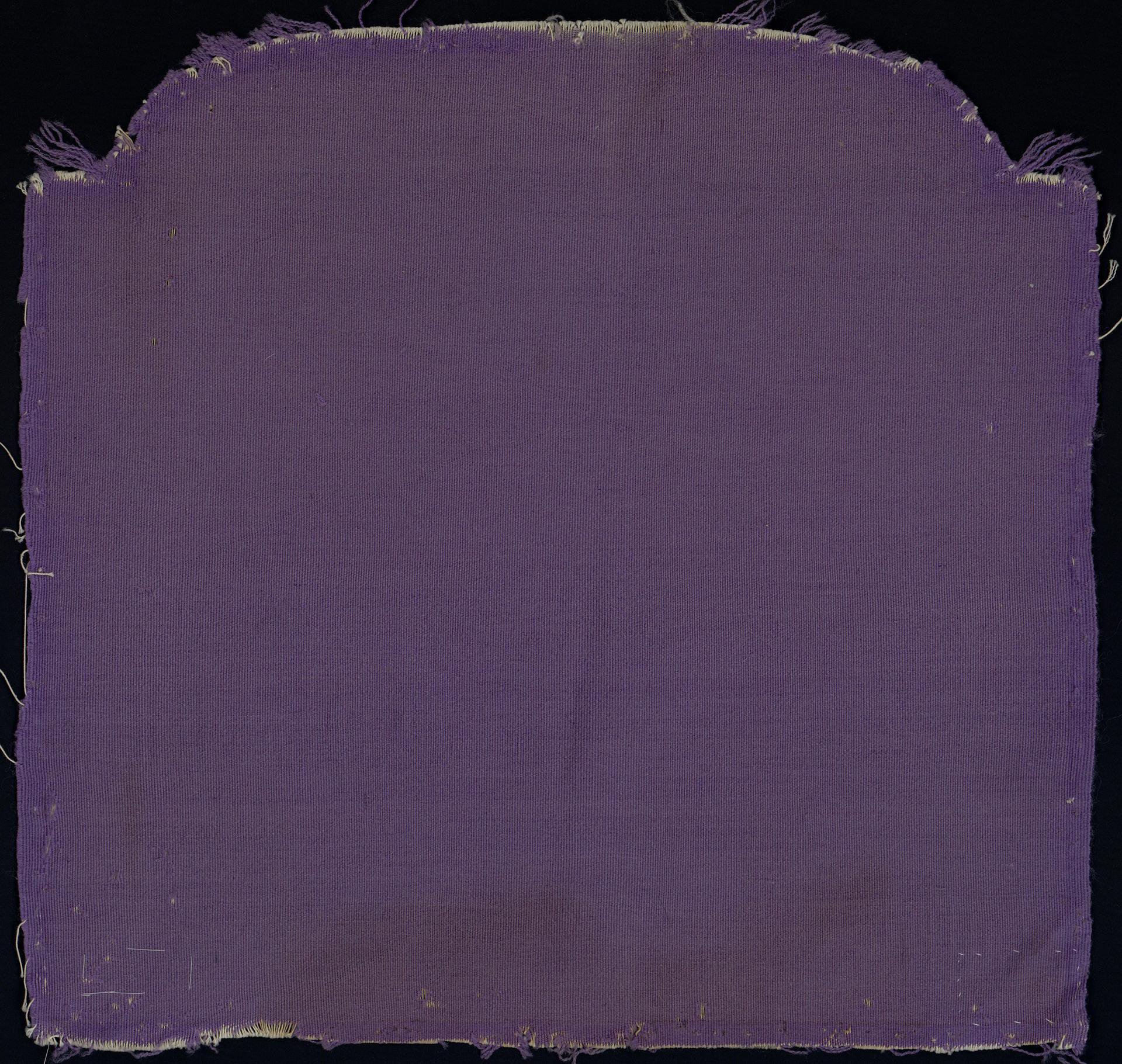
Origin: France, Aubusson
Date: second half of the 18th century
Material: wool, silk
Technique: tapestry weaving
Dimensions: height 44 cm; width 48 cm
Current Collection: The State Hermitage Museum
Inventory Number: T-15729
Hermitage ID: 488827
Rudanovsky Connection: Entered the Hermitage in 1919 from the collection of A. K. Rudanovsky.
A plain lilac silk panel for the back of a chair, cut to the profile of the frame and left undecorated — the invisible half of a tapestry suite.
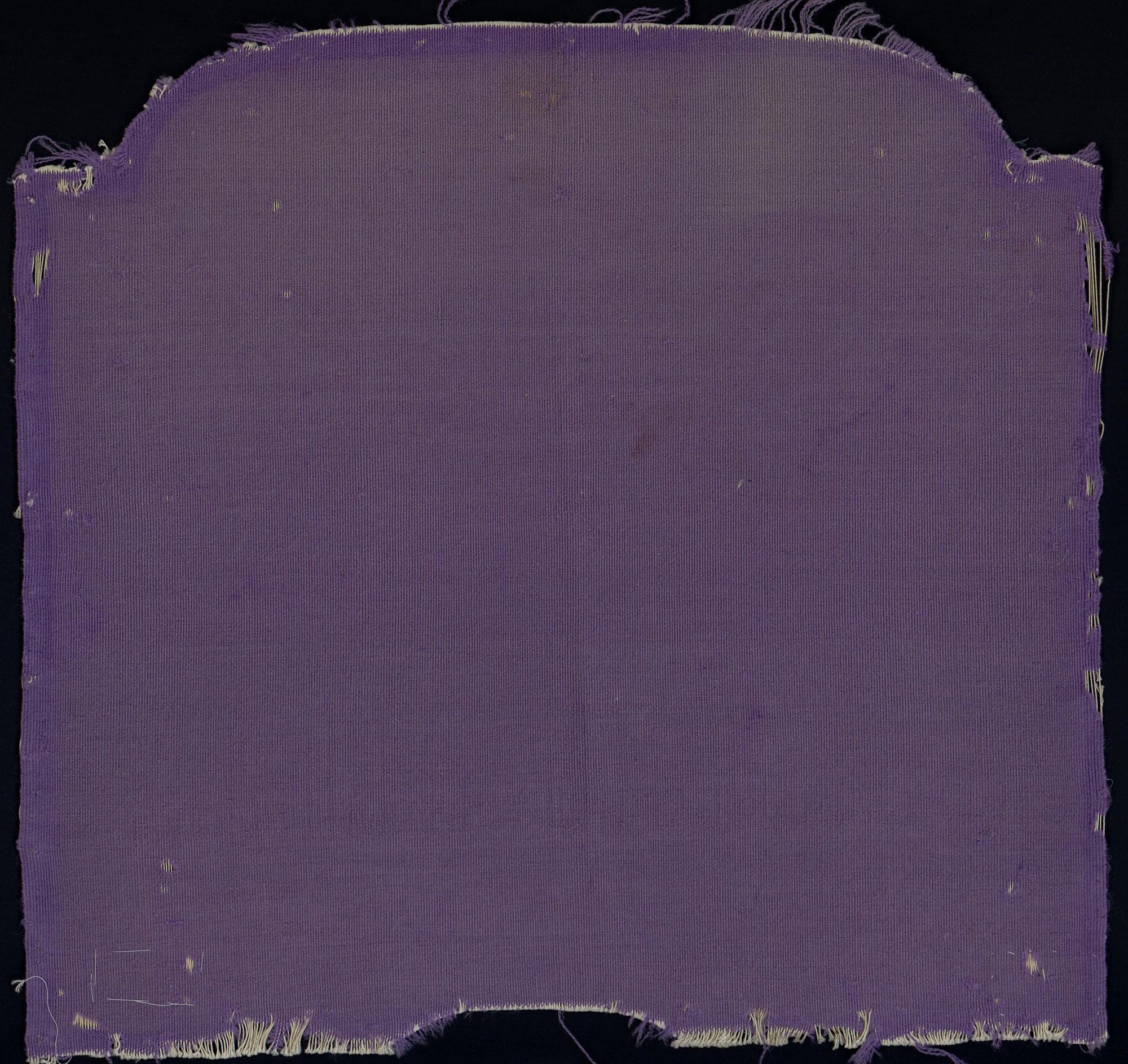
Tapestry: Upholstery for the Back of a Chair (T-15729). The State Hermitage Museum.
The panel comes from the collection of A. K. Rudanovsky and entered the Hermitage through the Department for the Protection of Monuments. It is not currently on permanent display.
It is one of five plain silk panels in the collection, all made for the backs of chairs, all in the same lilac tone. Together they form the reverse of the tapestry suite to which the decorated seats and backs belong.
The Object
The panel is almost square, with a curved top, stepped shoulders and straight sides. The silk is closely woven and softly lustrous, and the colour is a faded lilac that shifts toward grey in the folds.
There is no woven design. The surface is marked by creases, small stains and the pressure of the frame along the edges; the bottom edge has frayed into a fringe of pale warp threads.
The Economics of Upholstery
A suite of tapestry furniture was an expensive commission, and its cost was distributed unevenly across the object.
The face of a chair — the seat and the visible front of the back — was covered in tapestry, the most costly element: hand-woven wool and silk, months of work, a design commissioned from a workshop. The reverse of the back was covered in plain silk, a cheaper material, though still a luxury.
This distribution was not an accident. It followed the logic of visibility: money was spent where the object would be seen. The back of a chair, facing the wall, did not need a woven picture; it needed a clean, decent finish.
The Hierarchy of Surfaces
Every piece of furniture has a hierarchy of surfaces, and upholstery makes that hierarchy explicit.
The seat is the most visible and the most worn. The front of the back is the second most visible. The arms are seen and touched constantly. The back is seen only from behind, and the underside is never seen at all.
The upholsterer allocated materials accordingly: tapestry for the visible faces, silk for the back, linen for the underside. The result was an object that looked uniformly rich from the front and was economically constructed from behind.
This is not deceit. It is the ordinary economy of craftsmanship, and it is one of the things that makes old furniture legible: the hierarchy of materials tells us how the object was meant to be seen.
The Plain Panel and the Woven Panel
The plain panel and the tapestry panel are two halves of a single object.
In the museum they are separate: the tapestry faces are catalogued as decorated covers, the plain backs as lining panels, and they are stored and photographed separately. In the chair they were joined: the tapestry was stretched over the front of the back, the silk over the reverse, and the two were stitched to the same frame.
To see the suite whole, one has to imagine the two sides together — the flowers and the plain silk, the woven picture and its quiet reverse, the public face and the private one.
The Cut
The shape of the panel is a record of the frame.
The curve at the top and the steps at the shoulders follow the profile of the chair back. The sides are straight, where the fabric was carried around the frame and fixed to the wood. The bottom edge is cut straight, where the panel met the seat.
A cut of this kind is irreversible. The silk was measured, marked and cut to fit a specific frame, and once cut it could not be used for anything else. The panel is therefore tied to a particular chair, even though the chair no longer exists.
The Lining Trade
The plain side of a chair depended on a different trade from the woven side.
Tapestry came from the workshop of the weaver; silk lining came from the mercer or the silk merchant, who supplied piece goods by the metre. The upholsterer bought both, cut them to the frame and assembled the chair.
This division of labour is visible in the materials. The tapestry is a commissioned work, designed for the object; the lining is a commodity, chosen from stock. The one is unique, the other is standard — and both are necessary to the finished chair.
What the Reverse Tells a Conservator
For a conservator, the plain side is often more informative than the decorated one.
The stitching holes show where the fabric was attached; the creases show how it was folded; the wear shows where it was touched. The condition of the silk — its strength, its colour, its brittleness — indicates how it was stored and how much light it received.
The reverse also shows how the object was repaired. Patches, darns and re-stitched edges are evidence of a long life, and they are preserved as part of the object’s history rather than removed.
The Museum’s Decision
The fact that this panel was photographed at all is a museum decision worth noting.
When a textile enters a collection, it is documented: measured, described, photographed. Curators decide which side is «the» side — the one that represents the object in the catalogue and on the website. For a decorated cover, that is the face; for a plain lining, there is no choice, and the plain side becomes the image.
This decision shapes how the object is understood. A panel photographed from the front looks like a work of art; a panel photographed from the back looks like a piece of construction. Both are true, and the museum record preserves both possibilities.
The Colours of Silk
Lilac is a colour that changes with the light.
In daylight it reads as a cool, slightly grey violet; in warm light it becomes pinker and softer; in shadow it turns almost brown. The same panel can look like three different objects in the course of a day.
This mutability is characteristic of silk. The fibre has a triangular cross-section that reflects light in different directions, and the dye sits on the surface as well as within the fibre. The result is a colour that seems to move — an effect that eighteenth-century interiors exploited, and that photographs can only partially capture.
Provenance
The panel carries the inventory number T-15729 and entered the Hermitage through the Department for the Protection of Monuments from the collection of A. K. Rudanovsky.
In the Hermitage
The panel is preserved in the State Hermitage Museum in Saint Petersburg and is not on permanent display.
It is a modest object, but it completes the picture of the suite. Without the plain backs, the tapestry covers would seem to be complete objects; with them, we see the chair as it really was — a construction of different materials, each chosen for a different degree of visibility.