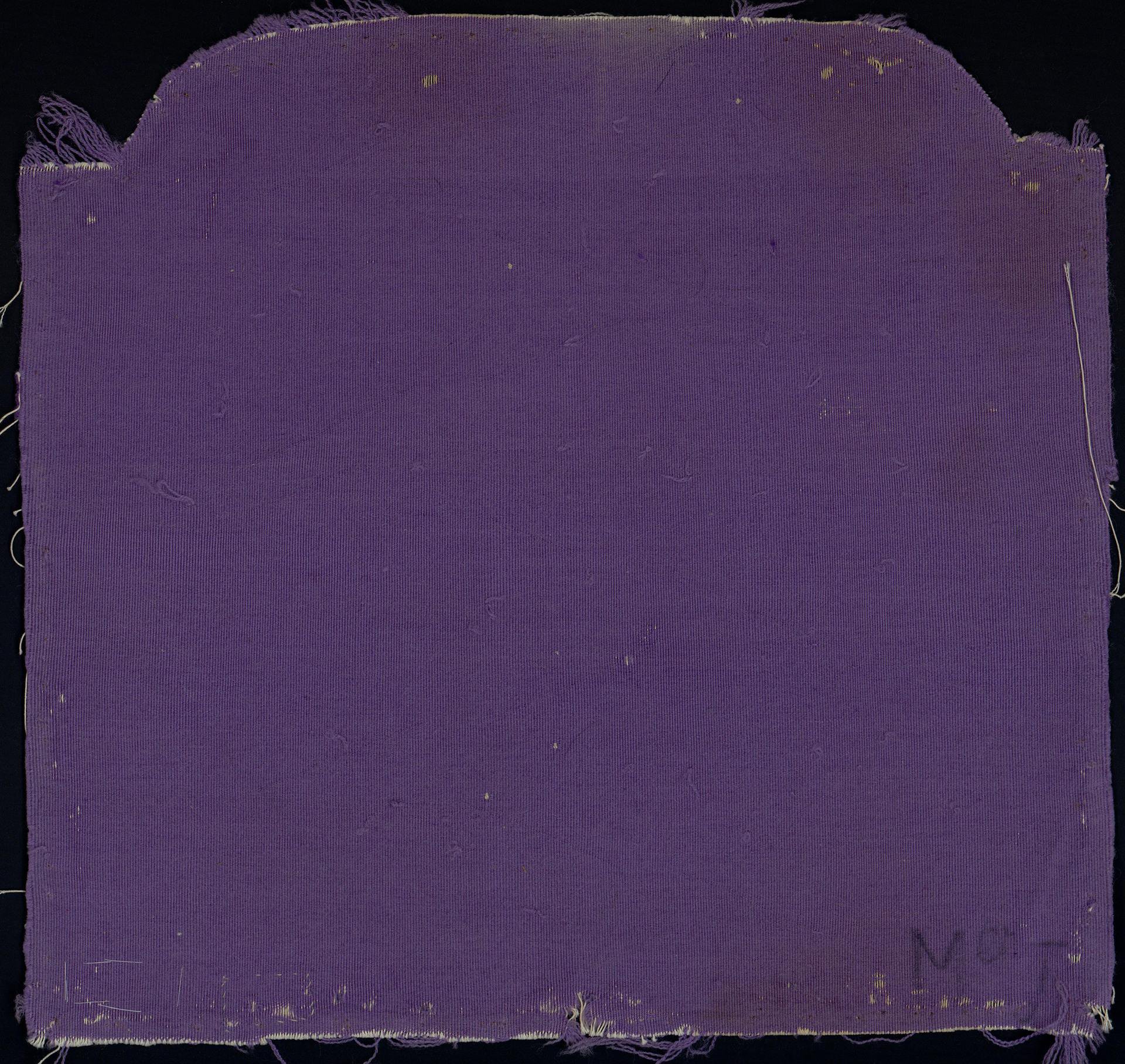
Origin: France, Aubusson
Date: second half of the 18th century
Material: wool, silk
Technique: tapestry weaving
Dimensions: height 44 cm; width 48 cm
Current Collection: The State Hermitage Museum
Inventory Number: T-15732
Hermitage ID: 488830
Rudanovsky Connection: Entered the Hermitage in 1919 from the collection of A. K. Rudanovsky.
A plain lilac silk panel whose cut profile preserves the shape of an eighteenth-century chair back that no longer exists.
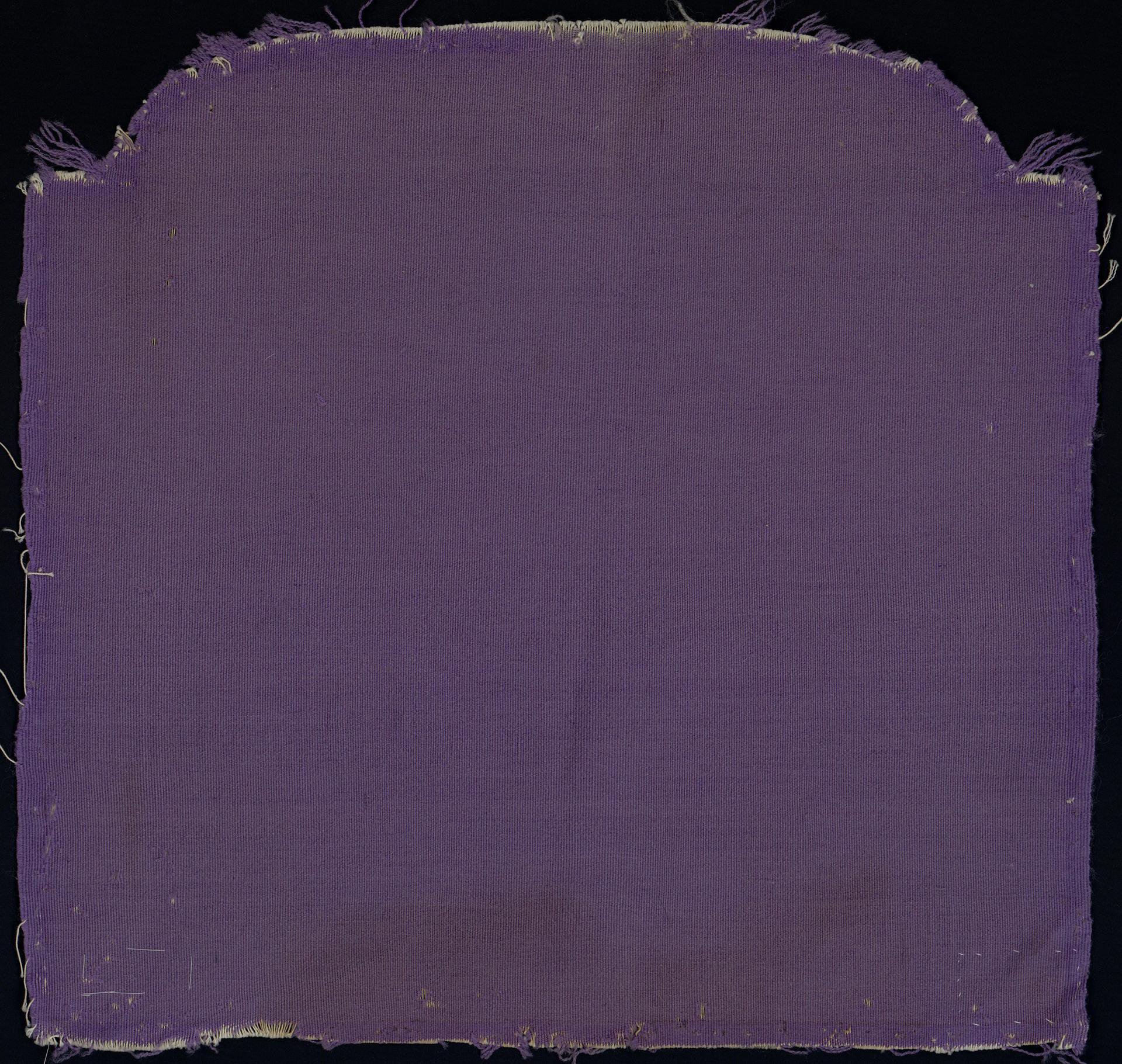
Tapestry: Upholstery for the Back of a Chair (T-15732). The State Hermitage Museum.
The panel comes from the collection of A. K. Rudanovsky and entered the Hermitage through the Department for the Protection of Monuments. It is not currently on permanent display.
It is a plain sheet of lilac silk, with no decoration, shaped for the back of a chair. Its interest lies less in its surface than in its outline: the curve, the shoulders and the proportions are a drawing of a piece of furniture, made in cloth.
The Object
The panel is nearly square. Its top edge rises in a shallow curve and then steps down at each shoulder; its sides are straight; its bottom edge is cut horizontally. The silk is plain, closely woven and softly lustrous, with a faded lilac colour and a fringe of loose warp threads along the lower edge.
There are creases, small stains and areas where the surface has been rubbed. The edges are frayed, and in places the weave has begun to open.
The Profile of the Chair
The outline of the panel is the outline of a chair back.
Eighteenth-century chair backs were not standardized. They were shaped by the menuisier to a design, and the profile could vary considerably: rectangular with rounded corners, oval, cartouche-shaped, with a curved crest and curved shoulders, or with a straight top and shaped sides.
The profile preserved here — a shallow curve across the top, a step at each shoulder, straight sides — belongs to the family of curved backs that dominated French chair-making in the middle and later eighteenth century.
Louis XV and Louis XVI
The history of the French chair in the eighteenth century is a history of changing silhouettes.
Under Louis XV, chairs became curvilinear: the back was shaped like a cartouche, the seat was rounded, the legs were cabriole, and the whole object seemed to flow. Under Louis XVI, the taste shifted toward straight lines and classical forms: oval or rectangular backs, tapered legs, geometric ornament.
The transition took place gradually in the 1770s and 1780s, and many chairs of the period combine elements of both styles. The profile of this panel, with its curve and its stepped shoulders, belongs to that transitional moment.
The Shape as Evidence
For a textile historian, the shape of a panel is a document.
The tapestry or silk cover was cut to the frame, and the cut preserves the frame’s profile even when the frame itself has disappeared. By measuring the curve, the width of the shoulders and the height of the panel, one can reconstruct the chair with some precision.
This is one of the ways in which dispersed collections can be reassembled. The covers of a suite, cut to different parts of the same chair, can be matched to one another; the measurements of the backs can be compared with the measurements of the seats; and the whole can be dated by the style of the profile.
Cutting to the Frame
The cut was made by the upholsterer, not by the weaver.
The weaver produced a rectangle of silk; the upholsterer laid it over the frame, marked the profile and cut. The accuracy of the cut determined the fit of the cover, and a poorly cut panel would wrinkle or pull when it was stretched.
The cut also determined the survival of the object. A panel cut to a specific frame could not be reused on a different chair; when the chair was re-covered, the panel became useless as upholstery and survived, if at all, as a piece of fabric.
The Missing Frame
The frame itself has disappeared.
Chair frames were made of wood, and wood is vulnerable: it burns, it is broken up, it is discarded when the fashion changes. A gilded frame might be stripped and re-carved; a plain one might be used for firewood.
What survives is the cloth that was cut to fit it. The panel is, in this sense, a negative of the chair: the shape of the missing object preserved in the material that covered it.
The Chair in the Room
The shape of a chair back is also a response to the room.
In the eighteenth century, chairs were arranged along the walls of a salon, moved into groups for conversation, and returned to their places. The back of a chair was therefore often seen against a wall, below a mirror, beside a console — and its profile had to work in that setting.
A curved back, with a stepped shoulder, produces a silhouette that reads against a plain wall. The curve softens the line; the shoulders give it structure. The profile of this panel was designed to be seen in a room, not in a museum.
Measuring a Fragment
The dimensions of the panel — 44 by 48 centimetres — are modest, and they are also informative.
The width corresponds to the width of a chair back between the uprights. The height corresponds to the distance from the seat to the crest rail. The proportion, slightly wider than tall, suggests a chair of the middle or later eighteenth century rather than the taller backs of the earlier period.
A textile fragment can therefore be measured like a piece of furniture. The numbers on the museum record are not neutral data; they are a set of clues to a missing object.
Gilding and the Frame
The frame that this panel covered was probably gilded.
Giltwood chairs were the standard furniture of the French salon: beech, carved, primed, gilded and then upholstered. The gold of the frame was the visual partner of the silk and the tapestry, and the three materials — wood, gold, textile — were designed to be seen together.
The panel gives us the shape of the frame but not its surface. The curve, the shoulders and the proportions are recorded in the cut of the silk; the carving and the gilding have disappeared with the wood.
What Was on the Back
The back of a chair is the part that faced the wall, but it was not invisible.
In a room arranged for company, chairs were moved, turned and grouped; the back was seen whenever a chair stood away from the wall. The plain silk was therefore a public material, chosen to look decent from behind.
The hierarchy was real but not absolute. A chair was finished all round, and the finish of the back was part of the impression the object made.
Provenance
The panel carries the inventory number T-15732 and entered the Hermitage through the Department for the Protection of Monuments from the collection of A. K. Rudanovsky.
In the Hermitage
The panel is preserved in the State Hermitage Museum in Saint Petersburg and is not on permanent display.
It is an object that asks to be read as a drawing as much as a textile. The colour and the material tell us about silk and dyeing; the outline tells us about chairs, frames and the craft of the upholsterer.