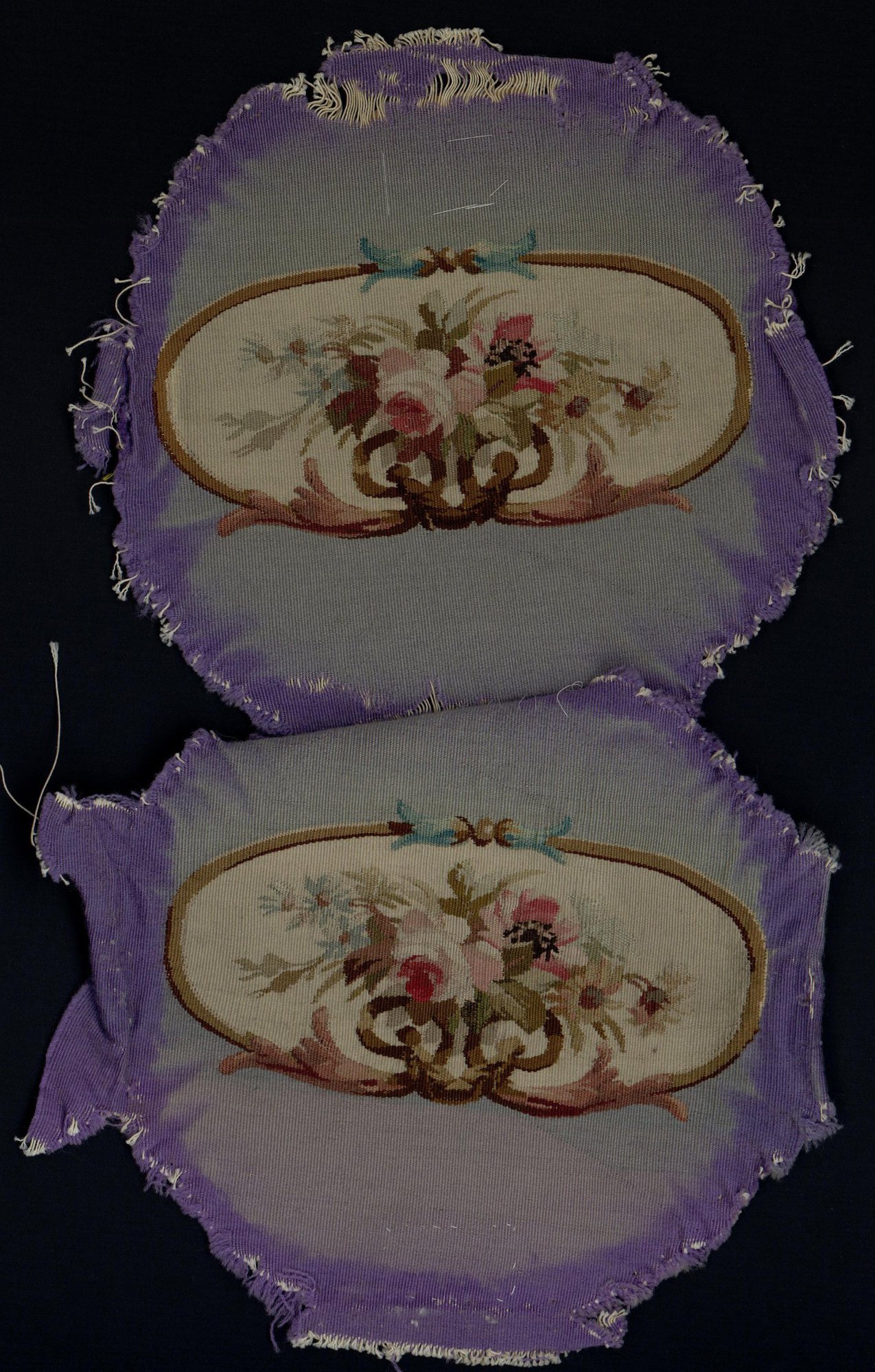
Origin: France, Aubusson
Date: second half of the 18th century
Material: wool, silk
Technique: tapestry weaving
Dimensions: height 44 cm; width 48 cm
Current Collection: The State Hermitage Museum
Inventory Number: T-15731
Hermitage ID: 488829
Rudanovsky Connection: Entered the Hermitage in 1919 from the collection of A. K. Rudanovsky.
A plain lilac silk panel for the back of a chair, recorded in the museum as tapestry weaving although its visible surface is a simple silk weave.
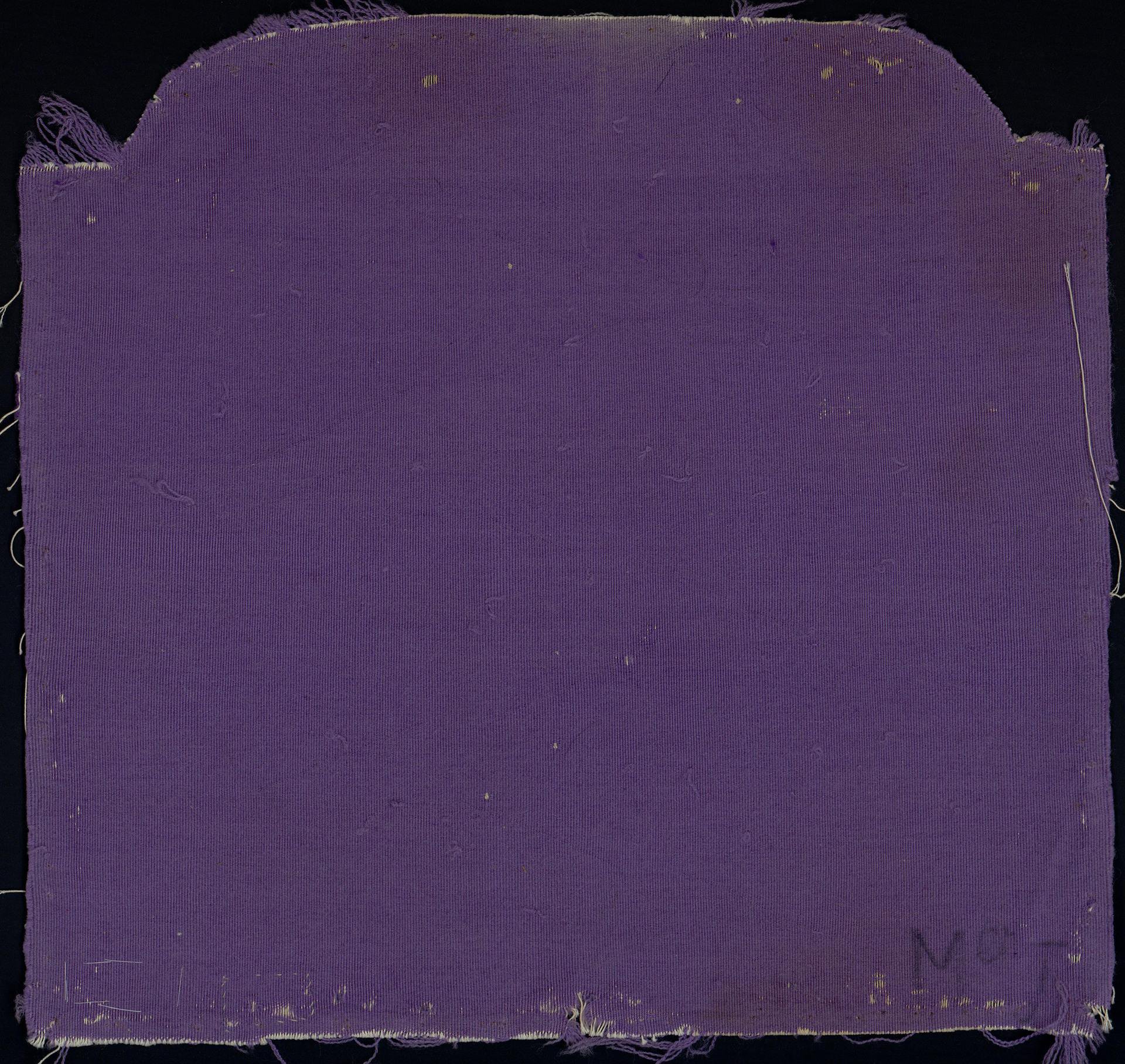
Tapestry: Upholstery for the Back of a Chair (T-15731). The State Hermitage Museum.
The panel comes from the collection of A. K. Rudanovsky and entered the Hermitage through the Department for the Protection of Monuments. It is not currently on permanent display.
It is one of five plain silk panels made for the backs of chairs in the same suite. The record describes the technique as tapestry weaving and the materials as wool and silk, and those two pieces of information deserve to be taken seriously: they tell us what the object is, and what it is not.
The Object
The panel is a rectangle with a curved top and stepped shoulders, cut to the profile of a chair back. The surface is plain lilac silk, closely woven, with a soft sheen and a slightly uneven colour.
The edges are frayed, the bottom has lost its warp into a fringe, and the surface is marked by creases and small stains. There is no pattern of any kind.
Wool and Silk
The materials recorded are wool and silk, and the combination is significant.
Tapestry is normally woven in wool, with silk used for highlights and for areas that need to shine. The face of a tapestry cover is a wool-silk surface; the reverse is usually a simpler fabric, often linen.
Here the visible surface is silk, but the record mentions wool as well. The explanation is that the panel belongs to a composite object: the silk lining on one side, the wool-and-silk tapestry on the other. The materials describe the object as a whole, not only the side we see.
The Technique Label
«Tapestry weaving» is a technical term with a precise meaning.
Tapestry is a weft-faced plain weave: the warp is completely covered by the weft, and the design is built up by discontinuous wefts that turn back within their own areas of colour. It is a slow, hand-controlled process, quite different from the weaving of a plain silk, where warp and weft cross evenly to produce a smooth, uniform surface.
The panel we see is a plain silk, not a tapestry. The label applies to the group to which the panel belongs — the tapestry covers of the suite — and reflects the way museum records describe composite objects by their most important technique.
This is not an error. It is a convention, and understanding it is part of understanding the object.
The Two Sides of a Cover
A chair cover has two sides, and they are made by different techniques.
The face is tapestry: wool and silk, woven with a design, slow and expensive. The reverse is lining: plain silk, woven on a simple loom, cheap by comparison but still luxurious.
The two sides are joined by the upholsterer, who stretches the tapestry over the frame, pads it, and closes the back with the lining. The finished object is a sandwich of techniques: tapestry, padding, wood, silk.
Conservation
The condition of a plain silk panel is different from that of a tapestry.
Silk is strong but sensitive: it fades in light, it weakens with age, and it is vulnerable to insects. A plain surface shows every stain and every crease; there is no pattern to distract the eye from the damage.
Conservation therefore concentrates on stabilisation rather than restoration: cleaning, supporting the weak areas, storing the panel flat and away from light. The aim is not to make the silk look new but to slow its deterioration.
The Colour of Silk
The lilac of the panel is the colour of old silk rather than the colour of new dye.
Silk takes dye deeply and reflects light strongly, and the combination produces a colour that seems to glow from within. Over time, the dye molecules break down, the fibre yellows, and the colour shifts toward grey.
What remains is a soft, dusty violet — less brilliant than the original, but more complex. It is the colour of an object that has aged in the dark.
Silk Weaving
Plain silk was woven on a simple loom, with the warp stretched horizontally and the weft passed across by shuttle.
The quality of the fabric depended on the fineness of the threads, the density of the weave and the evenness of the tension. A good plain silk has a smooth, regular surface and a lustre that comes from the way the light reflects off the long fibres.
The weave of this panel is fine and regular, with a slight ribbing that catches the light in horizontal bands. It is not a complicated textile, but it is a well-made one, and its quality is part of what made the chair expensive.
The Life of a Panel
The panel has had several lives.
It began as a length of silk, woven on a loom. It became part of a chair, cut, lined and stitched. It was used in a room, exposed to light and touched by hands. It was removed from the chair, perhaps when the furniture was re-covered, and kept. It was collected, nationalised, transferred to a museum and stored.
Each stage has left a trace: the weave, the cut, the stitching holes, the wear, the stains, the inventory number. The object is a record of its own history, written in silk.
Reading a Plain Surface
A plain textile is difficult to photograph and difficult to describe, because there is so little to hold the eye.
The way to read it is with raking light. Held at an angle, the surface reveals its weave: the lines of the warp, the passages of the weft, the tiny irregularities that show it was made by hand. The colour becomes secondary; the structure becomes visible.
Seen this way, the panel stops being a piece of purple fabric and becomes a woven object — a grid of threads, made on a loom, cut with scissors and sewn with a needle.
The Weight of Silk
Silk is light, but it is not weightless.
A panel of this size weighs very little, yet it has a distinct presence in the hand: cool, smooth and slightly stiff with age. It drapes in soft folds and holds a crease, and it makes a faint sound when it is moved.
These physical qualities are part of the object’s identity. A photograph can show the colour and the shape, but not the weight, the temperature or the sound — the properties that made silk desirable in the first place.
Provenance
The panel carries the inventory number T-15731 and entered the Hermitage through the Department for the Protection of Monuments from the collection of A. K. Rudanovsky.
In the Hermitage
The panel is preserved in the State Hermitage Museum in Saint Petersburg and is not on permanent display.
It is a useful object for thinking about how museums describe things. The record says «tapestry weaving», the surface says «plain silk», and both are true: the object is a composite, and its description is a compromise between the part and the whole.