Origin: Western Europe
Date: 19th century (?)
Material: rock crystal, bronze, malachite
Technique: carving, grinding, polishing, casting, repoussé, gilding, mosaic
Dimensions: 18.2 × 16.2 cm
Current Collection: The State Hermitage Museum
Inventory Number: E-12113
Hermitage ID: 152333
Rudanovsky Connection: Entered the Hermitage in 1919 from the collection of A. K. Rudanovsky.
A small ornamental vase of rock crystal, gilt bronze and malachite, made in Western Europe in the nineteenth century.
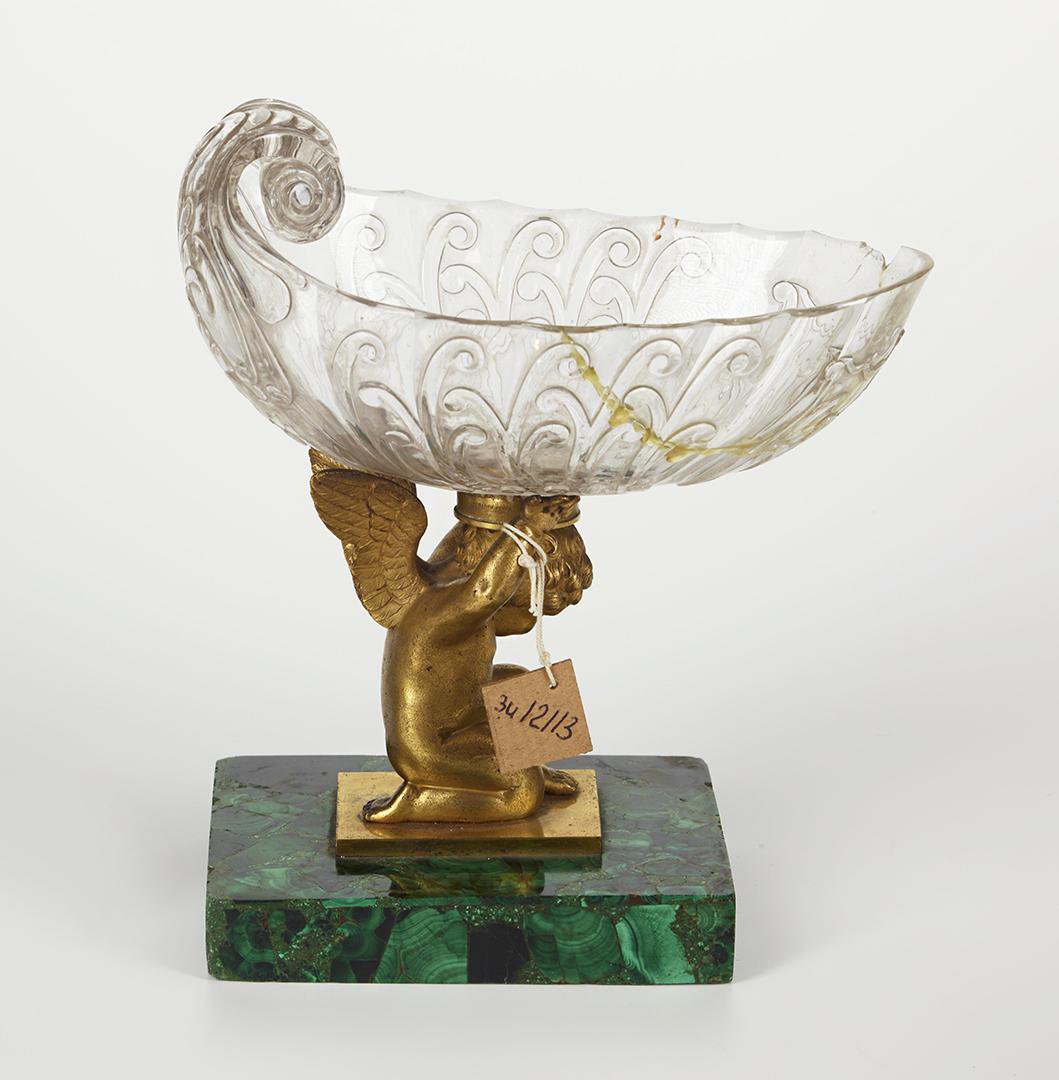
Vase (E-12113). The State Hermitage Museum.
The vase entered the Hermitage in 1919, transferred through the Department for the Protection of Monuments from the collection of A. K. Rudanovsky. It is not currently on permanent display.
It is a small object — 18.2 by 16.2 centimetres — composed of three materials: a crystal bowl, a gilt bronze figure and a malachite base.
The Object
The vase is built in layers.
At the bottom, a rectangular block of malachite; above it, a gilt bronze figure of a kneeling cupid, holding up a small platform; and on the platform, a bowl of rock crystal, carved in the shape of a shell or a boat, with a scroll handle at one end.
A paper label with the inventory number is tied to the cupid’s arm.
The Crystal
The bowl is carved from a single piece of rock crystal.
It is shaped like a shell, with a scalloped rim and a curved handle, and it is decorated with carved acanthus leaves on the outside. The crystal is clear and slightly clouded, with a few internal cracks.
Rock crystal was a precious material in the nineteenth century: it was hard, rare and difficult to carve, and it was used for the most expensive objects.
The Cupid
The cupid is cast in bronze and gilded.
He kneels on the malachite base, his wings folded, his arms raised to support the crystal bowl. His body is plump and childlike, and his face is turned upward.
The figure is a support as well as a decoration: it raises the bowl, and it turns the object into a small sculpture.
The Malachite
The base is made of malachite.
It is a rectangular block, polished, with the characteristic green bands and swirls of the stone. Malachite was a favourite material in Russia, where it was used for vases, tables and columns in the nineteenth century.
The green of the malachite contrasts with the gold of the cupid and the transparency of the crystal, and it anchors the object.
The Shell
The bowl is shaped like a shell.
Shells were a popular motif in the decorative arts of the eighteenth and nineteenth centuries: they suggested the sea, nature and abundance, and they were used for bowls, basins and ornaments.
The shell shape gives the vase its curve and its handle, and it makes the crystal look like something found rather than made.
The Technique
The object combines several techniques.
The crystal is carved, ground and polished; the bronze is cast, chased, repoussé and gilded; the malachite is cut and polished. Each material required a different specialist, and the object is the work of a team.
This combination of materials is characteristic of nineteenth-century luxury objects, where the aim was to display wealth and skill.
The Date
The vase is dated to the nineteenth century, with a question mark.
The uncertainty is honest: the object combines elements of different periods, and it may have been assembled from older and newer parts. The crystal bowl could be older than the mount, and the malachite base could be a later addition.
Objects of this kind often have a composite history, and the record reflects that.
The Cabinet
The vase was made for a cabinet.
It is a small, precious object, designed to stand on a shelf or a table among other curiosities. It was not made for use but for display: a piece for a collector’s cabinet.
The paper label on the cupid’s arm is a trace of that history: an inventory number, tied with string, from a museum or a collection.
The Label
A paper label is tied to the cupid’s arm.
It carries an inventory number, written in ink, and it is a trace of the object’s museum history. Labels of this kind were attached during inventory work, and they were often left in place.
The label is a small, human detail: a piece of paper, a piece of string, and a number that identifies the object in a store.
The Assembly
The vase is an assembly of parts.
The crystal bowl, the bronze cupid and the malachite base were made separately, by different hands, and then joined. The joins are visible: the cupid’s hands under the bowl, the platform on his back, the base under his knees.
Objects of this kind were often assembled from older and newer elements, and they were valued for their effect rather than their unity.
The Materials’ Trade
The materials came from far away.
Rock crystal was mined in the Alps, in Madagascar and in Brazil; malachite came from the Urals and from the Congo; bronze was cast in European foundries. Their combination in a single object is a sign of a global trade in luxury materials.
In the nineteenth century, such objects were collected by princes, bankers and industrialists, and they were displayed in cabinets and at exhibitions.
Small Objects
Small objects are often the most revealing.
A vase eighteen centimetres high can show the taste of a period, the skill of its craftsmen and the wealth of its owners. It is an object made to be looked at closely, and it rewards close looking.
This vase belongs to that category: a small, precious, composite object, made for a cabinet.
The Crystal’s Cracks
The crystal has cracks.
They run through the bowl, and they are visible as pale lines in the clear stone. Cracks are common in old crystal: it is brittle, and it can fracture with age or with a knock.
The cracks do not destroy the object; they record its history, and they give the crystal a cloudy, lived-in look.
The Nineteenth Century
The vase belongs to the nineteenth century.
It was a period of eclectic luxury: makers combined materials from different traditions, and they produced objects for a market of collectors and connoisseurs. Crystal, bronze and malachite were among the most fashionable materials.
The vase is a product of that taste: a composite object, made to display wealth and skill.
Provenance
The vase carries the inventory number E-12113. It entered the Hermitage in 1919, transferred through the Department for the Protection of Monuments from the collection of A. K. Rudanovsky.
In the Hermitage
The vase is preserved in the State Hermitage Museum in Saint Petersburg and is not on permanent display.
It is a small, precious object, and it shows how nineteenth-century makers combined crystal, bronze and malachite into a single, glittering ornament.
It is also a lesson in how objects are assembled: three materials, three crafts, and one small vase, standing on a shelf and waiting to be looked at, in a case, under a light, with a paper label tied to its arm, and a number written on it in ink, by a curator’s hand, some decades ago, and never removed from its string since.