Artist: French sculptor, 18th century
Origin: France
Date: late 18th century
Material: marble
Dimensions: 51 × 35 cm
Current Collection: The State Hermitage Museum
Inventory Number: N.sk-1190
Hermitage ID: 40457
Rudanovsky Connection: Entered the Hermitage in 1920 from the collection of A. K. Rudanovsky.
A French marble bust of the late eighteenth century showing a woman in a turban.
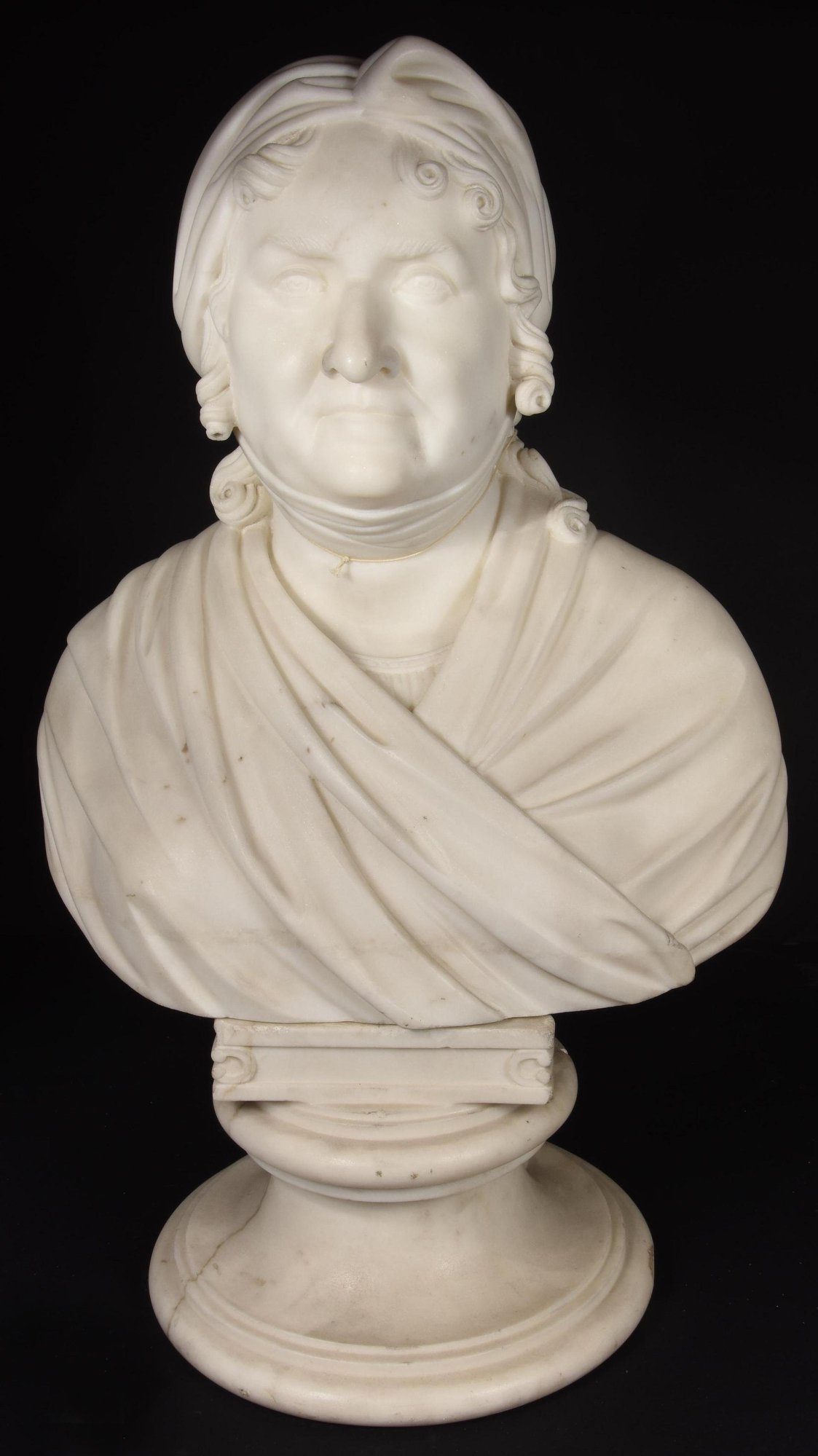
Woman in a Turban. The State Hermitage Museum.
The bust entered the Hermitage in 1920 from the collection of A. K. Rudanovsky, through the State Museum Fund. It is not currently on permanent display.
It is a white marble bust of a woman, her head wrapped in a turban, her shoulders covered with a heavy mantle.
The Object
The bust shows a woman from the chest up.
Her head is wrapped in a turban of folded cloth, and her face is full, with a broad forehead, a strong nose and a firm mouth. She wears a mantle that crosses her shoulders and falls in deep folds over the chest.
The bust stands on a turned marble base, and it is complete in itself, without arms or hands.
The Turban
The turban is the bust’s most distinctive feature.
It is a length of cloth, twisted and folded around the head, with a knot at the front and a fall of fabric at the back. It covers the hair completely, and it leaves the face framed by a soft, heavy band.
In the eighteenth century, the turban was a sign of the East — of Turkey, of the Levant, of the world of the sultans — and it was used in European art to mark a subject as foreign, exotic or theatrical.
The Face
The face is modelled with care.
It is full and round, with a broad forehead, a strong nose and a small mouth, and the cheeks are soft. The eyes are carved with lids, and the gaze is direct.
The face is not idealised: it has weight and character, and it suggests a real person rather than a type.
The Drapery
The mantle is heavy and simple.
It crosses the shoulders in broad folds, and it is carved with great attention to the weight of the cloth. The folds are deep, and they catch the light.
The drapery frames the face and gives the bust its monumentality: the woman is wrapped in cloth, and her body disappears into it.
The Base
The bust rests on a turned base.
It is a circular marble socle, with a moulded profile, and it supports the bust and gives it height. The base is slightly darker than the bust, and it has a few chips.
Bases of this kind were standard for busts of the period, and they allowed the sculpture to stand on a pedestal or a shelf.
French Sculpture
The bust belongs to French sculpture of the late eighteenth century.
French sculptors of the period produced portraits, allegories, garden figures and busts, and they worked in marble, terracotta and plaster. The bust was one of the most common forms, and it was collected by nobles and bourgeois.
The style of this bust is classical but not severe: the face is realistic, and the drapery is simple and monumental.
The Turquerie
The turban belongs to the fashion for turquerie.
Turquerie was a European taste for Turkish and Eastern subjects: it appeared in painting, music, theatre, costume and interior decoration, and it was especially popular in the eighteenth century.
The turban, the veil, the caftan and the pipe were its attributes, and they were used to create images of an imagined East — luxurious, sensual and mysterious.
The Hair
The hair is hidden by the turban, but a few locks escape at the temples.
They are carved as small curls, and they soften the line of the cloth. The hair is light brown, and it is visible only at the edges of the face.
That partial hiding is part of the turban’s effect: it frames the face and makes it the centre of the bust.
The Socle
The socle is turned on a lathe.
It is a circular base, with a moulded profile, and it is made of the same marble as the bust. Socles of this kind were standard in the eighteenth century, and they gave a bust its height and its finish.
The socle here is simple and classical, and it supports the bust without competing with it.
The Interior
Busts were made for interiors.
They stood on pedestals, cabinets, mantelpieces and bookcases, and they were collected by nobles and bourgeois. A marble bust was a sign of taste, and it was often placed in a library or a gallery.
This one is large enough to be a presence in a room, and small enough to be moved.
The Collector
The bust came to the Hermitage with the Rudanovsky collection.
Rudanovsky collected European art of many kinds, and his collection included sculpture as well as paintings, porcelain, glass and miniatures. Busts like this one were part of his cabinet.
The bust is therefore a double document: of French sculpture and of a Russian collector’s taste.
The Marble
The marble is white, with a few grey veins.
It is carved with care, and its surface is smooth and slightly polished. The marble gives the bust its cool, luminous quality, and it makes the face and the cloth appear to be made of the same substance.
Marble was the material of the finest sculpture, and its whiteness was valued as a sign of purity and permanence.
The Eyes
The eyes are carved with lids and pupils.
The pupils are incised, not blank, and they give the face a direct gaze. She looks at the viewer, and her look is steady and slightly severe.
Carved pupils are a departure from the classical convention, and they make the bust more lifelike: this is a portrait, not a statue of a goddess.
The Shoulders
The shoulders are broad and covered.
The mantle crosses them in heavy folds, and it hides the body, leaving only the head and the neck visible. The shoulders give the bust its width and its stability.
The contrast between the bare face and the covered shoulders is one of the bust’s visual structures: the face is exposed, the body is wrapped.
The Cloth
The cloth of the turban is the bust’s most skilful passage.
It is folded, twisted and knotted, and each fold is carved with a soft edge and a deep shadow. The cloth is heavy, and it sits on the head like a weight.
A turban is difficult to carve: it has no fixed form, and the sculptor must invent its folds. This one is convincing, and it gives the bust its particular and unmistakable character.
Provenance
The bust carries the inventory number N.sk-1190 and entered the Hermitage in 1920 from the collection of A. K. Rudanovsky, through the State Museum Fund.
In the Hermitage
The bust is preserved in the State Hermitage Museum in Saint Petersburg and is not on permanent display.
It is a fine example of French sculpture of the late eighteenth century, and it preserves the image of a woman in a turban — a face, a cloth and a fashion, carved in white marble.